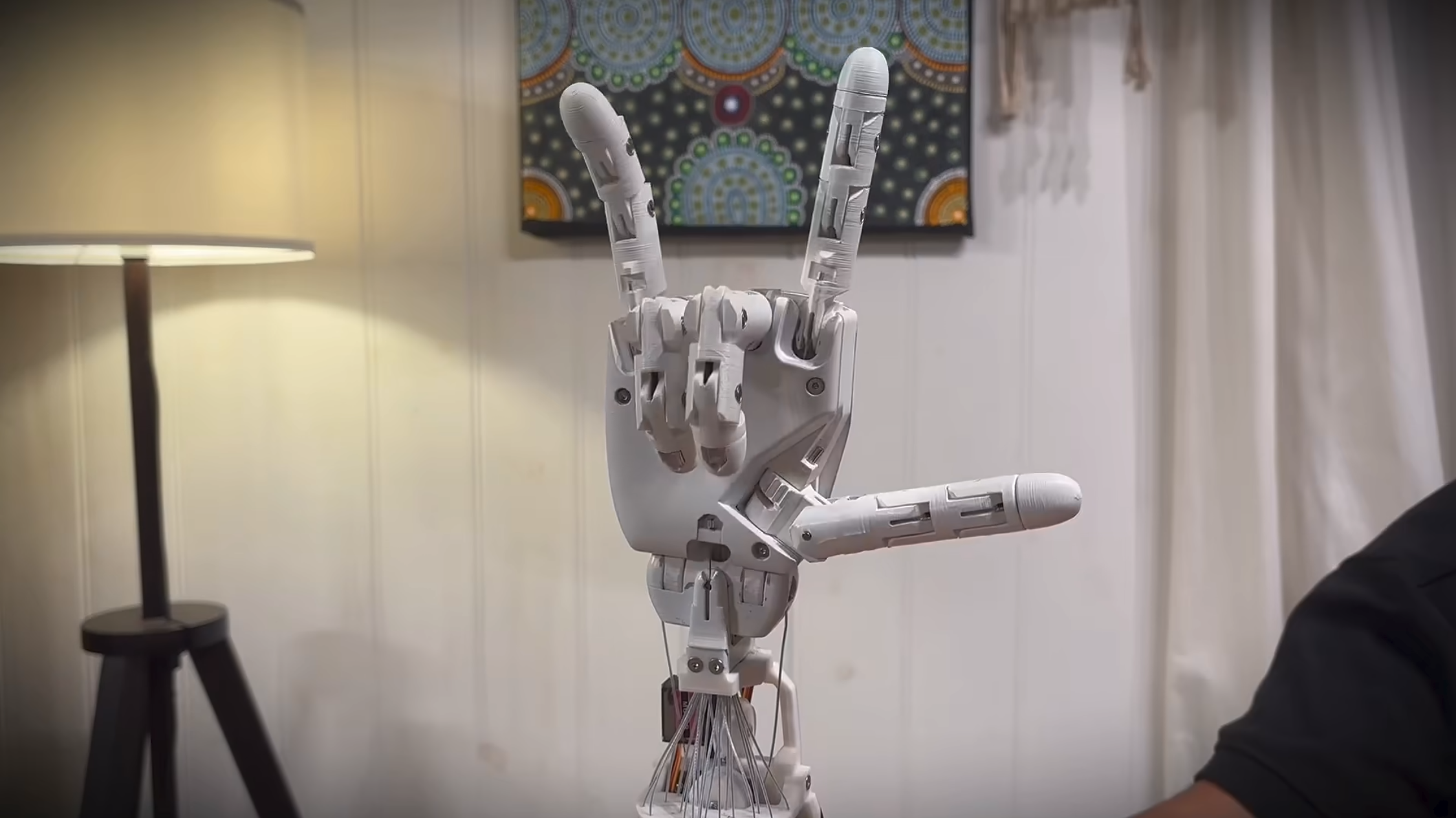
For all the recent advances in robot control enabled by machine learning, there are still a few problems which remain stubbornly difficult: locomotion, for example, or whole-body balance for humanoids. Dexterity, in particular, has emerged as a particularly hard problem, requiring both software and hardware sophistication; hardware capable of useful fine motor movement is often quite expensive. [Mahdi]’s been working on that problem, though, with an eighteen-degree-of-freedom robot hand that costs less than $300 in parts. Although the hand is the main point of the project, it’s really a full forearm. The skeleton is 3D printed and driven by servo motors; like a human hand, the motors are located mostly in the forearm and use tendons to actuate the joints. Unlike most servo-driven robot hands, it uses thin steel rope instead of synthetic fiber cables, which eliminates the need to tie small knots — the tendon can simply be tensioned and crimped in place.
To reduce friction, each tendon runs through a PTFE tube. Wherever a tendon would have to go past a joint, it passes through the joint’s center of rotation, which keeps the length of the tendon’s path from changing as the joint bends. Each finger on the hand can move side-to-side and flex two joints independently.
The base of the arm can also rotate on a servo motor, which made powering the servo motors a challenge: the servos draw too much current for small slip-rings, and larger slip-rings were too expensive. Since the arm didn’t need to rotate continuously, though, he instead used a coil of flat ribbon cable which winds in or our as the joint rotates, with a printed cable guide to keep it from kinking; not only is this much cheaper than a slip ring, it’s also more compact.
We’ve seen a few robot hands take the same tendon-based approach before, and the more realistic ones replace the servo motors with artificial muscles. Some have even 3D-printed tendons and ligaments.