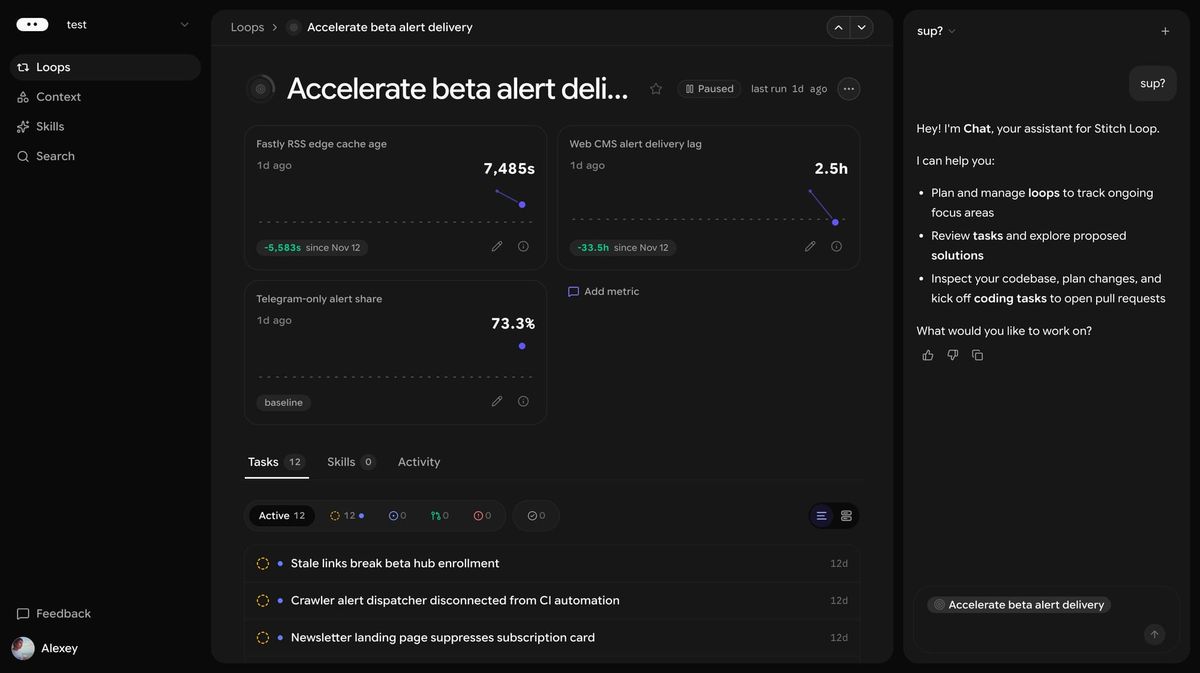
Google recently announced Loop, a self-improving Stitch agent that autonomously pursues goals, still waitlist-only. Its internal name is Jitro, the exact name of Jules v2.
Users create a Workspace for a GitHub project with basic details, then pick predefined loops like Harden Application Security or create Custom Loops from a prompt, title, icon, and objective.
The app describes loops as mid- to long-term objectives, specific or broad, that code can achieve. Context comes from Files, Links, repos, and 100+ Integrations like Jira, Linear, Datadog, Sentry, Notion, Snowflake, Salesforce, Intercom, Discord, Slack, and Figma, plus custom MCPs.
Loop then studies the project and writes its own Skills on the product and its metrics, in a separate Markdown-editable tab. It suggests metrics and goals that become loops right away, each shown as a running process. Finished loops list suggestions with a target metric value and progress status.
In my test, a goal to scale Telegram community contributions was split into KPIs for members, registered contributors, and active members, on a dashboard above Tasks, Skills, and Activity tabs. A task noted the channel lacked discussion threads and a bot, with labels, an update date, an Activity timeline summary, and Evidence linking the TestingCatalog site and channel behind the numbers. Its Solution, a Bot API intake bot with an editorial triage webhook, had impact, scope, and risk labels and launches development via Gemini, with production KPIs tracked post-release.
I think Loop mirrors how Google and many other companies run product work. Each Workspace equals a full product engineering team, so the user stops being an engineering and product lead orchestrating agents and becomes a senior manager over several teams, a big shift. We are slowly moving toward autonomous AI organizations, one management layer at a time. I expect substantial progress to happen in this area in 2027, assuming AI keeps advancing in a semi-regulated format.
Sources and related context #
- Google: Introducing Stitch Loop, a new way to build and evolve products : Supports: Google's announcement confirms Stitch Loop as a Google Labs experiment that connects to GitHub and integrations and is available through a waitlist.
- TestingCatalog: Google prepares Jules V2 agent capable of taking bigger tasks : Related context: Our April report covered Jitro as the next-generation Jules agent built around goals, insights, and a dedicated workspace.