TYLsemi just raised $43 million to let companies design their own AI chips without spending years and hundreds of millions of dollars doing it from scratch.
The San Jose startup emerged from stealth this week with an oversubscribed early-stage round led by Matter Venture Partners, joined by Viola Ventures, GHOVC, Egis Technology and a cluster of semiconductor-industry strategics, according to SiliconANGLE. Founders Mohit Gupta and Sunil Bhardwaj built their careers at Alphawave, the chip company Qualcomm acquired. Before that came stints at SiFive and Cadence Design Systems, then Rambus. They know exactly how brutal custom silicon has become. They used to sell the tools that made it that way.
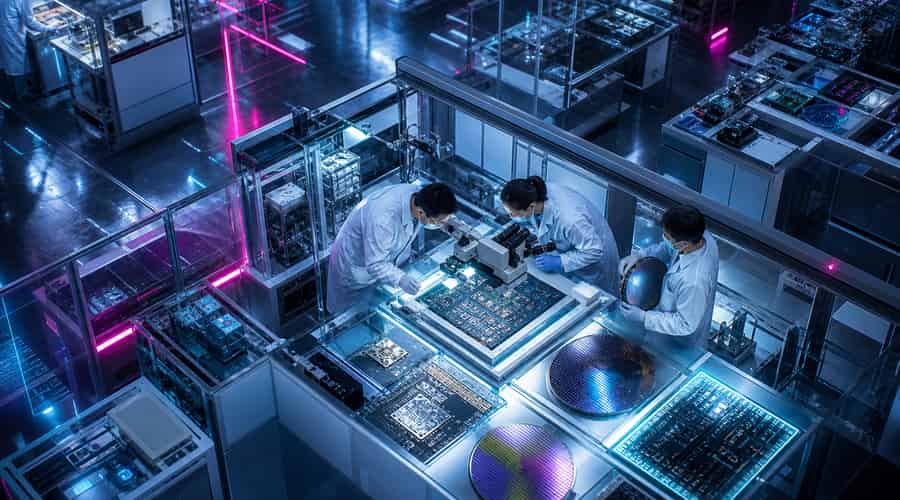
Here is the problem TYLsemi says it is solving. If you want a custom AI accelerator today, you are looking at years of design work and a budget that only a handful of companies can justify. Most teams just buy Nvidia GPUs instead and pay whatever markup that requires. TYLsemi's pitch is different: pre-built, standards-based chiplets you combine with custom packaging, so you get most of the benefit of custom silicon without designing every transistor yourself.
The company's first products are TYL.IO, a family of chiplets handling high-bandwidth connectivity over PCIe and ESUN, plus UALink, and TYL.Power, an integrated voltage regulator chiplet that manages power delivery inside the package. TYLsemi is manufacturing through TSMC. It expects to ship samples to qualified customers in 2027. A third piece, TYL.Forge, is the end-to-end platform that lets a customer define its own XPU or compute design - fabric too - and hand the integration and supply chain to TYLsemi. The company says it is already lining up lead customers for it.
TYLsemi's headline claim is specific: cut custom AI silicon development costs by nearly half, and cut time to market by roughly the same amount, GamesBeat reported. That is a real number. It is also a number TYLsemi will have to defend the moment its first chiplets actually reach a customer's board.
Everyone else raised a lot more #
Forty-three million dollars sounds like a lot. Then you see what TYLsemi is up against. Taalas, a Toronto startup, raised $169 million in February on top of $219 million total, backed by Quiet Capital and Fidelity, to build chips that print a specific AI model directly into silicon, SiliconANGLE and Yahoo Finance reported. Taalas says its HC1 chip, built on TSMC's 6-nanometer process, runs 17,000 tokens per second, 73 times faster than Nvidia's H200, on a tenth of the power. That's the number they're selling. MatX, founded by former Google TPU engineers, closed a $500 million Series B the same month, led by Jane Street and Leopold Aschenbrenner's Situational Awareness fund, with Marvell, Spark Capital and Stripe founders Patrick and John Collison also writing checks, Bloomberg and TechCrunch reported. MatX wants its chip, the MatX One, to run roughly ten times better than current hardware on large language model training and inference, with shipping targeted for 2027.
Both of those companies are chasing a narrower target than TYLsemi. Taalas and MatX build the finished chip. TYLsemi builds the pieces and the process other companies use to build their own. That is a genuinely different bet, closer to what Alphawave and SiFive already do at smaller scale. It means TYLsemi does not need to out-engineer Nvidia on raw chip performance. It needs hyperscalers and AI labs to trust a $43 million startup with the plumbing of their next data center buildout.
Frankly, that trust is the harder sale. Google and Amazon have already built serious in-house silicon teams, and Meta is not far behind: Amazon's Trainium and Google's TPU program are years ahead of anything TYLsemi has shipped. Those three are not TYLsemi's customers. Its customers sit a tier below: AI labs and cloud providers who want an alternative to Nvidia pricing but cannot justify building an internal chip team from nothing. That is a real market. Whether it is a $43 million market or a $500 million one is the question Matter Venture Partners is betting its money nobody has answered yet.
The test comes in 2027 #
TYLsemi's first real test is not this funding round. It is 2027, when TYL.IO and TYL.Power samples are supposed to land on a customer's desk and either work or don't.
Also read: Prime Intellect Raises $130 Million to Let Companies Own Their AI Models • Ollama Just Raised $65 Million to Become AI's Quiet Infrastructure Layer • Hachette, Elsevier and Scott Turow Sue Google Over Gemini's Book Training