On July 10, a Korean memory chip company made Nasdaq history, raising $26.5 billion in the largest-ever U.S. listing by a foreign company. The ticker is SKHY. The story ran on finance pages. Most developers scrolled past it. That was a mistake. In his investor roadshow, SK Hynix CEO Kwak Noh-jung said 2027 will be the worst memory supply year in the industry’s history — and demand will outpace production past 2030. When the company that controls 62% of the world’s AI memory supply warns that supply is about to get worse, developers should be paying attention.
The Real Bottleneck Is Not the GPU #
The semiconductor world keeps talking about the “GPU shortage.” That framing is off. The actual binding constraint is High-Bandwidth Memory — HBM — and SK Hynix makes most of it, supplying roughly 90% of Nvidia’s HBM requirements under a multi-year co-development deal.
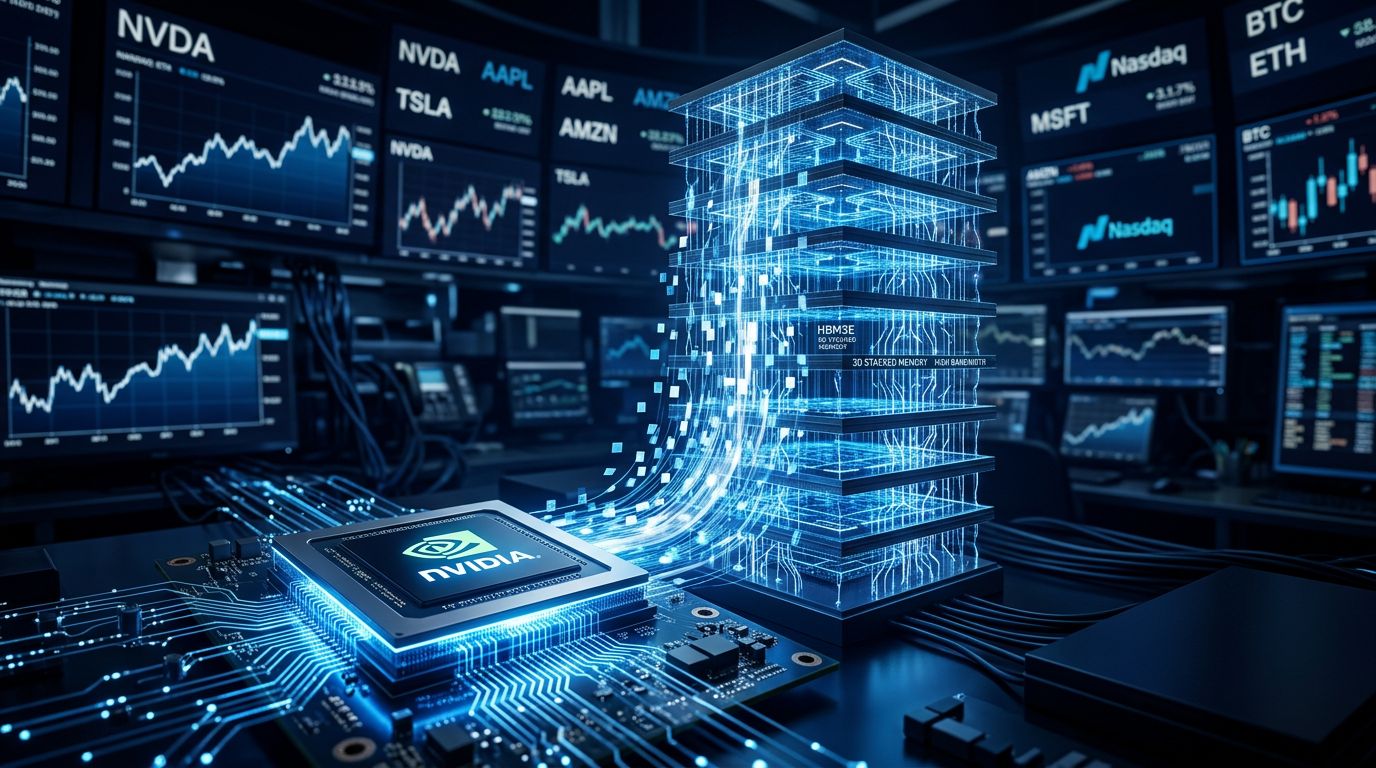
HBM is the ultra-fast stacked DRAM that lives physically beside the processor on an AI accelerator. Unlike conventional DRAM (32-bit-wide channels), HBM stacks multiple memory dies vertically using Through-Silicon Vias, creating a 1,024-bit-wide data highway. HBM3E delivers roughly 1.2 terabytes per second of memory bandwidth — about 20 times what a standard DDR5 channel provides. Without HBM, Nvidia’s H100, H200, and Blackwell chips cannot function at all.
TSMC’s CoWoS packaging process — which bonds HBM stacks to the GPU die — is fully allocated through at least mid-2027. You cannot add AI accelerator capacity faster than CoWoS capacity allows. The GPU is not the bottleneck. The memory packaging is.
Rubin Makes the Math Worse #
Nvidia’s Vera Rubin AI accelerator entered full production in June 2026. The upgrade looks impressive until you check the memory spec: each Rubin GPU integrates eight HBM4 stacks, carrying 288 to 384 gigabytes of memory with aggregate bandwidth approaching 22 terabytes per second. Compare that to the H100’s 80 GB and 3.35 TB/s. Rubin requires four to five times more HBM per chip than its predecessor.
SK Hynix became the first company to mass-produce HBM4 in February 2026 and is expected to supply roughly 70% of Nvidia’s Rubin HBM4 volume. Every GPU generation requires dramatically more HBM than the one it replaces. Supply cannot outrun demand when each new chip generation raises the memory requirement by a factor of four.
The Cost Cascade Is Already Hitting Your Bill #
HBM3E costs four to five times more than standard server DDR5. DRAM prices rose 172% year-over-year by Q3 2025. A compute reservation that cost $40,000 last year now runs $80,000 to $120,000 on on-demand pricing. GPU lead times sit at 30 to 52 weeks. Hyperscalers — Microsoft, Google, Meta, Amazon — locked in multi-billion-dollar Blackwell orders in 2025, crowding out everyone else through 2026 and into 2027. Midsize teams and startups are largely locked out of Blackwell quota allocations at any reasonable price.
API prices per token appear to be falling — down 60 to 80 percent since early 2025 across OpenAI, Anthropic, and Google. That’s real, but it is venture-subsidized. The labs are pricing inference below cost to acquire market share. When those subsidies normalize, the structural floor on inference pricing is set by HBM availability and cost, not competitive pressure. The cheap tokens you’re burning through today are borrowed time.
An Oligopoly With No Exit Ramp #
Three companies produce all the world’s HBM: SK Hynix at 62%, Micron at 21%, Samsung at 17%. No new entrants are realistically possible without three to five years of investment and billions in fab capacity. Only Micron operates US-based advanced memory manufacturing — and CHIPS Act investments targeting domestic HBM capacity will not deliver meaningful supply before 2027 at the earliest.
SK Hynix’s Nasdaq listing gives developers something unexpectedly useful: a live signal on AI supply chain health. When SKHY trades under stress, or when the CEO speaks on earnings calls, that is forward guidance on GPU access and inference costs — more actionable than most analyst reports that focus on model benchmarks.
What Developers Can Actually Do #
The shortage is structural. Here is what moves the needle:
Switch to independent GPU cloud providers. Neo-cloud providers typically charge 40 to 60 percent less than hyperscalers and provision in two to four weeks rather than 30-plus weeks.Understanding your actual HBM requirementshelps you pick the right instance type rather than defaulting to the biggest available.Apply FP8 quantization. Halving memory precision from FP16 to FP8 roughly halves HBM requirements. A workload that required eight H100s can often run on four.Optimize KV cache. LLM inference is memory-bandwidth-bound, not compute-bound. The difference between naive and optimized KV cache management can exceed 10x in effective GPU capacity — the same hardware serves far more concurrent requests.Use spot instances with checkpointing. Save model state every 15 to 30 minutes and use preemptible instances. This cuts training costs 40 to 70 percent.Distribute across providers. Single-provider dependency is a supply risk. Multi-provider GPU orchestration hedges against capacity constraints and spot preemptions.Extend your planning horizon. Compute procurement for AI needs to run 18 to 24 months ahead. Quarterly planning means you consistently arrive after the allocation windows close.
The Bigger Picture #
The AI industry spent two years debating model architectures and benchmark scores. The actual gating factor on when AI becomes cheaper and more accessible is not an algorithm — it is wafer yields, packaging capacity, and the quarterly output of three Korean and American memory companies. SK Hynix’s $26.5 billion Nasdaq debut made that dependency visible to investors. Developers should treat it as a supply chain alert.
The CEO said demand will exceed supply past 2030. That is not a doomsday prediction — it is a procurement schedule. Plan accordingly.