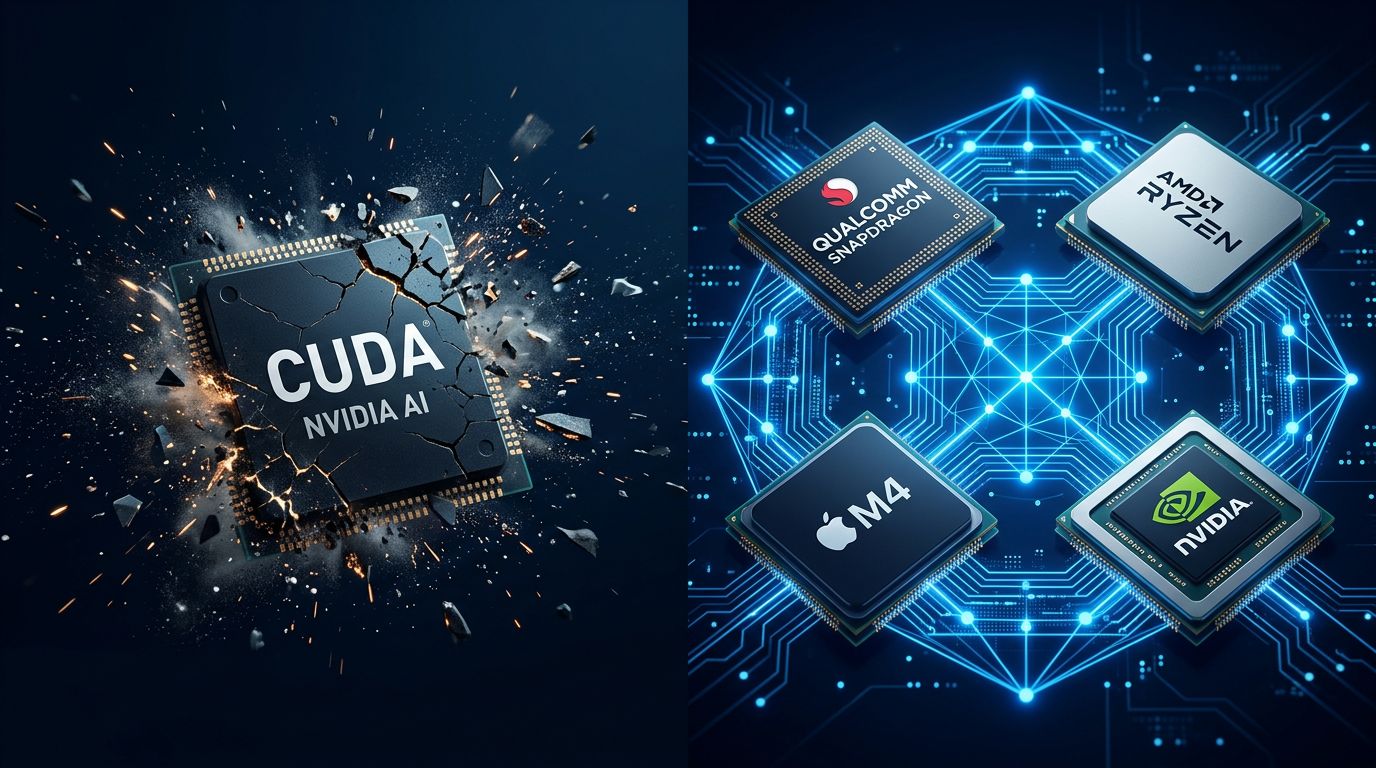
Qualcomm just spent $3.9 billion on a company that makes no chips. That tells you more about the AI hardware wars than any benchmark sheet ever could.
On June 24, Qualcomm confirmed it’s acquiring Modular — the startup behind Mojo (a Python-superset language targeting C++ GPU performance) and MAX (a hardware-agnostic inference platform that doesn’t require CUDA, PyTorch, or ROCm). Deal size: approximately $3.9 billion in Qualcomm stock. Expected close: second half of 2026, pending regulatory approvals.
For developers watching NVIDIA’s software moat with growing anxiety, this story just got more interesting — in a good way.
What Qualcomm Actually Bought #
NVIDIA’s real competitive advantage isn’t the H100 or the B200. It’s CUDA — a software layer built over 20 years, with roughly four million developers locked in. Code tuned for CUDA doesn’t run on AMD without a rewrite. It doesn’t run on Intel without a rewrite. Inference on Qualcomm’s new Dragonfly AI accelerators? Also a rewrite.
Modular built the abstraction layer that skips that. The MAX inference platform runs unmodified across NVIDIA Blackwell, AMD MI300X, Apple Silicon, ARM CPUs, and Intel hardware — no vendor-specific libraries required. The Mojo language extends this to custom GPU kernels: write once, compile to whatever’s in the rack.
Qualcomm’s Dragonfly AI300 accelerator — announced the same day as this acquisition, not a coincidence — needs developers to choose it over NVIDIA. Without software, that choice requires a rewrite. With MAX, it doesn’t. Qualcomm’s stated goal: a “silicon-agnostic compute layer” spanning edge to data center.
Meta is already a Dragonfly customer. AMD and Intel have spent years trying to build a developer-facing, multi-hardware software layer and failed to gain traction. Qualcomm just bought the only one that’s actually working in production.
What Changes for Mojo and MAX Developers #
Short answer: not much before the close, and probably not much after either.
Chris Lattner — who created LLVM, Clang, and Swift before co-founding Modular — is staying. So is co-founder Tim Davis, and the full ~150-person team. Lattner’s public statement was direct: this acquisition accelerates Modular’s mission “without deviating from supporting hardware from all vendors.”
The Mojo 1.0 roadmap is unchanged. The release still targets Summer 2026, and it comes with a specific commitment: the Mojo compiler goes open source at 1.0. Lattner’s post-acquisition framing — “a new era in open software development for Qualcomm” — is the clearest signal that this holds.
MAX users running on NVIDIA or AMD infrastructure don’t need to change anything. Qualcomm’s entire strategic rationale requires MAX to stay hardware-neutral. A MAX that favors Qualcomm silicon is a MAX that existing customers abandon, which makes the $3.9 billion worthless. That’s a strong structural incentive to keep it multi-vendor.
The Concern Worth Taking Seriously #
Vendor-neutral platforms have a documented tendency to develop “preferences” after hardware acquisitions. This is the legitimate worry, and dismissing it would be dishonest.
There’s a useful precedent: Qualcomm also acquired Arduino. That deal generated the same open-source anxiety, and Qualcomm largely maintained the open model. The company has a track record of preserving acquired ecosystems rather than closing them for proprietary advantage.
The signals to watch: Does Lattner stay vocal and public-facing? Does Mojo 1.0 open-source land on schedule? Does MAX’s performance on NVIDIA hardware stay competitive with TensorRT-LLM benchmarks? If those three things hold, the concern stays theoretical.
What Developers Should Do Now #
If you’re already on Mojo or MAX, don’t . The acquisition removes the startup runway concern — the single strongest argument against adopting an independent vendor’s AI stack. Qualcomm’s financial backing changes the long-term calculus significantly.

If you’re evaluating CUDA alternatives, this is a net-positive development. Qualcomm’s resources will accelerate MAX’s hardware support matrix and Mojo’s language stability — both gaps versus established options like vLLM and TensorRT-LLM.

If you’re migrating workloads off CUDA, the [Mojo 1.0 roadmap](https://docs.modular.com/mojo/roadmap/) is worth bookmarking. The compiler open-source is the inflection point where community contributions start compounding.
The AI hardware market is fragmenting by design. Cloud providers are building custom silicon. Hyperscalers are running mixed-vendor racks. The era of defaulting to CUDA because there’s no viable alternative is ending — and Qualcomm just paid $3.9 billion to ensure they’re positioned for what comes next.