Mark Zuckerberg (@finkd) launched Meta's Muse Code in beta on August 5th, giving developers a terminal-based agent designed to plan, execute and validate software engineering work across large repositories.
Muse Code is Meta's first dedicated coding agent built around the Muse model family. The release moves Meta beyond selling model access through an API and into the application layer, where Anthropic, OpenAI, Google and Cursor are competing to control how developers delegate work to AI.
Zuckerberg, Meta's founder, chairman and CEO, said in a thread on X that Muse Code is powered by Muse Spark 1.2, a newly announced coding-focused update to Muse Spark 1.1, which Meta released through a public Model API preview on July 9th. Meta launched the original Muse Spark in April after rebuilding its AI stack under Meta Superintelligence Labs. Zuckerberg studied computer science at Harvard before moving Facebook, which he founded in 2004, to Palo Alto, according to Meta's leadership profile.
For Zuckerberg, Muse Code puts a developer product behind his broader claim that AI agents will take over larger portions of software production. Meta is betting that the coding market will reward systems capable of sustaining work for hours, coordinating multiple workers and recovering from failures, rather than assistants that produce isolated code suggestions.
Persistent agents and parallel worktrees
Muse Code keeps specialized background agents active throughout a session, allowing them to accumulate context instead of restarting for each assignment, Zuckerberg said. For larger jobs, Muse Code delegates pieces of the task to subagents operating in parallel inside isolated Git worktrees.
That architecture closely tracks the direction of competing coding products. OpenAI's Codex app supports parallel agents working in separate worktrees, while Cursor's background agents execute asynchronous coding tasks in remote environments. The contest has shifted toward orchestration: how long an agent can work, how effectively it divides a project and how easily a developer can inspect the result.
Meta's differentiator is a local event log that records each model call, tool execution and code edit before the action runs, according to Zuckerberg. Muse Code can use that log to resume a task after a crash without requiring the developer to reconstruct the session. The design also gives developers a chronological record for auditing what an agent attempted and changed.
That record matters as coding agents receive broader access to shells, credentials and production repositories. Long-running autonomy increases the amount of code an agent can change before a human review, making traceability and recovery part of the product rather than an administrative feature.
Meta claims gains on long-running coding work
Zuckerberg said Meta tested Muse Spark 1.2 on an NVIDIA Hopper kernel optimization task that involved more than 1,000 tool calls over 24 hours. He said the model continued finding improvements after its initial exploration, although Meta did not publish the task, code changes or an independently reproducible evaluation in the thread.
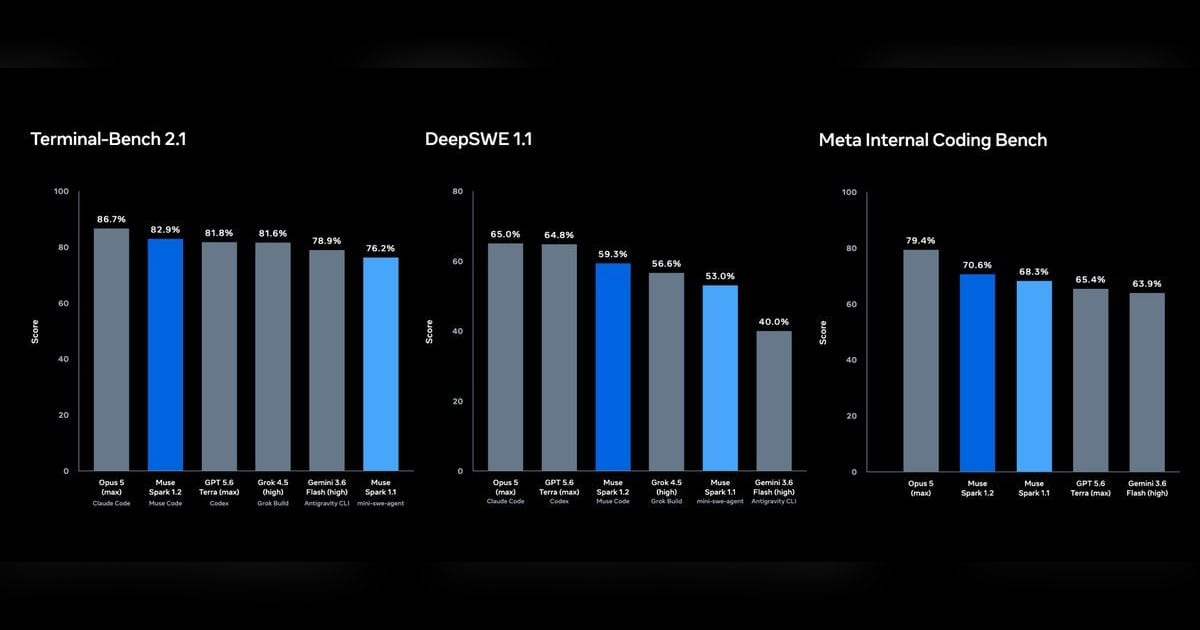
A benchmark chart attached to Zuckerberg's announcement reports an 82.9% score for Muse Code on Terminal-Bench 2.1, behind the 86.7% result Meta lists for Anthropic's Opus 5 and ahead of several other configurations in Meta's comparison. A second chart puts Muse Code at 59.3% on DeepSWE 1.1, below the Opus 5 and GPT-5.6 Terra results shown by Meta. The same chart lists Muse Spark 1.1 at 53%.
Those figures are Meta's evaluations. The announcement does not establish whether each model received equivalent tools, inference budgets or task-time allowances, variables that can materially change agent benchmark results. Meta's 24-hour kernel run also demonstrates persistence rather than the quality or production value of the resulting optimization.
Muse Spark 1.2 follows Muse Spark 1.1, which Meta released through a public Model API preview on July 9th. Meta said that version could manage a one-million-token context window, delegate work to parallel subagents and handle planning, tool use and context compaction. Muse Code packages those underlying capabilities into a workflow developers can operate directly from a terminal.
Zuckerberg said developers can install Muse Code with one command and begin on a contributor tier. Meta is releasing Muse Code as a beta, positioning developer use as both distribution for the agent and feedback for the next Muse models. Zuckerberg said larger models are in development.
The launch gives Meta a direct route into developer workflows after years of using open Llama models to cultivate adoption outside its consumer apps. Muse Code follows the newer Muse strategy: Meta controls the model service and now the agent running on top of it. That creates a product Meta can improve with usage data while competing for the engineering workloads that are becoming one of the clearest commercial markets for frontier AI.