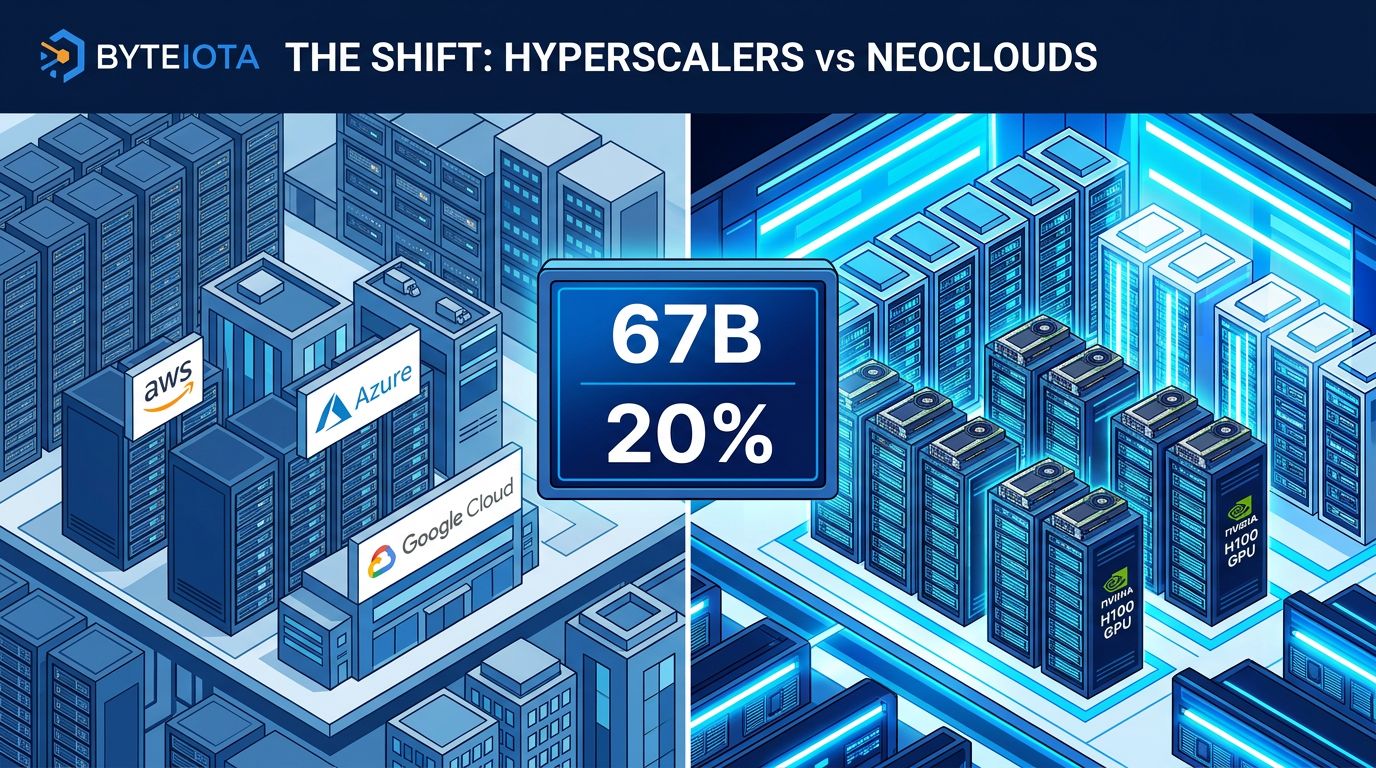
Gartner published a prediction yesterday that should land on every developer’s radar: by 2030, GPU-specialized neocloud providers will capture 20% of the $267 billion AI cloud market. In dollar terms, that is roughly $53 billion migrating away from AWS, Azure, and Google Cloud toward providers built specifically for AI workloads. The driver is not disruption for its own sake. It is straightforward unit economics: an H100 GPU costs $6.88 per hour on AWS and $2.95 per hour on Nebius. Developers running serious AI workloads are already doing that math.
The Pricing Gap Is Structural and Widening #
This is not a temporary arbitrage. Hyperscalers price GPU compute as a bundled service — virtualization layer, managed networking, compliance overhead, and multi-tenancy tax all baked in. Neoclouds strip that away and offer bare-metal access to the same NVIDIA hardware. The result is a gap that has widened, not narrowed, as hyperscaler overhead has grown faster than their cost reductions.
| Provider | Type | H100 per GPU-hour |
|---|---|---|
| Google Cloud | Hyperscaler | $11.01 |
| Azure | Hyperscaler | $6.98 |
| AWS | Hyperscaler | $6.88 |
| Lambda Labs | Neocloud | $3.99 |
| CoreWeave | Neocloud | ~$3.50–4.00 |
| Nebius | Neocloud | $2.95 |
If your team spends more than $10,000 per month on GPU compute and runs all of it on a hyperscaler, you are overpaying. The savings on neoclouds range from 40% to 85% depending on the provider and instance type — and the same NVIDIA H100 or B200 hardware is underneath. There is no magic, only margin.
The Market Is Already Moving #
The Gartner prediction is not speculative. CoreWeave reported $2.078 billion in Q1 2026 revenue — up 112% year-over-year — and carries a revenue backlog of $99.4 billion. Anthropic signed a multi-year contract in April. Microsoft committed $10 billion. Jane Street signed a $6 billion agreement. These are not startup customers taking a risk; these are the largest AI spenders in the world choosing neocloud infrastructure for their most critical workloads.
Hyperscalers are not standing still — combined capex across AWS, Azure, Google, Meta, and Oracle exceeds $600 billion in 2026 — but all three major providers are uniformly described as compute-constrained. Demand for AI infrastructure is outrunning what any single provider can supply, which is exactly the opening neoclouds needed to prove themselves at enterprise scale.
A Practical Playbook for Developers #
The question for most teams is not whether to use neoclouds, but when. Here is how to think about it:
Use a neocloud for:
-
Model training and fine-tuning runs (long jobs, predictable cost, batch scheduling)
-
Batch inference where latency is not a constraint
-
Research workloads with high iteration rates and disposable clusters
-
Running open-weight models (DeepSeek V4, MiniMax M3) at scale Stay on hyperscalers for:
-
Tightly integrated managed services (Kubernetes, identity federation, monitoring stacks)
-
Regulated workloads requiring existing compliance certifications (HIPAA, FedRAMP)
-
Global latency SLAs requiring multi-region redundancy
-
Small teams without bandwidth to manage raw GPU infrastructure
The architecture most mature AI teams run in 2026 is hybrid: neocloud for the heavy GPU jobs, hyperscaler for the application and serving tier. You pay a small egress fee to move data between them. At 40–85% GPU cost savings, it typically covers itself within the first month.
For specific providers: Lambda Labs and Nebius are the value picks for research and startups — zero egress fees and competitive H100 pricing. CoreWeave is the enterprise option with proper SLAs and a $99.4 billion backlog to prove it. Together.ai and Groq Cloud handle serverless inference with OpenAI-compatible APIs if you want to skip infrastructure management entirely. See the full GPU cloud pricing comparison for current rates across 15-plus providers.
The Catch #
Neoclouds are not drop-in replacements for AWS. There is no managed database, no built-in monitoring, no identity federation. Replicating what a hyperscaler provides by default requires DevOps hours — budget for that. Geographic coverage is limited compared to hyperscalers’ 40-plus regions, which matters for workloads with strict latency requirements. Uptime guarantees are often weaker; read the SLA carefully before committing a production workload.
There are roughly 200 neocloud providers in 2026, and consolidation is coming. Some of those providers will not exist in two years. Prioritize providers with enterprise contracts, verifiable uptime history, and institutional backing. The CIO Dive analysis of the Gartner report offers useful context on market maturity signals to watch.
For EU-based developers, there is an additional driver: the EU AI Act enters full enforcement on August 2, 2026. European neoclouds with GAIA-X certification are increasingly required for regulated public-sector workloads, as hyperscalers cannot always meet strict data residency requirements under the new framework. Gartner puts neocloud market share at 20% by 2030. Given CoreWeave’s current backlog trajectory and the widening cost gap, that number may be conservative. The time to run your own benchmark is now — before your competitors already have.