Cosmos is a new tool for AI-native engineering teams
Software development is moving out of the IDE. Well, it has moved out of the IDE.
Intent, Codex, Claude Code - all of these are agent interfaces that abstract code editing away.
For decades, the IDE was where software happened. You read code there. You wrote code there. You debugged code there. You ran tests there. You sat in front of the editor, typed the implementation, and used the rest of the toolchain to support that work. Then, AI started working its way into our workflows.
First, it was autocomplete. Then chat in the sidebar. Then, inline edits. Then, agents that could inspect files, modify code, run commands, and loop until they got something working.
That was the first phase of AI-assisted development: make the individual engineer faster inside the environment they already use.
The next phase is different.
Once agents are doing meaningful work, the bottleneck stops being “can the tool write code?” and becomes “can I trust this work enough to ship it?”
But teams have a harder problem.
An individual can build a personal workflow. A team needs an operating model.
That is where Cosmos provides value.
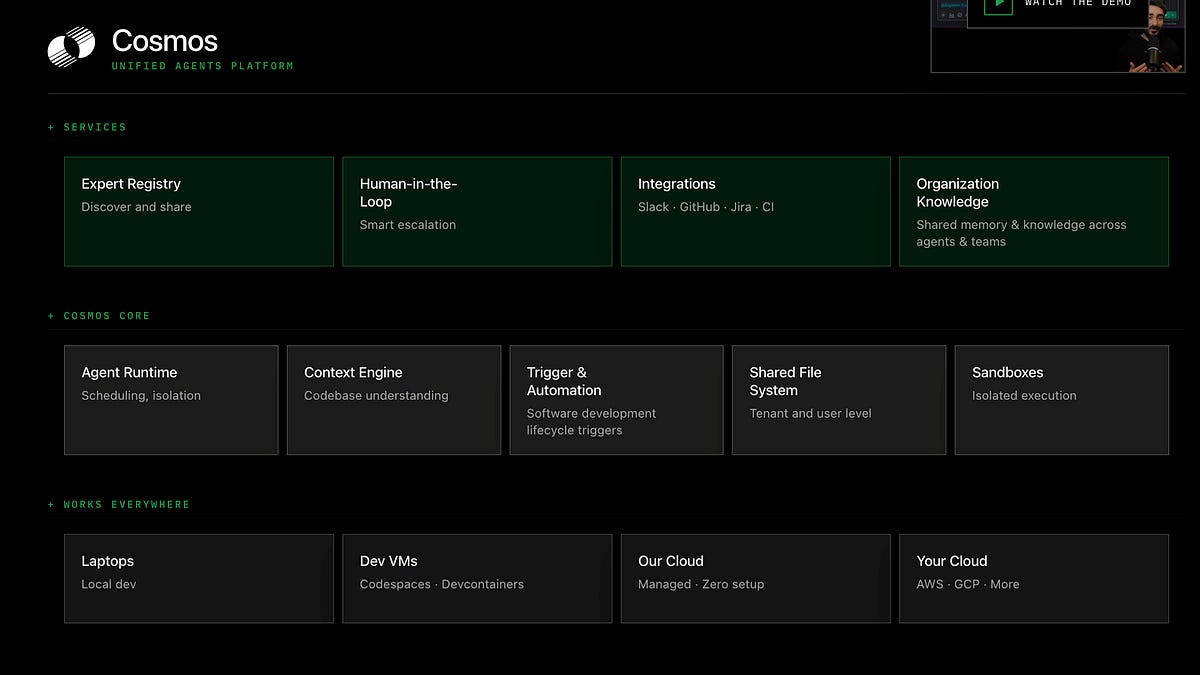
Cosmos is Augment's unified cloud agents platform: a shared system where agents work across triage, spec, implementation, review, testing, deployment, and feedback with the context, memory, and controls teams need. Humans steer; agents do the doing; the system gets better as the team uses it.
The problem is no longer code generation #
The first time you watch an agent make a non-trivial change, it feels like the future.
The twentieth time, you start noticing the mess. When you multiply this across entire teams, the mess gets pretty disruptive.
Today’s post is generously sponsored by Augment, friends of the newsletter and creators of Cosmos.
You’ll recognize Augment as a longtime sponsor of the newsletter, with tools like Augment Code and Intent already being loved by developers.
Cosmos is the next iteration, and it’s built for teams.
One engineer on your team might have a carefully tuned prompt for backend migrations. Another has a Claude Code skill that works great for tests. Someone else has a local script that spins up three agents in separate worktrees for adversarial reviews.
Agentic engineering is a paradigm shift, and it requires new tools.
The name Cosmos is hinting at something. Cosmos is Greek for order, specifically the ordered universe. It stands in contrast to chaos, which is the problem it seeks to solve.
Teams need a way to coordinate agents, humans, code, tools, memory, policies, review, and production feedback into one system.
Cosmos is that system.
AI-native teams have team-level systems #
Most AI coding tools are still designed around the individual developer, which makes sense. Individual adoption is where the market started. A single engineer installs Cursor, Claude Code, Codex, Intent, or another coding agent and immediately gets leverage.
But individual leverage does not automatically become organizational leverage.
In fact, it can make some organizational problems worse.
If agents make it easy to generate code, PR volume goes up. If PR volume goes up, review becomes the bottleneck. If review becomes the bottleneck, teams either slow down or start rubber-stamping changes. If they rubber-stamp changes, they ship bugs, regressions, and architectural drift faster than before. The same pattern shows up in incident management.
If agents help teams ship more code, production changes faster. If production changes faster, on-call has more context to reconstruct. The on-call engineer now has to correlate deploys, logs, metrics, Slack threads, dashboards, ownership, past incidents, and recent PRs under pressure. Human attention is necessary, but a bottleneck. We shouldn’t be seeking to pull humans out of the loop, but that doesn’t mean we should hide from tools that make that human’s job easier.
But at this point, these tools need to be built for whole teams.
Does AI make you more productive?
Augment is running research on the ROI that teams get from AI tools, including trying to find a productivity plateau from AI adoption.
We’d love to have you contribute!
Intent is single-player, Cosmos is multiplayer #
The distinction between Intent and Cosmos is helpful.
Intent is about the individual developer’s workflow after the IDE stops being the center of gravity.
You define a task. Agents coordinate inside a workspace. A spec gives the work shape. The tool helps you answer the key question: “Can I trust that the agents did the thing I asked them to do?”
That is a single-player problem.
Cosmos is aimed at the team version of the problem.
How does an organization make sure the best way to do something is not locked inside one engineer’s head?
How does a team turn a successful agent workflow into a reusable pattern?
How do you make sure code review, incident response, testing, and remediation all improve over time instead of starting from scratch every time a new agent session begins?
How do you keep humans in the loop for judgment without forcing them to inspect every line of agent-written code?
That is a multiplayer problem.
Cosmos is a bet that AI-native engineering teams need a shared system of record for agentic work. Not just prompts. Not just agents. Not just a dashboard. A coordination layer.
Experts are specialized agents in Cosmos #
Experts are specialized agents you can define in markdown and reuse across your entire team.
Here’s a sneak peek of how Augment is using experts internally to do code review.
Here’s another example of how they’re using experts for automated incident response.
Agents gather evidence, summarize, propose, and remember. Humans decide, approve, and handle the parts where judgment matters.
You’ll notice in this flow that these “experts” don’t actually pull humans out of the loop completely. The human still makes the judgment call, but the human is no longer starting from zero.
Augment is reporting that these agent workflow triages 81% of incidents now! Agents aren’t new to Augment, so it should be surprising that the number before introducing Cosmos was 0.4%.
That’s how big a difference this tool makes for teams.
**Want to set up your own experts? **Cosmos advisor helps you set them up with natural language so you don’t have to learn a new tool from scratch. If you want a jumpstart, you can use the library of experts that ships with Cosmos.
The model router is built for pro teams #
One underrated part of Cosmos is Prism, the model router. Prism handles model selection so you don't have to be an expert on model capabilities to get the most for your tokens.
Cosmos is intentionally model-agnostic. You can choose your own model, or get the model router to do it for you.
Historically, I haven’t really trusted model routers, under suspicion that they route you to the cheapest model.
This isn’t the case with Prism, because the tool is complexity-aware.
For each input, a small (read: inexpensive) planner model reads the request and decides which of the underlying models should handle it. From your perspective, Prism behaves like any other model in the picker. You pick Prism, then Prism picks the model. Choosing a model based on complexity is actually the easier part. The harder part is caching. Modern coding agents lean heavily on prompt caching to reduce cost and latency. Naively switching models mid-session throws the savings from the cache out the door. A naive router that re-routes every turn would burn most of its potential savings on cache misses, which could make the session more expensive than just staying on one model.
Prism’s only switches models when the expected win from a different model exceeds the cost of the cache eviction, which makes it an effective means of staying in your token budget without getting sub-optimal results.
Cosmos meets you where your work already happens #
Cosmos works on your local machine, in containers, in codespaces, in Augment’s managed cloud, or on your own cloud infrastructure.
That makes it easy to *run *Cosmos, but you also don’t have to move all your work inside of Cosmos. It has robust integrations to bring it into the work you already have going on. It integrates into Slack, Linear, a CLI, web, and mobile apps.
It also has MCP support and webhooks so building your own custom integrations is easy.
If you’re an engineering team looking to actually multiply your impact with AI, give Cosmos a try.