Cloudflare open-sourced its internal AI workspace — Cloudflare OS — on August 5, 2026, alongside @cloudflare/computer
, a hybrid agent runtime that already runs in production at Cloudflare for thousands of employees. Both projects hit GitHub and Hacker News simultaneously: the cloudflare/computer
repo trending at #1 today with 796 new stars, and the Cloudflare OS announcement pulling 224 points and 122 comments on Hacker News. This is not a concept demo — it is the actual internal tooling made public.
Why Containers Can’t Scale for Agents #
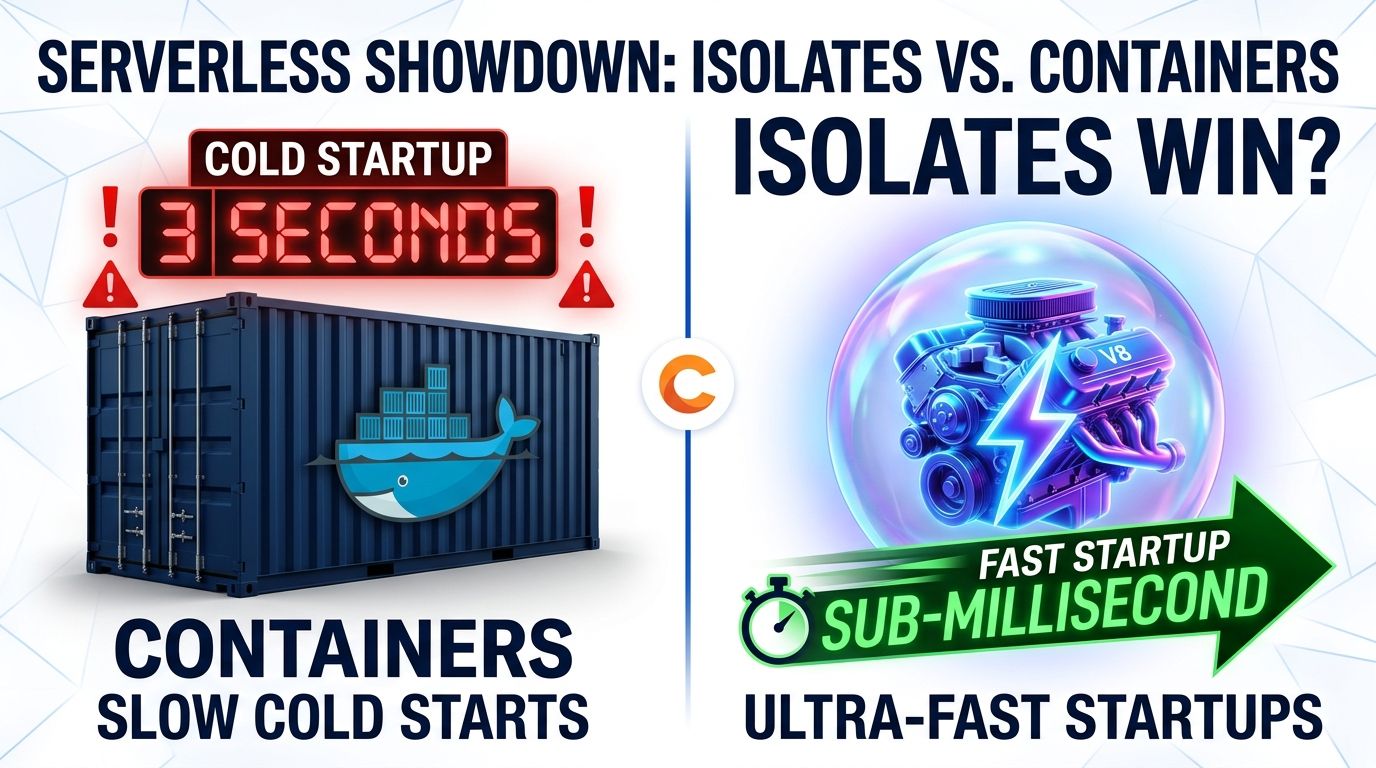
The core argument behind @cloudflare/computer is blunt: containers cannot support billions of concurrent AI agents. The memory overhead and cold-start latency make per-agent containerization economically unviable at scale. Cloudflare’s answer is an isolate-first model — V8-based Workers that start in under a millisecond with no concurrency limits — falling back to full Linux containers only when an agent genuinely needs native binaries or a package manager.
Kenton Varda, who created Sandstorm.io before joining Cloudflare, made the efficiency case directly in the Hacker News discussion: Dynamic Workers are “roughly 100x more efficient than a typical container — no limits on concurrent executions, no warm-up required.” If that claim holds under production conditions, it has real cost implications for anyone running agent fleets. The @cloudflare/computer
package gives developers both backends with a shared virtual filesystem backed by SQLite, plus a standard set of agent tools (read, write, edit, ls, exec) compatible with the AI SDK.
Installation is a single command:
npm install @cloudflare/computer
The catch: this is an early preview. Cloudflare explicitly warns it is “not suitable for production use at this time.” APIs are unstable. If you need something stable today, Cloudflare Sandboxes — also announced this week as GA — provides persistent, isolated compute environments that are fully production-ready.
What Cloudflare OS Actually Is (and Isn’t) #
Despite the name, Cloudflare OS is not a bootable operating system. It is an open-source enterprise AI workspace — employees interact with AI agents via a browser UI, with every conversation grounded in the organization’s curated knowledge and internal systems. Security is enforced by “Gatekeepers,” service-specific Workers that mediate access to external APIs and databases while logging data observations and enforcing access policies downstream.
The platform is model-agnostic, routing inference through Cloudflare AI Gateway. MCP-native. Apache 2.0 license. The GitHub repo is live at github.com/cloudflare/cloudflare-os. HN commenters noticed the lineage: this is Sandstorm.io rebuilt on Workers infrastructure, with AI. That is not a criticism — Sandstorm’s per-instance sandboxing model was architecturally sound but killed by the compute costs of containers. Workers solve that problem.
New Primitives: Durable Object Facets and Workflows #
Two new building blocks launched alongside Cloudflare OS that matter beyond the workspace itself. First: Durable Object Facets. Previously, Dynamic Workers — Cloudflare’s sandboxed execution environment for AI-generated code — could not maintain state. Durable Object Facets fix this: AI-generated code running in Dynamic Workers can now instantiate its own isolated SQLite database. Each agent-built app gets its own database. If one breaks, nothing else notices. Available in beta for Workers Paid plan users.
Second: the Workflows engine was rearchitected to support 50,000 concurrent workflow executions. For anyone building durable background agents — tasks that run for minutes or hours across multiple steps — this concurrency ceiling increase changes what is practical to build on Cloudflare today.
The Trade-Off to Understand Before Committing #
The “open source” label here deserves scrutiny. The code is Apache 2.0 — genuinely open. However, running it requires Durable Objects, Dynamic Workers, R2, and a Workers Paid plan. There is no on-prem path. One Hacker News commenter summarized it plainly: “so tied to their platform, there is no vendor portability.” Several developers hit friction just getting the deployment working, with multiple paid Cloudflare tiers required before testing even begins.
That trade-off may be entirely acceptable depending on your architecture. If you are already building on Cloudflare Workers, the isolate-first model is a genuine performance and cost advantage over Kubernetes-based agent runtimes. If you need multi-cloud or on-prem flexibility, Kubernetes remains the answer — it just does not solve the billion-concurrent-agents scaling problem as elegantly. Choose based on your actual constraints, not the announcement.
Key Takeaways #
- Cloudflare OS is an open-source enterprise AI workspace (Apache 2.0) built on Workers, MCP, and Durable Objects — not a traditional OS despite the name
- @cloudflare/computer gives agents a hybrid compute environment (isolates for 90%+ of tasks, containers only when necessary) but is preview-only; Cloudflare Sandboxes are GA if you need stability now
- Durable Object Facets is the genuinely new primitive: AI-generated code running in Dynamic Workers can now maintain isolated SQLite state — enabling truly stateful AI apps in the Workers ecosystem
- The performance claims are real (100x isolate efficiency vs. containers) but the infrastructure lock-in is also real — there is no multi-cloud or on-prem path