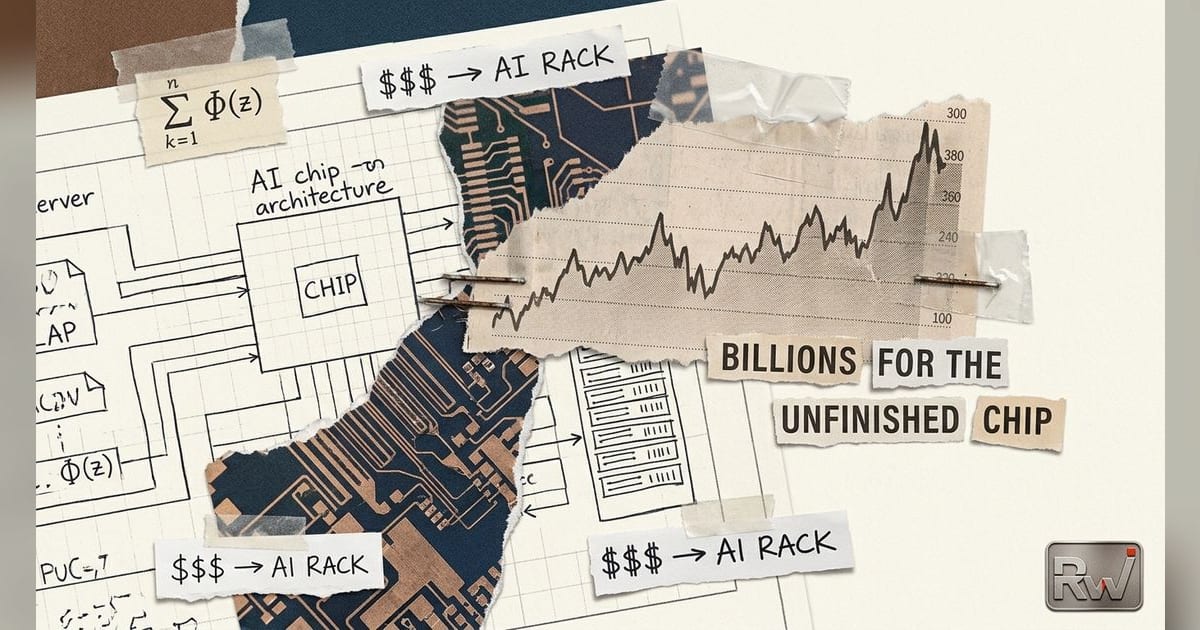
James Dacombe, the 25-year-old founder running two capital-intensive hardware companies, has raised another $312 million for OLIX, valuing the London AI chip developer at $3.3 billion before its first processor reaches customers.
OLIX announced the Series B on August 3, two years after its founding and less than six months after a $220 million financing valued it at just over $1 billion. Tech.eu reported that New York investor Fundomo led the new round. OLIX said Arm, Hudson River Trading and Netflix co-founder Reed Hastings participated.
Dacombe has been building companies since his teens. He dropped out of high school at 16, worked as a software engineer and started neurotechnology developer CoMind at 17, according to his Forbes profile. He remains CoMind's CEO while leading OLIX, an unusual dual mandate given that both companies develop complex physical systems. Companies House records show he became an OLIX director when OLIX was incorporated on March 22, 2024.
A $532 million sprint to silicon
OLIX's two announced rounds since February total $532 million. The earlier financing was led by Hummingbird Ventures, and its February valuation of just over $1 billion means investors have more than tripled the OLIX valuation in under six months.
That acceleration reflects the cost and timing of semiconductor development. OLIX says the Series B will finance manufacturing and supply-chain commitments, continued development of its silicon platform and delivery of its first DX-1 systems to customers in the second half of 2027. Its careers page lists 21 openings spanning chip design, optics, embedded software, manufacturing and infrastructure across London, Bristol, Austin and Toronto.
The schedule leaves Dacombe with roughly a year to move from design and testing into customer hardware. The round gives OLIX capital for its stated manufacturing and supply-chain commitments while placing a $3.3 billion valuation on execution milestones that remain in front of it.
Dacombe's token factory
OLIX is targeting inference, the stage when trained AI models process prompts and generate answers. Dacombe's central argument is that one general-purpose accelerator should not handle every operation involved in producing a token. OLIX describes a data center as a token factory and proposes assigning different parts of a model to specialised chips arranged across complete server racks.
DX-1, the first processor in OLIX's planned X-1 platform, is designed for decode, when a model reasons and produces output tokens. OLIX says the chip will keep models in on-chip SRAM and connect processors through optical links, moving data with light rather than copper. A deterministic compiler will schedule work across the rack.
The architecture is also a supply-chain bet. OLIX says DX-1 avoids high-bandwidth memory and advanced packaging, two constrained components in current AI systems. That could make production easier to scale if the design performs as intended, although it shifts more of the engineering burden onto OLIX's custom chips, optical connections, compiler and rack integration.
OLIX claims DX-1 can exceed 10,000 tokens per second per user on 100-billion-parameter models while improving throughput per watt, and says the architecture can extend to models with 10 trillion parameters or more. Those figures are company projections for hardware that is scheduled to reach its first customers in 2027. The Series B validates investor appetite for the design, rather than production performance.
Two hires for the manufacturing phase
Dacombe is adding executives whose backgrounds match OLIX's next set of problems. Nick McKeown, a Stanford computer science professor and former Intel executive, has joined the board. His work spans programmable networking, data-center systems and semiconductor companies, making the appointment particularly relevant to OLIX's plan to coordinate many chips across a rack.
Matt Briers has joined as chief financial officer. Briers was Wise's CFO and helped take the payments company public, according to Tech.eu. His experience adds public-market finance expertise as OLIX prepares for supplier commitments, inventory and capital planning tied to its planned 2027 delivery.
The appointments also show how Dacombe is trying to compensate for OLIX's youth. He has recruited a networking researcher with semiconductor and infrastructure experience and a finance chief who has already taken a technology company to the public market. Their experience will be tested against a product schedule that gives OLIX little room for semiconductor delays.
Inference challengers are attracting larger checks
OLIX is entering a heavily financed contest. Fellow UK inference chip developer Fractile said in May that it raised $220 million. Data Center Dynamics reported that Fractile is developing in-memory-compute chips and, citing The Information, that the hardware could become available in 2027. In California, TechCrunch reported in July that Etched closed a $300 million Series C at a $10.3 billion valuation, based on comments from co-founder and Chief Operating Officer Robert Wachen. Etched says it has manufactured chips and placed initial systems with customers for testing.
These companies share a thesis that rising inference demand will create room beside Nvidia for processors built around narrower workloads. Their architectures differ, but each must prove that specialised hardware can keep pace as model designs change, integrate into data centers and deliver enough savings to justify a new software and systems stack.
OLIX is positioning against Nvidia and general-purpose GPU systems for inference, while also competing with other photonics startups. Dacombe has persuaded investors to fund that proof at an unusually early point. The $3.3 billion valuation prices in a successful chip tape-out, manufacturing ramp, optical rack integration and customer acceptance. OLIX's next milestone is concrete: put DX-1 systems in customers' hands in the second half of 2027 and let the token factory thesis face workloads outside its own simulations.