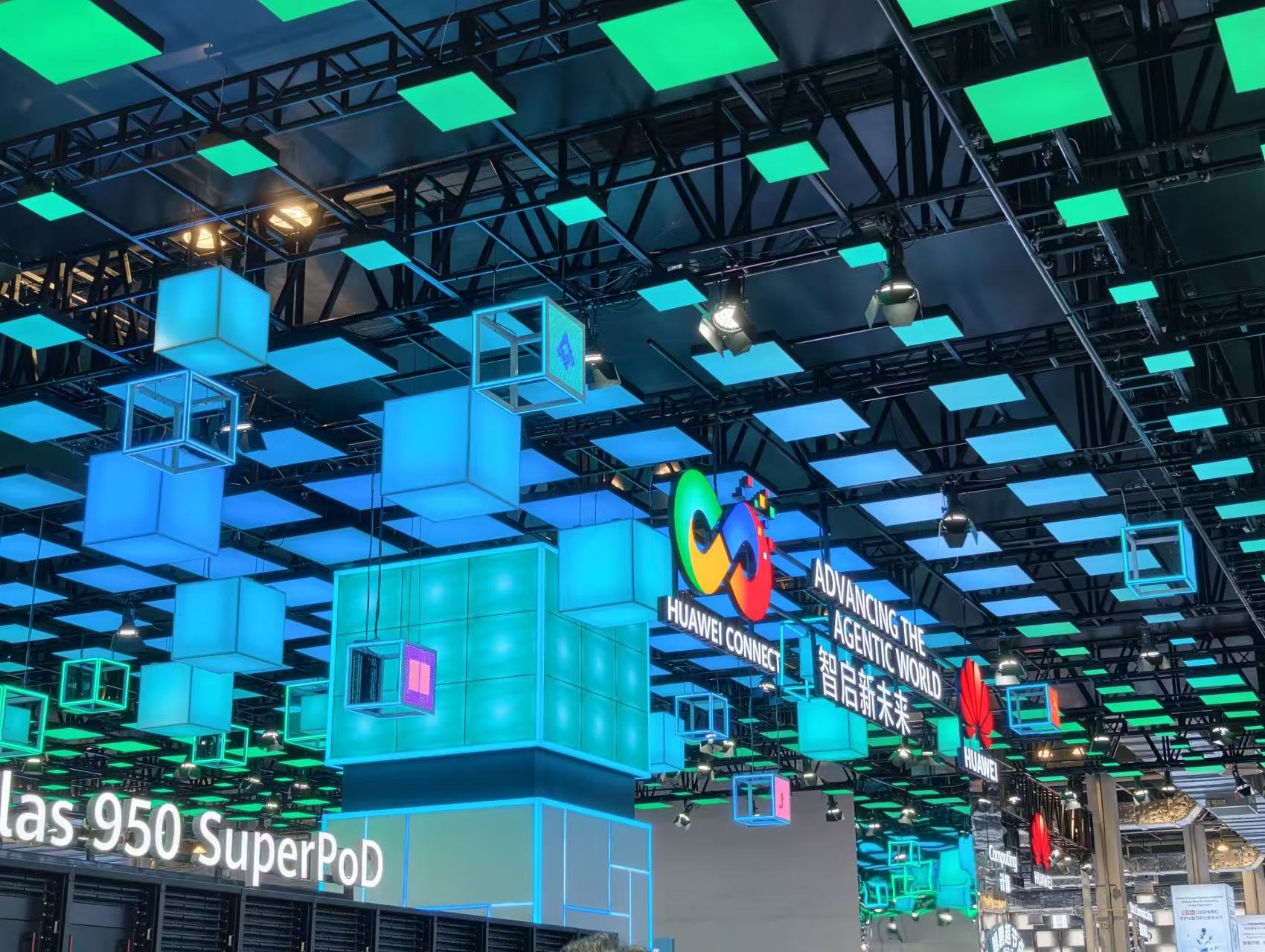
The TechNode team attended HUAWEI CONNECT 2026 this morning, where one thing stood out: as AI models continue to grow, the industry’s biggest question is no longer just what AI can do, but what it takes to run models at this scale. The answer increasingly comes down to computing power.
At the event, Huawei Deputy Chairman and Rotating Chairman Wang Tao (David Wang) delivered a keynote titled Advancing the Agentic World, Building a Solid Silicon Foundation.
He outlined Huawei’s latest plans for AI infrastructure, with a particular focus on the Ascend 960 SuperPoD, the industry’s first SuperPoD to use NPO technology.
Why d****o w****e n****eed SuperPoDs?
Let’s start with the basics. Traditional AI computing relies on multiple servers working together. But as models reach the 10-trillion-parameter scale, simply adding more servers is not enough. The chips need to exchange huge amounts of data, and communication between servers can become a bottleneck.
Huawei said that in a 100,000-card AI cluster, communication between chips can account for more than 40% of training time under traditional architectures.
The company’s SuperPoD approach connects multiple computing nodes through high-speed interconnects. The nodes share unified memory and work together like a single computer.
This is essentially a rethink of how AI computing power should be organized.
Why i****s the Ascend 960 SuperPoD w****orth w****atching?
The newly announced Ascend 960 SuperPoD supports up to 4,096 NPU cards, delivering up to 8E FP8 computing power and up to 1PB of HBM capacity. But what I find most interesting is not just the numbers. It is the use of NPO, or Near-Packaged Optics.
As AI clusters grow, the amount of data moving between chips increases rapidly. Traditional copper connections and pluggable optical modules face growing challenges in bandwidth, latency, power consumption, and connection density.
NPO takes a different approach: bringing optical components closer to computing chips to shorten the distance that high-speed electrical signals need to travel.
Huawei’s Hi-ONE is an NPO product developed for this purpose. According to Huawei, Hi-ONE delivers 7.2T of transmission capacity per engine. In the Ascend 960 SuperPoD, around 5,500 Hi-ONE units can replace the 48,000 800G optical modules that would otherwise be required, reducing power consumption by more than 550kW.
Huawei also said that the system’s mean time between failures will double, while availability will reach 99.8%. This means Huawei is not simply launching a more powerful AI chip. It is trying to solve the challenges of chips, interconnects, storage, and system architecture as one problem.
From c****hip c****ompetition to s****ystem c****ompetition
This was another point that stayed with me from the keynote. When we talk about AI chips, we often focus on computing power, process technology, and memory capacity. But as AI models enter the super-large-scale era, the performance of a single chip is only one part of the picture.
How chips connect, how data moves, how memory is shared, and how storage works together can be just as important as raw computing power. Huawei’s latest work around the Ascend 960 SuperPoD, NPO, and UnifiedBus is essentially about turning more computing resources into one coordinated system.
That also explains why Huawei is discussing AI clusters with up to one million cards. As AI agents run continuously, autonomous driving requires real-time computing, and phones, PCs, cars, and IoT devices gain more AI capabilities, demand for computing power will only continue to grow.
The future of AI may not simply be about building a bigger model. It may be about building a massive infrastructure made up of chips, computing power, networks, and storage.
After seeing the Ascend 960 SuperPoD today, my biggest takeaway was this: AI is racing ahead in the foreground, while computing power is quietly rebuilding the world behind it. And the intelligent world may ultimately begin with individual chips, SuperPoDs, and the networks that connect them. The future is computing power everywhere.