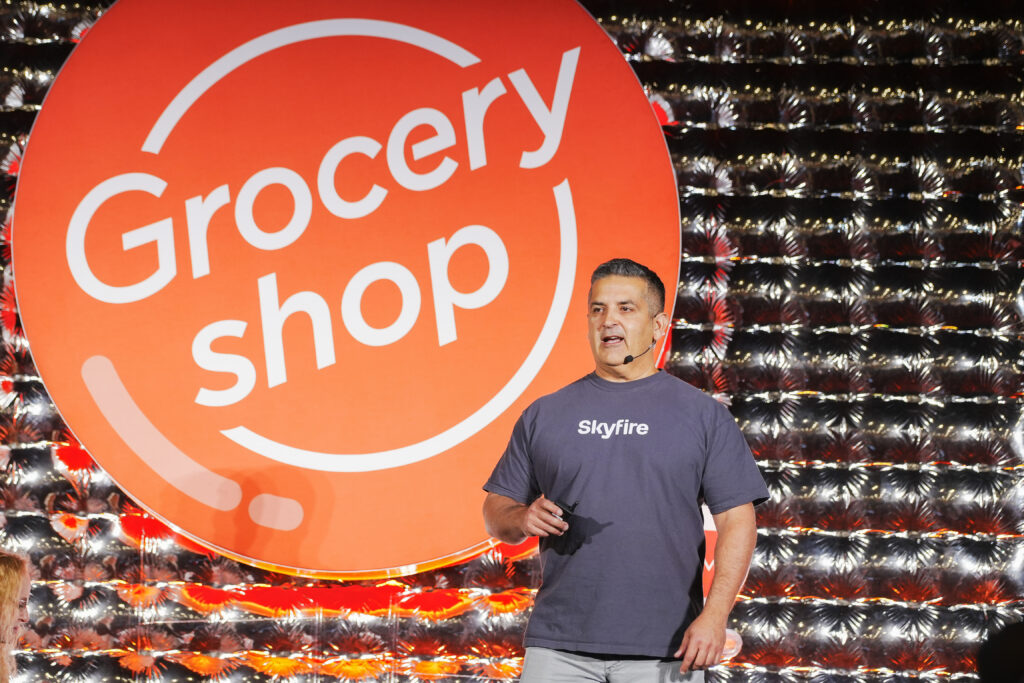
Groceryshop 2026 brought more than 4,000 senior leaders to Las Vegas, including teams from over 1,300 retailers and consumer brands, to explore what is next in commerce. Well, usually the question is “What’s next?” This year, everyone already knew the “What” – the big question was “How?” AI and agentic commerce were everywhere, from the main stage to nearly every conversation we had on the floor.
Amid all of that noise, Skyfire came to bring the conversation back to the question sitting underneath every agentic ambition in the building: how does a merchant know which AI agents to trust?
Skyfire stood strong #
We were honored to compete in the Startup Pitch session, “Technologies Boosting Revenue and Conversion,” alongside five impressive companies: Nudge, Portal, corvera, Shelflife, and EVERYAISLE. Any merchant worried about the pace of innovation in commerce should have been in that room. Skyfire was selected for the finals and earned the highest scores from the judging panel, and we are grateful to Harshad Agashe of Albertsons, Deepak Jose of Niagara Bottling, Manuel Queiroz of Bright Pixel Capital, and Deborah Weinswig of Coresight Research for the recognition, and just as much for their sharp questions.
On stage, our CEO Amir Sarhangi laid out the obstacle in front of all of it. The agent traffic that wants to do real things, like log in and check out, gets blocked by layers of web security. That happens because merchants and financial institutions still can’t answer three basic questions about an arriving agent: who the end user is behind it, who the agent is, and what it’s authorized to do on that person’s behalf. Until those questions are answerable, fraud teams are right to keep the walls up.
We didn’t ask the room to take that claim on faith. Live on stage, we showed a fully agentic shopping trip running on Verve Market, the personalized online grocery service that matches products from local stores to each shopper’s dietary needs. An agent built a complete grocery order on vervemarket.com, eleven items with a same-day delivery window, and brought it to its customer for a single approval. The purchase then completed through Skyfire Checkout, with Mastercard cardholder authentication verifying the payment before the order was placed. The demo earned the reaction we hoped for, but the detail that matters most for every merchant reading this happened before the show: Verve went from first conversation to live and accepting trusted, customer-authorized agents in under a day, on their existing storefront, with nothing rebuilt.
Amir’s message to the room was that this is solvable now, and that solving it does not require merchants to rebuild anything. Through the open KYA (Know Your Agent) protocol, merchants can recognize and accept trusted, customer-authorized agents on their existing infrastructure, with activation possible in minutes.
The five questions merchants asked us all week #
The pitch took three minutes. The conversations around it filled three days, and they were remarkably consistent. Five questions came up again and again, and they are worth answering here the way we answered them in Las Vegas.
- If an agent does the shopping, how do we keep our relationship with the customer? This was the most common question and the most emotional one. The answer is identity. An agent does not have to arrive as an anonymous request. A verified agent can arrive as a recognized extension of a customer you already know, with your loyalty relationship intact, and you remain in control of that relationship.
- How much of the traffic we block today is actually our customers’ agents? Almost nobody knows, and that is the point. More than half of ecommerce traffic is now automated, and blocked-traffic reports rarely reach the business side of the house. The first step of any agentic strategy costs nothing: ask your security team for the number.
- Do we have to pick a protocol? There is real confusion in the market around UCP, ACP, APIs, and everything in between, and most of those paths are heavy lifts that do not put the merchant in control. KYA is interoperable with the protocols emerging across the ecosystem, and it works at the scale merchants actually need, which is the scale of the web.
- Does this mean rebuilding our commerce stack? No. Recognizing trusted agents works with the storefront, payment, and identity infrastructure you already run. This is a configuration decision, not a replatforming project.
- What does a safe first step look like? A small, instrumented pilot. A few hundred agent-completed orders will teach you things nobody in your category knows yet: who these customers are, how their order values compare to your baseline, and how often they complete a purchase. The merchants who run that pilot first will out-learn everyone who waited.
Where we go from here #
Our mission coming out of Las Vegas is the same one we walked in with: educating the market that agentic commerce is not just about building smarter shopping agents. The ecosystem also needs the trust infrastructure that lets merchants confidently open the front door to them.
Or, as Amir put it on stage: your next customer is going to be an agent, and every merchant is going to want that.
Thank you to the Groceryshop team for a great show and a great stage. If you are a merchant working through any of the five questions above, we would love to compare notes.