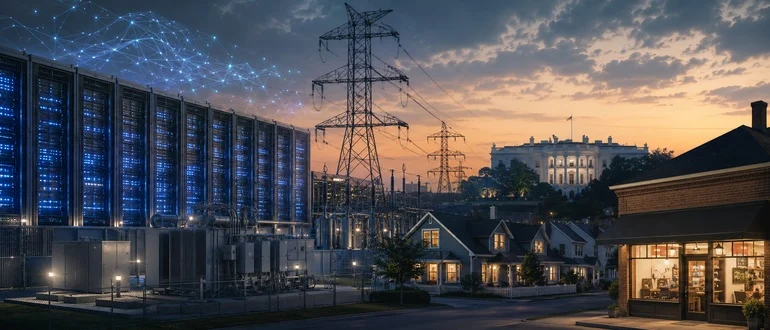
The Trump administration is preparing to expand an initiative aimed at neutralizing a growing political liability: the risk that the artificial intelligence (AI) boom could drive up electricity bills for Americans.
The White House plans a summit in the coming weeks bringing together utility executives, independent data center developers, and state governors, according to Reuters, citing three sources familiar with the matter. The goal is to secure a voluntary pledge ensuring that the rapid expansion of AI infrastructure does not result in households and local businesses subsidizing the tech industry’s massive power requirements.
The guest list and final details for the summit are currently being finalized as administration officials iron out the framework with state executives and energy sector leaders.
The upcoming event builds on an earlier “Ratepayer Protection Pledge” signed at the White House by tech giants including Amazon.com Inc., Google, Meta Platforms Inc., Microsoft Corp., OpenAI, Oracle Corp., and xAI.
Under that initial agreement, the companies committed to financing the electricity infrastructure required for their AI projects — including new power generation, grid upgrades, and fees for unused reserved capacity — rather than passing those costs onto current utility customers.
“President Trump’s Ratepayer Protection Pledge has been so impactful that additional stakeholders also want to sign it,” a White House official told Reuters, confirming the administration’s intent to broaden the coalition.
“I view this as a positive. Power is one of the key constraints in the AI infrastructure build-out, with a lot of behind the meter power being brought online, and growing objections to large datacenters and their impact to local communities,” said Dan O’Brien, president and chief operating officer at The Futurum Group. “Consumers want to feel some protection that AI infrastructure will not be prioritized over household and other business power needs, nor will the price of electricity see meaningful price inflation due to supply and demand dynamics as AI infrastructure grows its share of the total grid usage.”
Political stakes are high for the administration, which has aggressively pushed to accelerate domestic AI infrastructure to maintain a competitive edge over global rivals like China.
However, the sheer volume of electricity required by modern data centers has triggered alarms among state regulators, lawmakers, and consumer advocacy groups. Critics have warned that without strict guardrails, ordinary ratepayers could end up funding billions of dollars in grid modernization projects required to serve some of the world’s wealthiest tech firms.
By broadening the pledge to include the utilities that distribute power and the developers that build data centers, the White House hopes to create a more comprehensive framework. The administration has consistently messaged that the United States can simultaneously dominate the global AI race and lower domestic energy costs, casting this initiative as a direct reassurance to voters worried about inflation and utility inflation.
However, the voluntary nature of the agreement has drawn skepticism from industry observers. Because the pledge lacks formal regulatory enforcement mechanisms, questions remain over whether the participating companies will deliver concrete, binding financial commitments or if the initiative will ultimately serve as a symbolic public relations victory.
“The White House is already behind the eight ball, and the summit is responding to a fight already playing out locally,” said Mitch Ashley, vice president and practice lead for Software Lifecycle Engineering and AI-Native Software Engineering at The Futurum Group. “Households and businesses are pushing back through municipal rate cases and setting local restrictions, and state regulators are setting the real terms for AI power costs ahead of any federal framework.”
“A voluntary pledge cannot govern that reality,” Ashley said. “Utilities and data center developers need binding cost-allocation commitments with enforcement mechanisms, because the municipalities already restricting where AI facilities can be sited and billed will not wait for Washington to catch up.”