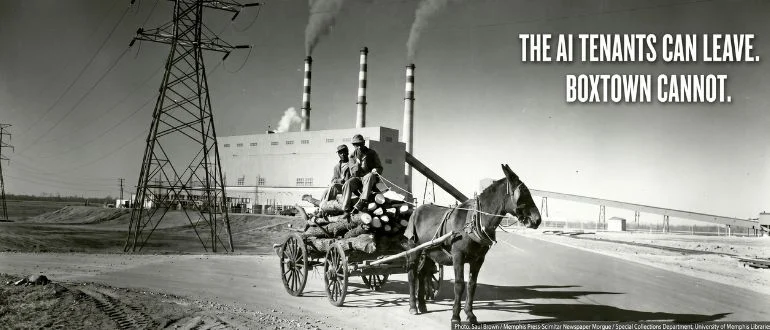
Boxtown residents James Threadford Jr. (front) and Albert Lee Wright collect firewood from a horse-drawn cart in Memphis, Tennessee, in January 1961. A power plant stands behind them. The photograph recently appeared in The Christian Science Monitor’s reporting on Boxtown. Photo by Saul Brown, Memphis Press-Scimitar Newspaper Morgue, Special Collections Department, University of Memphis Libraries.
In January 1961, Memphis newspaper photographer Saul Brown captured Boxtown residents James Threadford Jr. and Albert Lee Wright riding a horse-drawn cart piled with firewood. Behind them stood a power plant. The photograph contained an entire economic system in one frame: Two men collecting fuel while an industrial facility generated electricity almost within reach. Some Boxtown homes still lacked electricity at the time.
More than six decades later, this historic community in southwest Memphis again lives beside infrastructure producing one of the world’s most valuable resources. This time, it is not merely electricity. It is machine intelligence, manufactured inside the massive Colossus AI data center complex originally built by xAI to train Grok.
The Christian Science Monitor’s recent reporting from Boxtown describes residents sitting on their porches close enough to smell fumes from the facility beyond the woods. They are trying to understand what this new neighbor means for their health, utility bills, property and community. They are also confronting a question their parents and grandparents would recognize: What does a community receive when it hosts infrastructure built primarily to benefit people somewhere else? The technology has changed. The bargain looks awfully familiar.
The Tenant is Not the Owner
It would be easy to turn this into an article about Anthropic. Colossus 1 was built for Grok, but in May, Anthropic announced an agreement to use all its available compute capacity. The original announcement described more than 300 megawatts and over 220,000 Nvidia GPUs, which Anthropic said would help it increase usage limits for Claude subscribers.
SpaceX’s subsequent offering documents revealed that the full arrangement had grown beyond that initial facility. The company now says its agreements with Anthropic provide access to approximately 325,000 Nvidia GPUs across Colossus and Colossus II, its wider data center complex spanning Memphis and nearby Southaven, Mississippi. Anthropic has agreed to pay SpaceX approximately $1.25 billion per month through May 2029, after a reduced-fee ramp-up period. Following an initial three-month period, either party can terminate the agreements with 90 days’ notice, according to SpaceX’s prospectus disclosure.
That arrangement creates an irresistible contrast. Anthropic is a public benefit corporation that has made responsible AI central to its identity. It is now running workloads on infrastructure surrounded by concerns about emissions, water, electricity consumption and the treatment of a predominantly Black community already burdened by industrial pollution.
But making Anthropic the villain would be too easy, and mostly wrong. Anthropic did not select Boxtown, convert the former factory, install the computing infrastructure or make the original decisions about how Colossus would be powered. It needed compute, and SpaceX had an enormous amount available. Anthropic rented it.
Google has made a similar deal. Beginning in October, it is expected to pay SpaceX $920 million per month for access to approximately 110,000 Nvidia GPUs, CPUs, memory and related infrastructure. That agreement can also be terminated on 90 days’ notice after its initial commitment period, according to Reuters’ reporting on the Google-SpaceX compute agreement.
Taken together, the agreements reveal what Colossus is becoming. It is not simply the physical home of Grok. It is a giant compute-rental business capable of serving whichever AI company needs capacity and is willing to pay for it. SpaceX can rent the machines, reclaim them for Grok or redirect them toward another opportunity. The tenants and models can change. The infrastructure and its effects on the surrounding communities cannot move nearly as easily.
The business logic is difficult to miss. SpaceX is hedging its exposure to Grok. If Grok develops into a market-leading model and requires the capacity, the termination provisions give SpaceX a path to reclaim it. If Grok falls behind while Anthropic, OpenAI, Google and rapidly improving Chinese models fight for the lead, SpaceX can still collect substantial rent from whichever companies need the machines.
That makes SpaceX harder to dislodge, but it does not guarantee that it will capture the greatest long-term value. Leasing GPUs and data center capacity is an infrastructure business. Providing intelligence and owning the applications, agents, workflows and customer relationships through which that intelligence is consumed is something else entirely. The models themselves may eventually become commodities, but the economic outcome for a company renting machines is different from the outcome for one that owns them, where intelligence is put to work.
For now, SpaceX has a position in both layers. It owns Grok, a contender in the model race, while also owning part of the racetrack. The leases protect it if its own horse does not win.
Who is Responsible?
That distinction raises an increasingly important question about the impact of AI data centers on local communities: Who is responsible when the companies using the computing capacity can change every few months?
The primary responsibility belongs to the owner and operator of the physical infrastructure. Anthropic and Google still have supply-chain obligations. A company cannot outsource every ethical question simply because it rents rather than owns the machines performing its work. But SpaceX controls the enduring asset. It decides how the facility operates, how its capacity is allocated and who gets to use it. It collects the rent and retains the underlying value after any particular customer leaves. SpaceX calls the shots, while Boxtown lives with them.
Boxtown was founded after Emancipation by formerly enslaved people who built homes from abandoned railroad boxcars and shipping materials. Its residents created a community through self-sufficiency, entrepreneurship and generational land ownership. They did not wait for someone else to rescue them.
The City of Memphis eventually annexed the community and promised municipal services. Those services were slow to arrive. Taxes were collected while roads remained unpaved and homes continued without indoor plumbing or electricity. The power plant in the background of that 1961 photograph did not automatically translate into power for the people living beside it.
Colossus brings that history uncomfortably close to the present. Boxtown is once again being asked to live beside infrastructure that matters enormously to the wider economy without any clear accounting of how the community participates in its benefits.
The Monitor article discusses billions of dollars, hundreds of megawatts and some of the most advanced computing systems ever assembled. What it does not identify is a meaningful employment dividend for Boxtown. That does not prove Colossus created no jobs. It does demonstrate that neither the Anthropic nor Google agreement is being presented as a jobs program for the surrounding community. These are rental agreements for machines.
That makes AI data centers different from the industrial bargain communities were once asked to accept. For generations, towns tolerated factories, power plants and warehouses because they employed hundreds or thousands of local people. The work could be dangerous and the pollution real, but the economic exchange was visible. The plant supported families, funded local businesses and sometimes provided a path into the middle class.
An AI data center can represent billions of dollars in investment, consume the electricity of a small city and operate with a permanent workforce that barely registers against the scale of the facility. The old social contract, under which industrial disruption was exchanged for local payroll, does not transfer cleanly to a building filled with servers.
Where is Boxtown in the Bargain?
I explored this collision in “The AI Race Comes to Rural America,” which examined a proposed data center campus beside Broadview, Montana, a town of roughly 140 people. The specifics differ, but the governance problem is the same. Companies arrive with capital, lawyers, energy specialists and political access. Residents arrive with questions about their wells, electricity bills, roads and property. One side has already planned the project. The other is often told about it after the consequential decisions have been made.
This is becoming one of the defining tensions in America’s emerging Intelligence Grid. As I wrote in “America at 250: Building the Intelligence Grid,” the country is creating an infrastructure layer comparable in significance to the railroads, electrical grid and internet. It will consume capital, land, electricity, water, construction capacity and public attention on a scale no previous wave of enterprise computing approached.
The buildout is already so constrained by electricity that data center developers increasingly need to arrive with their own power strategy, a trend I examined in “All the Best Data Center Invites Are BYOP.” SpaceX did exactly that in Memphis by using natural gas turbines to get Colossus running faster than the traditional grid could accommodate it. Moving at software speed may be an impressive engineering achievement, but the resulting emissions still enter the physical world at the speed of combustion.
Those costs do not remain inside the data center. AI is absorbing industrial real estate, grid capacity, transformers, skilled trades and energy infrastructure that would otherwise serve other parts of the economy. It is why I have argued that AI is not merely crowding out the economy but hollowing parts of it out. The effects appear gradually in higher costs, deferred public projects and resources redirected toward facilities whose economic benefits may accrue far from their host communities.
None of this means Colossus should be shut down or that AI data centers should not be built. The compute has to live somewhere. Memphis has a proud history of ambitious ideas, from the first self-service grocery store to FedEx, and it has every right to compete for a central role in the AI economy. But competition does not eliminate the obligation to negotiate an honest bargain with the people closest to the facility.
What has Boxtown received? Has SpaceX funded independent air monitoring and made the results easily accessible? Are residents protected from infrastructure costs appearing on their utility bills? Is there transparent reporting of emissions, water consumption and peak electricity demand? Are there enforceable local hiring and training commitments? Will a defined share of tax revenue reach the neighborhood bearing the greatest burden? Is there a community-benefits agreement that survives regardless of which AI company rents the GPUs?
Those are not anti-AI questions. They are the questions societies have always asked when private infrastructure becomes important enough to shape public life.
I have spent much of the past year thinking about this imbalance while finishing my forthcoming book, The Indispensability Trap. The book examines what happens when a new infrastructure becomes essential, why value often migrates from the companies that build it to those that build on top of it, and who bears the costs that never appear on its owners’ balance sheets. Boxtown brings that argument down from the scale of national economics to the distance between a family’s porch and the industrial facility operating beyond the trees.
Ninety Days
Anthropic can leave with 90 days’ notice. Google can leave. SpaceX can reassign the GPUs, reclaim them for Grok or rent them to another company. Models will rise and fall in the rankings. Contracts will be renegotiated. Corporate structures and logos will change. Boxtown has no corresponding termination clause.
It was there when residents gathered firewood in the shadow of a power plant whose electricity did not reach their homes. It is there now as hundreds of thousands of advanced processors manufacture intelligence for customers and users around the world. Unless something fundamental changes, it will still be there after the current tenants have moved on and the next names appear on the contracts.
The AI industry likes to describe compute as capacity, measured in GPUs, megawatts and tokens. Boxtown reminds us that capacity always exists in a place. It draws from a particular grid, affects particular air and occupies land beside particular people. Those people are not an externality or a permitting obstacle. They are parties to the bargain, whether the companies signing billion-dollar compute agreements acknowledge them or not.
The AI tenants can leave. Boxtown cannot. Any honest accounting of the intelligence economy has to begin there.