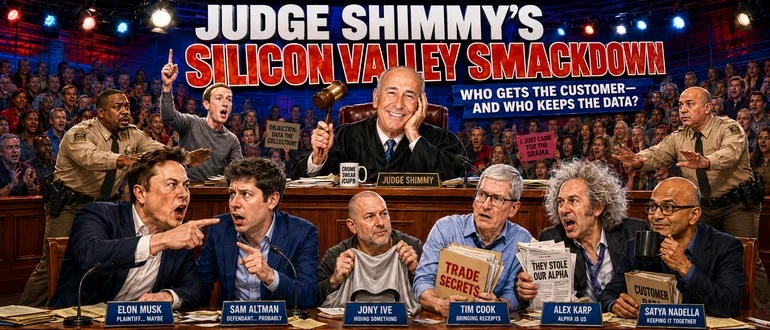
Welcome to Judge Shimmy’s Silicon Valley Smackdown, the only courtroom show where the litigants arrive in private jets, accuse one another of stealing humanity’s future and then continue the proceedings on X during the commercial break.
Today’s guests are not struggling working-class people fighting over an unfaithful partner or demanding a paternity test. They are billionaires and corporate titans fighting over former employees, trade secrets, broken partnerships, abandoned nonprofit missions, market monopolies and control of artificial intelligence. Frankly, most of them are not especially likable. That only makes for better television.
All rise. Judge Shimmy is now presiding.
The case before the court is Apple v. OpenAI and the Extended Silicon Valley Family. The clerk will please read the complaint, assuming she can get through it before someone files another one.
Apple has sued OpenAI, its io Products hardware unit and two former Apple employees, alleging that OpenAI orchestrated a campaign to acquire and exploit Apple’s confidential hardware designs, manufacturing processes and other trade secrets. Apple says more than 400 former Apple employees now work at OpenAI. OpenAI says it has no interest in anyone else’s trade secrets and remains focused on building innovative technology.
Today’s episode is called: “My AI Partner Ran Off With 400 of My Employees—and Now It Wants to Replace Me.”
Apple enters the courtroom carrying a folder full of legal papers and the quiet confidence of a company that has done this before. It invited OpenAI into the family home by integrating ChatGPT into Apple devices. Now Apple believes its former partner is building a new consumer device with help from the very people who designed the iPhone, Apple Watch and other products that made Apple the most valuable consumer technology company in the world.
This is less like discovering that your partner has been unfaithful and more like discovering that your partner has moved in with your ex, hired half your family and is opening a competing restaurant across the street using what you allege are your recipes.
The famous ex in this story is Jony Ive. He is not named as a defendant, but his presence hangs over the courtroom. Ive helped design the iMac, iPod, iPhone, iPad and Apple Watch. He later left Apple, created the design company LoveFrom and helped establish io Products with a group that included other former Apple designers. OpenAI acquired io last year in a deal valued at approximately $6.5 billion.
Sam Altman and Ive have not revealed exactly what they are building. They have described an ambition to move beyond traditional products and interfaces. Whatever the eventual device looks like, it is not difficult to understand why Apple is paying attention. If the AI model or agent becomes the primary interface between people and computing, the smartphone—and its collection of apps—may no longer sit at the beginning of every digital interaction.
Apple is not merely worried that OpenAI might build another gadget. It is worried OpenAI might build the thing that comes after the iPhone.
Apple’s complaint names Tang Tan, formerly a vice president of product design at Apple and now OpenAI’s chief hardware officer. It also names Chang Liu, a former Apple electrical engineer. Apple alleges that Tan encouraged recruits to bring Apple components to OpenAI interviews for “show and tell” sessions. In one incident described in the complaint, a candidate allegedly remarked that he did not know employees were permitted to remove the components from the office.
Judge Shimmy would now like to see Exhibit A—and perhaps check everyone’s pockets before they leave the courtroom.
OpenAI denies wanting Apple’s trade secrets. It is also important to note that hiring people from a competitor is not itself unlawful. California’s resistance to noncompete agreements is one reason Silicon Valley developed into Silicon Valley. Employees move, knowledge travels with them and companies are not entitled to own human beings simply because they once issued them a badge and a MacBook.
Trade secrets are different. If Apple can prove that confidential designs, components or manufacturing processes were improperly taken and used, OpenAI could have a serious problem. At this stage, however, these remain allegations that Apple will have to establish in court.
Still, Apple’s reaction follows a familiar script. Steve Jobs once declared “thermonuclear war” on Android, which he considered a stolen product. Apple subsequently spent years battling Samsung and other smartphone competitors over patents and product designs. When Apple believes someone is threatening the family business, it does not throw a chair. It throws a federal complaint.
Apple may have legitimate trade-secret claims. The litigation also creates a strategic benefit. A lawsuit can slow OpenAI’s hardware program, complicate recruiting, frighten suppliers, distract executives and make every design decision subject to scrutiny. Even if Apple does not stop the product, it may be able to make the journey considerably more expensive.
Before OpenAI can answer, the courtroom doors swing open and Elon Musk charges down the aisle. Nobody called him as a witness, but that has never stopped him from joining a fight involving Sam Altman.
Musk and Altman co-founded OpenAI in 2015. The relationship later collapsed amid disagreements over control, funding and the organization’s direction. Musk eventually created xAI as a direct competitor and sued OpenAI and its leadership, alleging that they had betrayed the organization’s original nonprofit mission. Musk lost that case at trial, although he has said he will appeal.
In the Springer version, this is the disputed-paternity portion of the program. Musk and Altman both claim a special relationship with OpenAI’s origin story, original mission and moral legitimacy. Each believes the other betrayed the family.
Judge Shimmy will not be ordering a DNA test for ChatGPT today, although at this point it might clear up a few things.
Following Apple’s lawsuit, Musk returned to X and repeatedly called Altman “Scam Altman.” He accused Altman of stealing an open-source AI charity and then stealing Apple’s phone technology. Altman fired back that Musk was the one selling public-market investors on short-term space data centers. Musk responded that SpaceX would begin flying them next year and joked about whether Altman’s “parole officer” would allow him to visit.
For the record, these are not lines invented for the parody. These are substantially the arguments being made by executives responsible for companies valued in the hundreds of billions, and potentially trillions, of dollars. The bailiff moves closer. He is instructed not to touch anyone carrying a rocket company.
At this point, Alex Karp enters the courtroom as an expert witness. Karp announces that he is not there to “throw shade” at the model companies. He then proceeds to block out the sun.
The Palantir CEO says AI models have been “completely, irresponsibly, oversold.” He says enterprises are livid about paying for tokens that create little or no value while potentially surrendering their intellectual property and competitive “alpha” to AI providers. When a CNBC interviewer suggested that Karp sounded angry, he insisted that he was merely channeling the voice of American business.
That is precisely what every calm and disinterested guest says immediately before security forms a semicircle around the stage.
Karp’s argument deserves to be taken seriously. Enterprises are beginning to ask harder questions about the value they receive from their AI spending, what happens to the information they feed into models and whether the companies operating those models can learn from their most valuable knowledge.
Karp is not exactly a neutral witness, however. Palantir benefits from positioning foundation models as interchangeable components while Palantir provides the application, governance, data and operational layer around them. His position is that enterprises should retain control of their data and competitive alpha—and that Palantir can help them do it.
Judge Shimmy appreciates the testimony but reminds the witness that promoting your own platform while accusing everyone else of taking the customer’s data is still promoting your own platform.
Now Satya Nadella takes the stand. Nadella plays the soft-spoken, enormously wealthy uncle who helped finance the entire family enterprise but has recently become concerned about what the children intend to do with everyone else’s property.
Microsoft is one of OpenAI’s most important financial and infrastructure partners. It supplied the computing power, capital and commercial distribution that helped transform OpenAI from a research laboratory into one of the most influential companies in the world. Yet Nadella is now warning that a small number of AI giants cannot be allowed to concentrate too much knowledge and power, commoditize entire industries or “eat the economy.”
His argument contains an even more fundamental challenge to the model companies. An AI provider cannot charge an enterprise to use its model and then also use the enterprise’s data, knowledge and intellectual property to make that model—and potentially the provider itself—more valuable. The customer cannot be both the paying customer and the unpaid supplier of the raw material.
Judge Shimmy s the proceedings. Even this courtroom understands that when you pay for dinner, the restaurant does not ordinarily get to follow you home and empty your refrigerator.
This is the reverse information paradox. Companies pay AI providers for access to intelligence, but that intelligence becomes far more useful when connected to the company’s proprietary data, institutional knowledge and accumulated experience. If that information subsequently improves the provider’s models, products or competitive position, the enterprise has effectively paid someone to extract part of its advantage. The vendor collects the subscription revenue, the customer supplies the valuable context and the distinction between customer and product begins to disappear.
Nadella’s warning is especially revealing because Microsoft helped create the conditions that enabled OpenAI’s rise. It also exposes the growing divide between model providers and the platforms sitting closer to enterprise customers. Microsoft increasingly advocates a multi-model world in which companies control their own data, preserve their institutional knowledge and choose among models rather than surrendering themselves to one.
Uncle Satya makes a compelling case. Judge Shimmy has only one question: Is Microsoft protecting enterprises from the model companies, or has Frankenstein’s monster escaped the lab and become a threat to the company that helped bring it to life?
Microsoft wants enterprise AI consumption to occur through Azure, Microsoft 365, Copilot and its expanding agent ecosystem. It does not want OpenAI—or any other model provider—using Microsoft’s customers and their data to build a direct relationship that makes Microsoft less important. Nadella’s principle may be sound, but it also maps rather conveniently to Microsoft’s commercial interests.
The witness may answer after conferring with counsel.
By now, the original Apple lawsuit has become almost incidental. Everyone is talking at once. Apple says OpenAI took its people and perhaps its secrets. Musk says Altman took OpenAI’s nonprofit mission. Altman says Musk is selling dreams about orbiting data centers. Karp says the model companies are taking enterprise alpha. Nadella says the customer cannot be charged for the model and then mined for the data that makes it valuable.
Order in the court.
Judge Shimmy has heard enough about who stole whose engineers, who betrayed whose nonprofit and who called whom a scammer. The court wants answers to two more important questions: Who gets custody of the customer, and who keeps the data?
That is the real dispute beneath the spectacle.
Apple wants the customer inside its privacy-protected walled garden, using Apple hardware, Apple services, Apple identity and the App Store. OpenAI wants a direct and continuous relationship with the customer through the model, the agent, accumulated memory and whatever device it is building with Ive. Microsoft wants enterprise knowledge connected to its cloud, productivity applications, copilots and agents. Palantir says customers must retain their data and competitive alpha while offering itself as the platform through which that control can be exercised. Musk wants users within an expanding X, xAI and SpaceX orbit.
Everyone says the data belongs to the customer. Everyone is building an ecosystem that becomes far more valuable when the data never really leaves.
The contested property is not simply a collection of files sitting in a database. It is our conversations, preferences, behaviors, histories, relationships and personal context. For businesses, it is institutional knowledge, intellectual property, workflows, customer information and the accumulated experience that distinguishes one company from another.
The model can be replaced. The infrastructure may be commoditized. The tokens will probably become cheaper. The company that owns the interface through which intelligence is consumed, however, has an opportunity to own the customer relationship. The company that retains the customer’s data and accumulated context may possess the more durable advantage.
The customer cannot be charged for the model, mined for the data and then told that both are necessary parts of the service. At some point, Judge Shimmy needs to determine who is paying whom.
This court is therefore ready to rule.
Custody of the customer is awarded to the customer. The data goes with them. Every company is ordered to provide genuine portability, explain what it collected, disclose what it retained and offer a practical way for customers to leave without abandoning years of accumulated knowledge and context.
Apple immediately appeals. OpenAI files a competing motion. Microsoft requests clarification. Palantir offers to manage the court’s data. Musk posts that the judge is compromised and announces plans to build a better court on Mars.
Wait—is that Zuck standing up in the audience? Does he have something to say?
Oh, for God’s sake.
Court adjourned.
Bailiff, please escort the billionaires back to X.