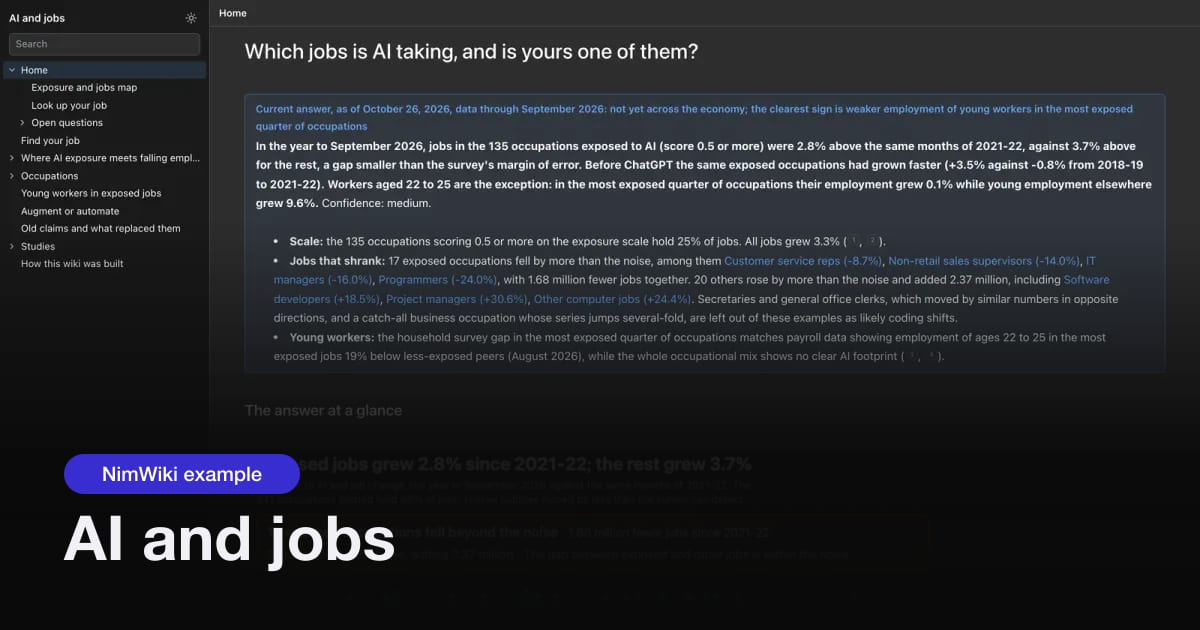
We had Claude Code build a wiki on one question, which jobs AI is taking, from Census survey data through September 2026. The answer so far, how it was built, and how to look up your own job.
There is no shortage of opinions on which jobs AI is taking. We wanted an answer we could check, so we had Claude Code build a wiki on that one question from the government’s own jobs data, and we refresh it as each new month of data comes out.
The result is the AI and jobs wiki, one of the example wikis on NimWiki. Here is what it says as of October 26, 2026, with data through September 2026.
The answer so far #
Not yet across the economy. In the year to September 2026, jobs in the 135 occupations most exposed to AI were 2.8% above the same months of 2021-22. Jobs in every other occupation were 3.7% above. The gap is smaller than the survey’s margin of error, and before ChatGPT the same exposed occupations had been growing faster than the rest.
The clearest sign is among young workers. In the most exposed quarter of occupations, employment of workers aged 22 to 25 grew 0.1%, while young employment elsewhere grew 9.6%. Payroll data from Stanford’s Digital Economy Lab show the same pattern.
Some exposed jobs did shrink. Seventeen of the 135 fell by more than the survey can detect, including customer service representatives (down 8.7%) and computer programmers (down 24%), while 20 others rose by more than the noise. Low-exposure occupations moved in both directions too: 13% of exposed occupations fell beyond the noise against 7% of the rest, and similar shares of each grew. The wiki rates its confidence as medium, because the survey is small for single jobs, the exposure scores date from 2023, and no source isolates AI as the cause.
Is yours one of them? #
The wiki’s Home page has a search box covering 513 occupations by title or common job title. Find your job shows pay and exposure scores, and each occupation has its own page. A map of every occupation, sized by jobs, shows where yours sits next to the rest.
How the wiki was built #
Every number is computed by a script from files saved in the project: the Census Current Population Survey monthly files from October 2018 to September 2026, BLS employment projections and AI exposure categories, exposure scores from the “GPTs are GPTs” paper, and the Anthropic Economic Index. Nothing is typed from memory, and one command reruns the pipeline when Census posts a new month.
The wiki also lists what would change its answer, each tied to a dated release: the October jobs report and Census microdata in early November, the next Challenger layoff report, and the BLS 2026-36 projections in 2027. When one of those lands, the answer gets a new date.
See it and the other examples #
Open the AI and jobs wiki. Built a wiki on a strategy question? See more examples at NimWiki, including Is NVIDIA’s financing buying demand or borrowing it? and Who predicted AI right?
Related posts #
-
Architecture Decision Records Written by Your Coding AgentHow to keep architecture decision records and a decision log when Claude Code and Codex make decisions faster than anyone writes them down: the agent records each decision in the page it affects, with who decided, when, what was rejected and a quote from the session.
-
How to Keep a Project Wiki with Claude CodeInstall the free Nimbalyst Wiki plugin in Claude Code, run setup, and Claude writes a markdown wiki of your decisions, open questions and tracked items in your repo, which you read and edit in your browser.
-
Overwhelmed Working with Coding Agents? Have Them Write You a WikiRunning several Claude Code or Codex sessions produces more decisions and open questions than one person can track. Here is the approach we use: the agents distill their work into a short wiki for you, and you read, think and set direction.