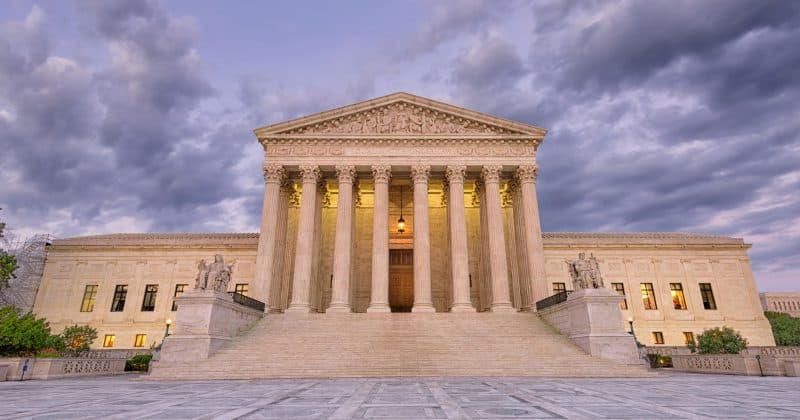
The Supreme Court's 6-3 ruling shifts tariff authority back toward Congress and elevates the USTR's role, with ripple effects already hitting crypto markets.
The Supreme Court just redrew the map on who gets to set tariffs in the United States.
In a 6-3 decision handed down on February 20, 2026, the Court ruled in Learning Resources, Inc. v. Trump that tariffs imposed under the International Emergency Economic Powers Act (IEEPA) were unconstitutional. The core reasoning: tariff authority belongs to Congress, not to the executive branch operating under vaguely defined emergency powers. The ruling effectively neutered one of the administration’s most aggressive trade tools and handed the baton to the Office of the US Trade Representative, led by Ambassador Jamieson Greer.
What actually changed #
The president didn’t lose all tariff power. He lost the ability to use IEEPA as a blank check for trade policy.
In its place, the USTR is now running the show through Section 301 of the Trade Act of 1974, a more traditional and legally grounded mechanism for investigating and responding to unfair trade practices. Ambassador Greer has already initiated multiple Section 301 probes involving over 15 countries and the European Union, with investigations centered on forced labor and other trade violations.
President Trump, for his part, announced alternative tariffs of 10-15% on global imports following the ruling, this time leveraging different statutory authorities.
Section 301 investigations require formal processes, evidence gathering, public comment periods, and bilateral negotiations. That’s a far cry from the executive-order-driven tariff blitzes that characterized the IEEPA approach.
Why crypto cares about trade law #
Bitcoin experienced a sharp price fluctuation in the immediate aftermath of the Court’s decision. The price initially rose approximately 2% before retreating below $65,000.
The IEEPA tariffs were unpredictable by design. They could appear overnight, targeting any country or product category with minimal warning. With the shift to Section 301 investigations, the timeline for new tariffs becomes more transparent. Probes take months. Negotiations take longer.
The bigger picture for investors #
The USTR is now the central node for US trade enforcement, and Ambassador Greer’s office is staffing up accordingly. The March 2026 initiation of Section 301 probes across more than 15 countries represents one of the most ambitious trade investigation campaigns in recent memory.
The 10-15% alternative tariffs announced by Trump are worth watching closely. These are being implemented under different statutory frameworks, and legal challenges are already forming. Some trade lawyers expect cases targeting these new tariffs under Section 122 of the Trade Act to reach the courts within months.
Bitcoin’s retreat below $65,000 after the initial pop suggests that traders haven’t figured out whether this shift is net positive or negative for risk assets. Each probe conclusion, each bilateral negotiation breakdown, each retaliatory measure from a trading partner becomes a potential catalyst.
Disclosure: This article was edited by Editorial Team. For more information on how we create and review content, see our