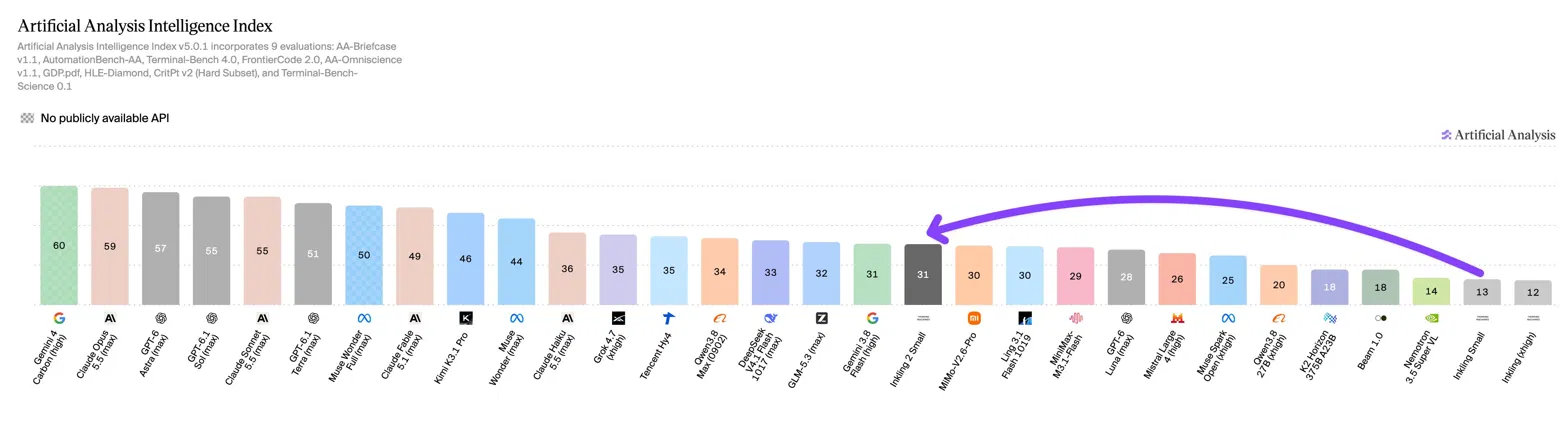
Mira Murati’s Thinking Machines Lab has put out Inkling 2 Small, and the model has jumped straight to the top of the pack among models built outside China, scoring 31 on the Artificial Analysis Intelligence Index v5.0.1. The company’s plan to eventually release the model’s weights would make it the highest-scoring open-weights model developed outside China based on current rankings, according to Artificial Analysis.
Unlike the original Inkling, which launched with full weights available from day one, Inkling 2 Small is starting out as a proprietary model. It’s available first through Thinking Machines’ Tinker platform and the Tinker Playground, with a full weight release planned for later under what the company has said will again be an Apache 2.0 license.
Inking 2 Small Benchmarks #
The scale of the improvement over Inkling Small is hard to miss. The new model’s score is up 18 points from its predecessor, and it gets there while generating roughly four times as many output tokens per task. That puts it level with Google DeepMind’s Gemini 3.8 Flash (high) and ahead of Xiaomi’s MiMo-V2.6-Pro on the index.
The gains are sharpest on agentic and long-horizon work. AutomationBench-AA rises from 5% to 46%, FrontierCode 2.0 climbs from 5% to 25%, and HLE-Diamond moves from 12% to 29%. On AA-Briefcase, which tests long-horizon business workflows involving spreadsheets, presentations, and memos, Inkling 2 Small scores 1,527 Elo against 912 Elo for Inkling Small, and also clears Claude Sonnet 5.5 (medium) at 1,439 Elo and Gemini 3.8 Flash (high) at 1,203 Elo. It passes half of all rubric checks, up from a fifth for Inkling Small.
Coding is more of a mixed bag. Inkling 2 Small scores 25% on FrontierCode 2.0 against 11% for Claude Sonnet 5.5 (medium), but falls to 13% on Terminal-Bench 4.0 versus 30% for Anthropic’s model, suggesting the two take fairly different approaches to coding tasks.
On creative agentic work, Inkling 2 Small scores above Claude Haiku 5.5 and Grok 4.7 on the AA-3D benchmark, and also edges out Gemini 3.8 Flash on both AA-3D and Code2Video-AA, though it still trails Claude Sonnet 5.5 on those same tests. Against its own predecessor, Inkling (xhigh), the jump is steep: 438 Elo higher on AA-3D and 553 Elo higher on Code2Video-AA.
Research-level physics also improved, with Inkling 2 Small scoring 56% on CritPt v2, up from 34% for Inkling Small, though that still sits behind Gemini 3.8 Flash (high) at 65%.
Fewer Hallucinations, But Mostly By Answering Less #
On AA-Omniscience v1.1, Inkling 2 Small’s hallucination rate drops sharply, from 61% for Inkling Small down to 27%. But Artificial Analysis notes that most of that improvement comes from the model simply attempting fewer questions, with its attempt rate falling from 77% to 53%. Accuracy only edges up from 32% to 34%, leaving its net score at 16, still behind Gemini 3.8 Flash (high) at 23 and Claude Sonnet 5.5 (medium) at 19.
Verbose And Pricier To Run #
Inkling 2 Small is a notably heavy thinker. It averages around 150,000 output tokens per Intelligence Index task, compared to about 37,000 for Inkling Small, 31,000 for Claude Sonnet 5.5 (medium), and 99,000 for Gemini 3.8 Flash (high). That verbosity shows up in the bill: at $1.18 per Intelligence Index task, it costs almost six times what Inkling Small did, though it still comes in cheaper than Gemini 3.8 Flash (high) at $7.77 and Claude Sonnet 5.5 (medium) at $10.02 for similar scores.
Token pricing is set at $0.30 per million input tokens and $1.00 per million output tokens, with cached input tokens priced at $0.03 per million.
Inkling 2 Small Model Details #
Inkling 2 Small is a 594-billion-parameter model with 17 billion active parameters, taking text and image input and producing text output. It launches as a proprietary reasoning model available through Tinker, with Thinking Machines saying a full weights release under an open license is still to come, as it was for Inkling before it.
The company thanked Nvidia for its support on the release, alongside partners who helped test and benchmark the model, continuing a partnership between the two that dates back to earlier this year. Thinking Machines has framed Inkling 2 Small as one more step toward its broader goal of building customizable intelligence that organizations can fine-tune and deploy on their own terms, rather than renting access to someone else’s model.