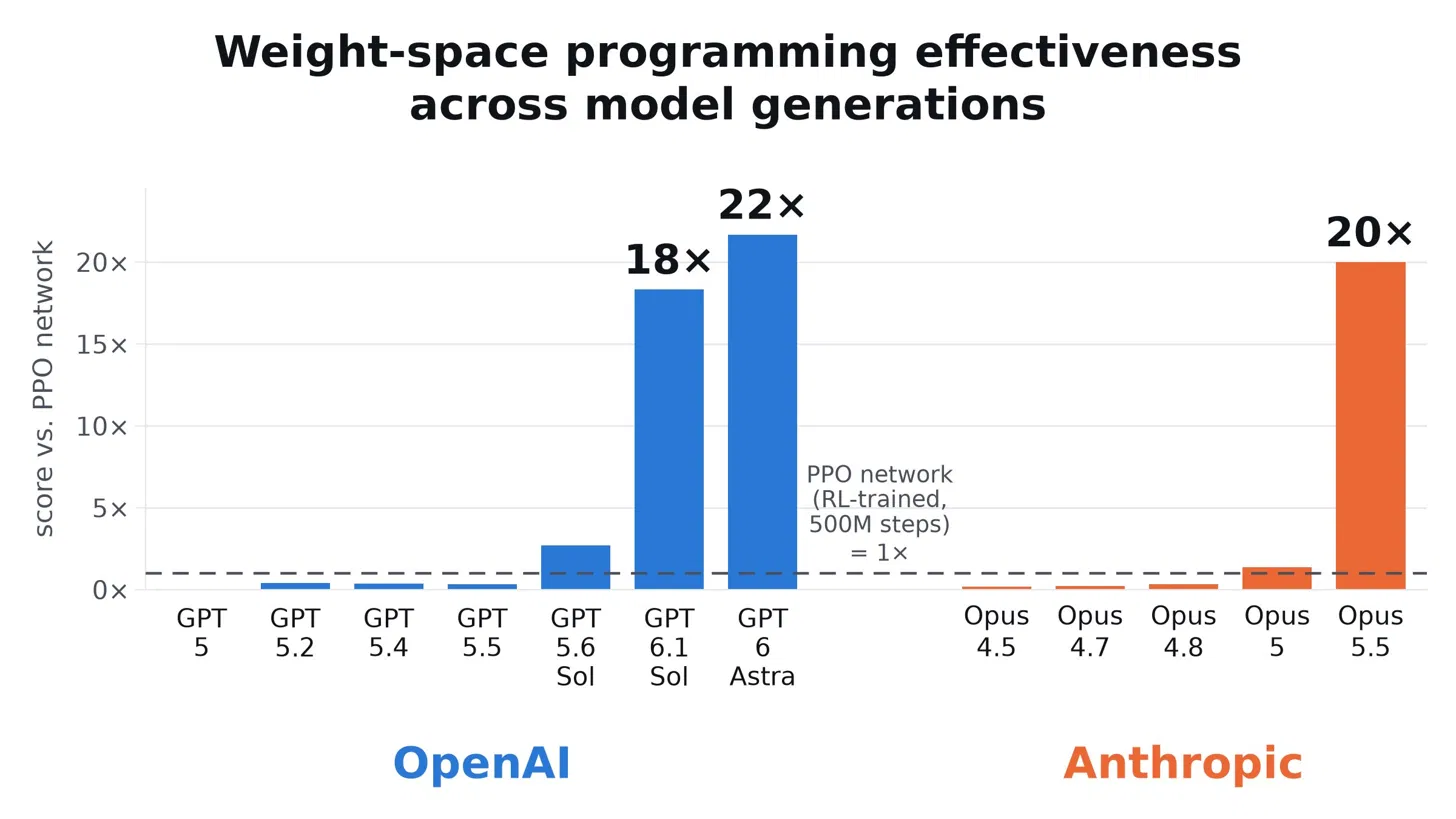
A Google Research scientist says he has independently reproduced the results of a widely discussed MIT CSAIL blog post on “Weight-Space Programming” — the discovery that frontier AI models can read and rewrite a neural network’s raw weights by hand, without training — and found something the original post didn’t test for: the ability only shows up in the newest generation of models, and it wasn’t there even a few versions ago.
Who’s making the claim #
The claim comes from Alex Krentsel, an autonomous systems PhD at UC Berkeley and senior researcher at Google Research, who is also known for building Exo, an open-source agent harness designed around the idea of letting an AI agent safely rewrite its own code at runtime. In a post on X, Krentsel said he reran Experiment 5 from the MIT blog post — where a model is handed the blank, all-zero weights of a small neural network and the rules of the Atari game Breakout, and has to write a complete, working set of around 20,000 weights in a single reply, with no training and no tools — across multiple generations of both OpenAI and Anthropic models, using the same prompts and scoring the original researchers used.
What the chart shows #
Krentsel’s results, plotted against a traditionally-trained reinforcement learning network (trained with PPO for 500 million steps, set as the 1× baseline), show a sharp, discontinuous jump rather than a gradual climb. Earlier models in both families — GPT-5 through GPT-5.5 on the OpenAI side, and Opus 4.5 through Opus 4.8 on the Anthropic side — score close to zero, essentially unable to write a working Breakout-playing network from scratch. The capability then appears abruptly: GPT-5.6 Sol manages roughly 2-3× the PPO baseline, before jumping to 18× with GPT-6.1 Sol and 22× with GPT-6 Astra, the same model MIT’s researchers used in their original post. On Anthropic’s side, the jump is just as sudden — Opus 4.5 through 4.8 barely register, Opus 5 inches just above the baseline, and Opus 5.5 leaps to 20×.
Why Krentsel thinks this matters #
Krentsel frames this less as a one-off curiosity and more as a new, emergent capability — the kind of step-change that tends to get attention precisely because it doesn’t scale smoothly with model size or benchmark scores the way most capabilities do. His read is that this is actually a continuation of a much older line of interpretability work from the 2010s, the kind where researchers would manually inspect individual neurons in small networks and label them by hand — “this neuron lights up when the image contains a dog, so this is the dog neuron.” That process scaled, with tooling, to networks with maybe a thousand nodes. What Krentsel says he’s now watching happen is that general-purpose reasoning models have become capable enough to do that same kind of manual, neuron-by-neuron inspection and editing, just applied to meaningfully larger — though still comparatively small — networks, and to do it by reasoning rather than through purpose-built interpretability tooling.
The self-improvement question #
Where Krentsel goes further than the original MIT post is in connecting Weight-Space Programming to the idea of a model editing its own weights at runtime, a more direct and literal version of the kind of self-improving systems he’s been building with Exo. He’s candid that he doesn’t think this is feasible yet for today’s largest models, given the scale gap between the roughly 20,000-weight Breakout network in the demonstration and a frontier language model’s weights, which run into the hundreds of billions. But he suggests that if the trend in his chart continues across a few more model generations, closing that gap may not be far off — a prospect that sits close to the broader, ongoing conversation among researchers about recursive self-improvement moving from a theoretical milestone to something labs are already seeing early signs of, and distinct from other recent approaches that pursue self-improvement by rewriting the exploration strategy layered on top of a model rather than touching its weights directly.
The bigger picture #
If Krentsel’s reproduction holds up, it adds a useful data point to the original research: Weight-Space Programming doesn’t look like a capability that’s been quietly present in AI models all along and only recently noticed — it looks like something that wasn’t really there in GPT-6 Astra and Claude Opus 5.5’s immediate predecessors and showed up fairly suddenly. That pattern echoes a theme running through a lot of recent interpretability work out of the major labs, including efforts to isolate and name the specific internal directions inside a model’s weights that drive behaviors like sycophancy — the broader project of turning a model’s weights from an opaque block of numbers into something that can be read, labeled, and edited directly, by another model, in plain language.