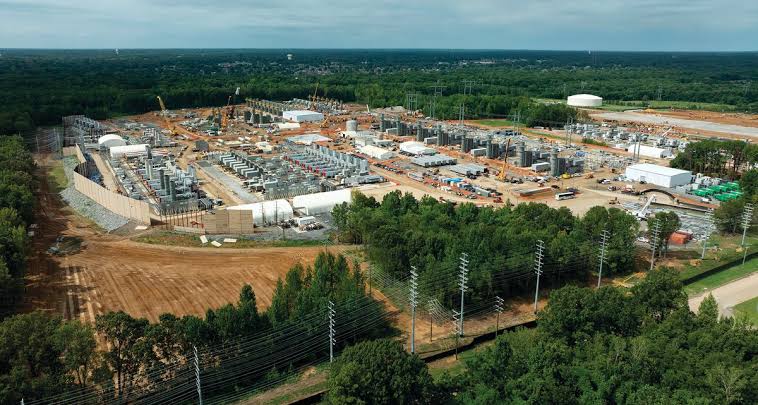
The race to build the biggest datacenters in the world has become the defining infrastructure story of the AI era. Every major AI lab — OpenAI, Anthropic, Google DeepMind, Meta, and xAI — now depends on a handful of hyperscale AI data centers that cost tens of billions of dollars and consume as much electricity as a mid-sized city. As of October 31, 2026, independent research outfit Epoch AI has ranked the world’s largest AI data centers by compute capacity, measured in H100-equivalents (H100e) — a standard unit that lets facilities running different chips (Nvidia GPUs, AWS Trainium, Google TPUs) be compared on a like-for-like basis.
Below are the 10 biggest datacenters in the world right now, ranked by compute, with a look at who owns them, who uses them, and how much they cost to build.
1. Colossus 2 — Memphis, Tennessee (xAI) #
Colossus 2 is, by a wide margin, the biggest datacenter in the world by compute as of October 2026. Owned by Elon Musk’s xAI (under the entity SpaceXAI), the Memphis facility currently runs an estimated 1.1 million H100-equivalents of compute, with capacity projected to climb toward 1.8 million H100e as buildout continues. It draws roughly 946 megawatts of IT power and has cost an estimated $35.8 billion so far, running on Nvidia’s B200 and B300 chips. Colossus 2 isn’t just an xAI facility anymore — Anthropic signed a deal to lease compute capacity from xAI’s Colossus data centers, a surprising tie-up given the two companies’ rivalry, and coding tool Cursor also draws on the site. The original Colossus 1 facility, also in Memphis, is now fully leased out to Anthropic.
2. Anthropic-Amazon New Carlisle — Indiana (Amazon) #
Amazon’s Project Rainier campus in New Carlisle, Indiana is the second-biggest datacenter in the world by compute, and currently the single largest AI data center on Earth by power draw, at over 1,000 megawatts of IT power. Built specifically to train and run Anthropic’s Claude models, the site runs on Amazon’s own Trainium2 chips rather than Nvidia GPUs, reflecting Amazon’s bet on vertically integrated AI silicon. The campus is expected to eventually span 30 buildings and cost upward of $35 billion. It’s a critical piece of the compute backbone behind Anthropic, whose rapid growth under CEO Dario Amodei has made the company one of the most closely watched in AI.
3. Microsoft Fairwater Atlanta — Georgia (Microsoft) #
Microsoft’s Fairwater campus in Atlanta, Georgia hosts an estimated 769,000 H100-equivalents of compute, backed by 636 megawatts of IT power and roughly $24.1 billion in capital investment. Fairwater Atlanta works in tandem with Microsoft’s other Fairwater site in Wisconsin (see below) to form what Microsoft calls an AI “superfactory,” designed to train frontier models at a scale previously unseen in cloud computing. OpenAI has historically been the primary beneficiary of Microsoft’s AI infrastructure, though that relationship has evolved as OpenAI increasingly builds and leases capacity of its own through Stargate.
4. OpenAI Stargate Abilene — Texas (Oracle / OpenAI) #
Stargate’s flagship site in Abilene, Texas was the first physical manifestation of OpenAI’s $500 billion Stargate infrastructure push with Oracle and SoftBank. The Abilene datacenter currently runs an estimated 509,000 H100-equivalents of compute on Nvidia’s B200 and B300 chips, drawing about 421 megawatts of power, at a cost of roughly $15.9 billion. It remains the only Stargate site that’s even partially operational, though OpenAI and Oracle have since announced five additional Stargate campuses across Texas, New Mexico, Ohio and the Midwest, pushing the project’s total planned capacity toward 7 gigawatts.
5. Google Pryor (North) — Oklahoma (Google) #
Google’s Pryor, Oklahoma facility is one of the company’s oldest and most important AI compute hubs, hosting several hundred thousand H100-equivalents of compute powered by Google’s custom Tensor Processing Units (TPUs) rather than Nvidia GPUs. The site draws roughly 368 megawatts of IT power and has cost an estimated $13.9 billion to build out. Compute at Google Pryor is believed to primarily serve Google DeepMind’s training workloads. Google’s TPU strategy has increasingly paid off for the company — the search giant recently even ran TPU inference from space under Project Suncatcher, a sign of how aggressively it’s pushing its custom silicon beyond conventional data centers.
6. DayOne Nusajaya — Johor Bahru, Malaysia (DayOne / GDS) #
DayOne Nusajaya is the largest AI data center outside the United States and a sign of how far the AI data center race has spread beyond American soil. Located in Johor Bahru, Malaysia, the facility is operated by data center firm DayOne (part of GDS Holdings) and hosts hundreds of thousands of H100-equivalents of compute, backed by roughly 473 megawatts of IT power. The Nusajaya campus has become a key piece of Southeast Asia’s AI infrastructure buildout, and reports have linked Chinese AI firms, including Alibaba and ByteDance, to training activity at data centers in the region — a workaround some believe is tied to US chip export restrictions.
7. Meta Prometheus — New Albany, Ohio (Meta) #
Meta’s Prometheus supercluster in New Albany, Ohio is one of the most unusual entries among the biggest datacenters in the world — a sprawling, ad hoc buildout of traditional data center buildings, colocation facilities, and even weatherproof tents, all stitched together to get Meta’s AI compute online faster. Prometheus currently hosts an estimated 763,000 H100-equivalents of compute on Nvidia B200 chips, drawing 631 megawatts of power at a cost of roughly $23.9 billion, with Meta targeting a full 1 gigawatt of capacity at the site. Mark Zuckerberg has described Prometheus as one of the first gigawatt-scale AI superclusters in the world, positioning Meta to compete directly with OpenAI, Google DeepMind and Anthropic on raw training capacity.
8. DayOne Kempas — Johor, Malaysia (DayOne / GDS) #
Just down the road from Nusajaya, DayOne’s Kempas campus in Johor, Malaysia is the second Malaysian facility to crack the top 10 biggest datacenters in the world, underlining just how much AI compute capacity is now concentrated in this corner of Southeast Asia. Kempas currently runs an estimated 368,000 H100-equivalents of compute, with that figure projected to climb to 481,000 as more buildings come online. Together, DayOne’s Nusajaya and Kempas campuses draw close to 400 megawatts of power “in service,” making the combined Johor cluster one of the largest AI compute hubs anywhere outside the US.
9. Microsoft Fairwater Wisconsin — Mount Pleasant, Wisconsin (Microsoft) #
Microsoft’s original Fairwater facility in Mount Pleasant, Wisconsin — which Microsoft has called the world’s most powerful AI data center at the time of its launch — hosts an estimated 559,000 H100-equivalents of compute, backed by 555 megawatts of IT power and around $17.7 billion in investment. Operated jointly with OpenAI in mind, Fairwater Wisconsin works alongside the newer Atlanta campus as part of Microsoft’s broader AI superfactory strategy. Microsoft’s data center spend has been a major factor in the eye-watering AI infrastructure numbers being thrown around industry-wide, even as the relationship between Anthropic and OpenAI’s respective cloud backers continues to shift.
10. Google Columbus — Columbus, Ohio (Google) #
Rounding out the list of the 10 biggest datacenters in the world is Google’s Columbus, Ohio facility, which hosts an estimated 409,000 H100-equivalents of compute, up sharply from 215,000 just months earlier, with projections pointing toward 707,000 H100e as the buildout continues. The site runs across multiple generations of Google’s custom TPU hardware — v5e, v5p, v6e and the newest v7 chips — and draws 303 megawatts of IT power at an estimated cost of $11.5 billion. Columbus sits inside Google’s broader central-Ohio AI compute cluster, which shares a business park with Meta’s Prometheus campus, making this stretch of Ohio one of the single densest concentrations of AI data center capacity on the planet. Google’s data center investments have paid off handsomely as AI reshapes its business — notably, Search recently fell below 50% of Google’s total revenue for the first time ever.
Why The Biggest Datacenters In The World Keep Getting Bigger #
What’s striking about this list of the biggest AI data centers in the world is how recent nearly all of it is — virtually every facility here either didn’t exist or was a fraction of its current size just two years ago. The scale of investment is staggering: the 10 largest AI data centers alone represent well over $200 billion in combined capital expenditure, and that figure is climbing every quarter as xAI, Amazon, Microsoft, OpenAI, Google and Meta race to out-build each other.
It’s also worth underlining that these figures, sourced from Epoch AI’s independent AI data centers tracker, are estimates built from satellite imagery, permit filings, and public disclosures rather than official specifications — so the exact ranking and numbers shift as new data comes in and these mega-projects keep expanding. What won’t change anytime soon, though, is the underlying trend: whoever controls the biggest datacenters in the world increasingly controls the pace of AI progress itself.
Compute, power and cost figures are sourced from Epoch AI’s AI Data Centers database, current as of late October 2026.