The software industry has largely solved the human authoring bottleneck in Rust. Generative AI and automated translation agents can now write memory-safe code in seconds. But this unprecedented velocity has exposed a much harsher reality: we are colliding with the limits of compiler physics.
Over the last three years, Rust has aggressively evolved from a promising systems language into the foundational backbone of enterprise infrastructure. Today, over 2.26 million developers use Rust, and nearly 50% of surveyed organizations run non-trivial Rust workloads in production.
The industry tolerates the steep learning curve because the business ROI is absolute: Google’s Android team systematically migrated memory-critical subsystems to Rust and dropped vulnerability density by a factor of 1,000 – from 200 down to an astonishing 0.2 CVEs per million lines of code. AWS architected Firecracker in Rust to deliver microVM boot times under 125 milliseconds. Microsoft is neutralizing the root cause of 70% of Windows kernel vulnerabilities, and Cloudflare is processing over 40 million edge requests per second via its Pingora proxy.
But as Rust transitions from isolated services into massive, multi-team monorepos, a severe operational tax emerges. According to JetBrains, 46% of developers report that small-change rebuilds are a major problem, and 25% of organizations identify Rust CI build times as a primary blocker to shipping software.
Important note: The industry is obsessed with optimizing rustc in isolation. But treating enterprise build performance as a language-specific compiler problem is an engineering trap. If you are only looking at Cargo, you are already losing.
Here is the data-driven reality of what happens when Rust gets big, and how principal engineers are fundamentally restructuring their pipelines to survive it.
The Physics of the Stall: The Foundational Crate Cliff #
In a small Rust project, cargo build is delightful. At enterprise scale, it is a sequential bottleneck governed by three inescapable compiler mechanics:
- Procedural Macro Expansion: Heavy frameworks (Serde, Tokio) execute arbitrary Rust code at compile time, creating a single-threaded serial execution gate that starves downstream compilation.
- Monomorphization: Rust achieves zero-cost abstractions by generating specialized machine code for every generic type instantiation, inflating LLVM IR and spiking local CPU and RAM pressure.
- Link-Time Optimization (LTO): Final binary synthesis requires cross-crate optimization passes that are heavily memory and single-thread constrained.
These mechanics mean that in large workspaces, build performance is not governed by the size of your code change, but by its location in the Directed Acyclic Graph (DAG).
Benchmarking Bevy: To illustrate this, we benchmarked the Bevy game engine. Bevy is a refreshingly simple, data-driven game engine built in Rust. It serves as a great benchmark for large Rust projects because its monorepo consists of 64 heavily interdependent crates covering everything from complex ECS (Entity Component System) logic to math, rendering, and UI. As a pure Rust project, Bevy demonstrates how a large Rust codebase behaves.
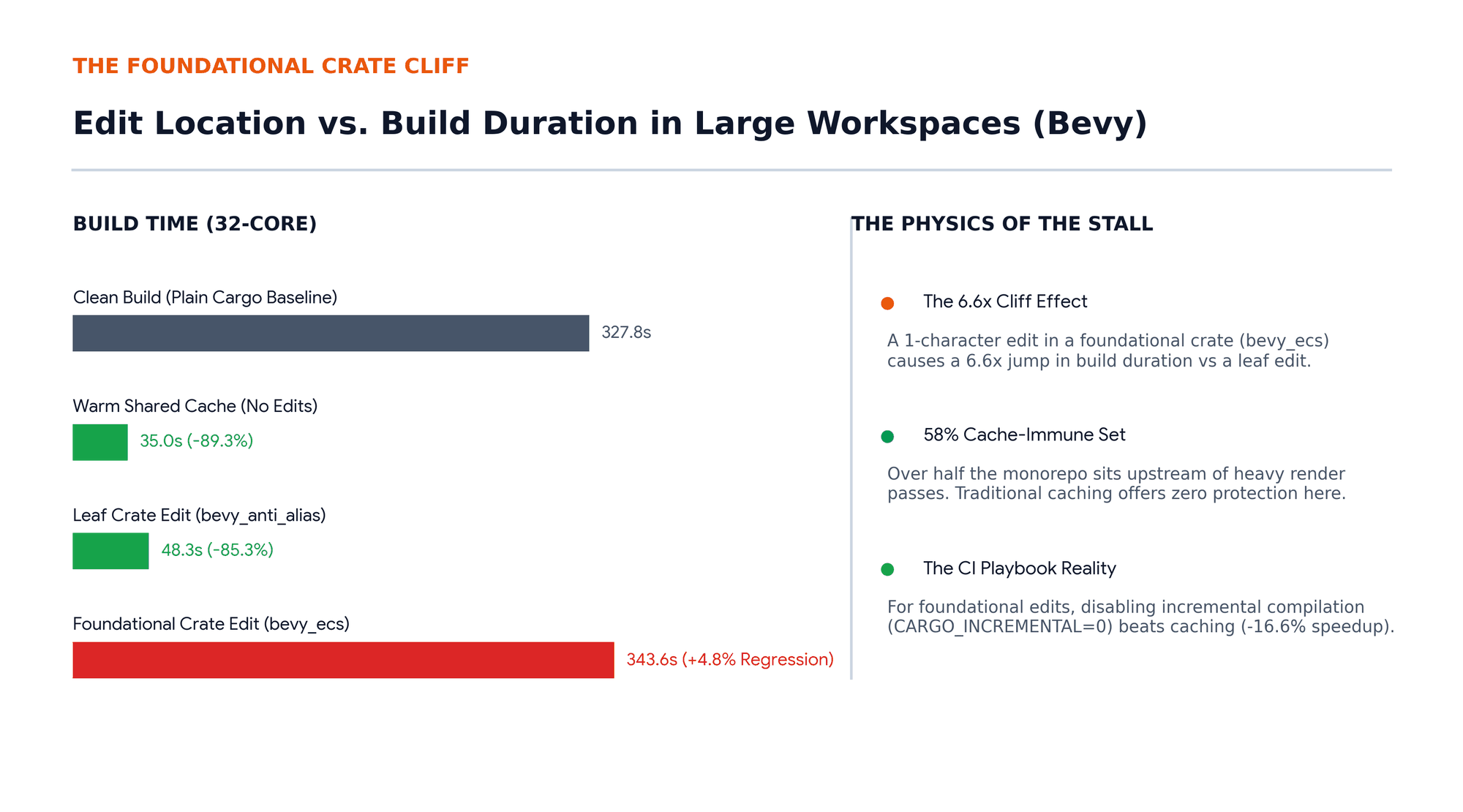
Empirical benchmarks on the Bevy workspace reveal a stark reality known as the Foundational Crate Cliff.
On a warm shared cache, a clean build takes 35.0s. If a developer makes a single-character edit to a leaf crate (bevy_anti_alias), the build takes 48.3s, preserving an 85% cache speedup.
However, making that exact same single-character edit to a foundational crate (bevy_ecs) invalidates 33+ downstream dependencies. Because massive downstream crates like bevy_pbr (170s compile) are forced to rebuild, the edit causes a 6.6x jump in build duration to 343.6s. This is a +4.8% regression compared to having no cache at all.
In the Bevy workspace, 58% of all crates sit in this cache-immune upstream regime. If your architecture relies heavily on core foundational crates, traditional local caching provides zero protection against the critical path.
The Wrapper Fallacy: More controversially, attempting to solve this foundational crate cliff with standard language-level compiler wrappers (like sccache) frequently results in a net negative. In rigorous benchmarking across eight different Bevy edit scenarios, sccache produced a net performance regression in all 8 cases, running +6.8% to +11.5% slower than plain cargo. Why? Because non-cacheable proc-macro and binary targets trigger cascading misses down the graph, forcing the wrapper to repeatedly execute expensive sequential compiles while adding its own overhead.
The Polyglot Trap #
Unlike Bevy, a pure Rust project, enterprise Rust almost never compiles in a vacuum, and Rust is rarely the only language used. The Android Open Source Project (AOSP) version 17 perfectly illustrates this polyglot reality.
Between AOSP 15 and AOSP 17, rustc invocations surged by 61% as Rust aggressively swallowed legacy C/C++ subsystems. Yet rustc sits inside a colossal execution graph containing over 81,000 clang invocations, thousands of JVM tasks, and over 23,000 custom AIDL code generators. This equates to 120,000 total task invocations across 20 different tools.
If your build acceleration tooling only accelerates C++, your pipeline will hit a hard wall. Benchmarks show an unaccelerated 16-core AOSP build takes 232 minutes. Accelerating only C++ compilation drops build time to 69 minutes, but stalls permanently because rustc, javac, and IDL generators become the new single-threaded bottlenecks.
To break the polyglot wall, enterprise teams must abandon tool-specific wrappers in favor of generic acceleration. By accelerating the entire build tree through process distribution and shared caching that handles all 20 tools AOSP consists of – including clang, rustc, javac, and bespoke scripts – build times drop to a manageable 17 minutes, an 84% reduction.
The AI Code Generation Paradox #
This infrastructure gap is currently colliding with the ultimate velocity multiplier: Generative AI.
Today, according to recent surveys, more than 78% of Rust developers use AI coding assistants, and programs like DARPA TRACTOR are using LLMs paired with formal analysis to automatically translate massive legacy C codebases into idiomatic Rust.
AI has effectively eliminated the human authoring friction that historically slowed Rust adoption. But this introduces the AI Code Generation Paradox:
AI accelerates typing, but it actively weaponizes compiler physics against your CI/CD pipelines. Leading automotive companies are already projecting their build workloads to increase by 500% in 2026 due to autonomous coding agents.
The Engineering Playbook: Actionable Mechanics #
Developers do not experience rustc in isolation; they experience a 4-stage iteration loop: Dependency Checks, Multi-Language Compilation, Link/LTO Passes, and Test Suite Validation. Accelerating compilation alone is a local maximum.
If your organization is scaling Rust, here is the technical playbook required to restructure your pipeline:
- Pre-evaluate workspace depth: Stop guessing about cache effectiveness. Run
cargo tree -p <expensive_crate> -e normalto map upstream dependencies. If over 50% of your workspace sits upstream of core crates, local caching alone will hemorrhage velocity on foundational edits. - Disable incremental compilation in CI: Set
CARGO_INCREMENTAL=0for all clean CI builds. Because CI runners rarely benefit from local incremental state, turning this off delivers a free 16.6% speedup (273.4s vs 327.8s) simply by bypassing incremental bookkeeping. - Ditch language-specific wrappers: Avoid relying on wrappers like sccache for complex, macro-heavy monorepos. They are highly susceptible to proc-macro cascades and frequently yield slower build times than native cargo.
- Deploy whole-build-graph acceleration: Adopt generic acceleration solutions that can optimize different compilers, code generators, scripts and tests, using multiple acceleration strategies such as shared caching, distributed processing, parallel execution and more.
- Cover every use case: Make sure the technologies you deploy target CI builds, developer IDEs and AI coding, deliver maximum performance while minimizing cloud costs, and offer visualization and troubleshooting tools to quickly recover from failures and optimize bottlenecks.
Conclusion #
Rust has won the enterprise. The language is ready for scale. Agentic coding offers the velocity potential – don’t let your infrastructure be the bottleneck.