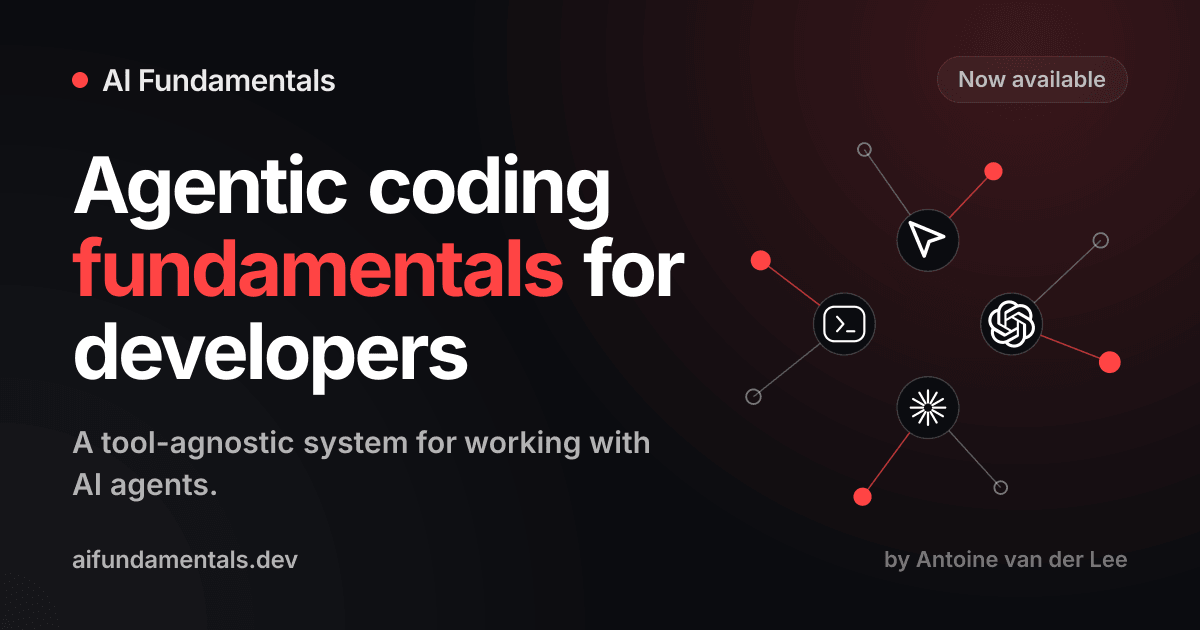
Agentic engineering changed how I build software, and today I’m launching the course I wrote about it: AI Fundamentals. I use agentic engineering and agentic coding for the same shift: you write less code yourself, and spend more time describing outcomes, reviewing changes, and improving the system around your agents.
The course has been on my plate for a long time. In this article, I’ll explain why I waited so long to launch it, where the lessons come from, and what you can expect inside.
#
I put up the landing page with a waitlist in January. That is more than nine months ago, and I’m sure some of you wondered when it would finally arrive. I waited on purpose.
AI development tools change every few weeks. There is always a new model, a new product, or a new workflow that promises to change everything. I didn’t want to add to that noise with a course that was written after a few weekends of testing. I also didn’t want to teach you where to click in one specific tool, because that screenshot would be outdated before you finished the lesson.
So I kept using agents every day for SwiftLee, RocketSim, websites, automations, and product analysis. To not lose anything, I recorded voice memos almost every day to capture what I learned along the way. Looking back months later, those memos turned out to be a goldmine, as they held learnings I had already forgotten.
Those memos became the raw material for the course. I only turned a learning into a lesson once it kept coming back, regardless of the tool or model I used. That is the foundation of the course.
#
I’ve been developing apps since 2009. I moved from manual memory management to ARC, from Objective-C to Swift, and from Auto Layout to SwiftUI. Each of those changed the code I wrote.
ARC never made me question whether I should read every diff. Agentic engineering did. Suddenly I had to answer questions like:
- When should I commit?
- How much code should I read myself?
- When do I review a plan instead of an implementation?
- Which work should I delegate?
- How do I stay focused when several agents work at once?
I also made mistakes. Running agents in parallel across Git worktrees left me with local changes in the wrong place. An automation opened around twenty pull requests, and all of them needed my review. Those mistakes taught me more than any model announcement did.
#
Every lesson combines two things: my own experience and official documentation. The experience is the part you can’t get from a manual, like which review habits survived and which instructions my agents kept ignoring. The documentation keeps the facts correct and honestly, also made me learn a lot along the way. I prepared lessons by reading sources like the docs from Cursor, OpenAI, Anthropic, and Google, and against open standards like AGENTS.md and the Model Context Protocol, and then wrote everything in my own words. I see it as a combined win-win version of lessons, combining my experience with official background.
I also measure instead of guess. When I analyzed 1,674 of my own agent sessions, 94.2% of the tokens were cache reads, and only 0.6% were the replies written by the agent. In other words, the tips I always see about getting shorter answers from your agent would only optimize the smallest part of my usage (that was quite eye opening). I wrote about the details in my article on reducing token usage in Claude Code, Codex, and Cursor, and the course teaches you how to do the same analysis for your own setup.
I learned a lot myself while building the course, because finding the extra context behind topics I thought I knew made me look at them differently.
#
The course has 9 modules and 66 lessons. Most lessons are text on purpose, because a button in a video can move within months while the reasoning stays the same. You’ll find diagrams, prompt teardowns, review checklists, and assessments, and you finish with a certificate of completion.
- Course introduction. Why I created the course and my own journey to agentic coding.
- Understanding agentic coding. What agents are and how they differ from autocomplete and chat assistants.
- The agentic coding mindset. Why this feels like a mental shift, and how to handle code you didn’t write yourself.
- Getting started with agentic coding. Choosing a tool, CLI versus IDE, local versus cloud agents, and picking the right model.
- Task context, prompts, and execution. Context, tokens and what they cost, and the plan, execute, and review loop.
- Building and improving agent instructions.
AGENTS.md, agent skills,hooks , and MCPs. - Validation, safety, and feedback loops. Reviews, linters, tests, stop rules, and security.
- Scaling across projects and environments. Parallel agents, reusable commands, and cross-repository work.
- Wrapping up and certification. Measuring your workflow and receiving your certificate.
You practice in the Looply sample project, a small website that runs in any browser. You don’t need Xcode or any specific programming language to follow along. You can find the full curriculum on the AI Fundamentals landing page.
#
AI Fundamentals is for developers who want to move beyond an occasional coding question in a chat window. You might use autocomplete, paste errors into ChatGPT, or let an agent make small changes. However, you might not have a workflow yet that you fully understand or trust.
You don’t need experience with a specific tool. Whether you use Cursor, Claude Code, Codex, or another agent, the principles apply. I do expect basic development experience, because your knowledge of Git, pull requests, and code review is what makes agents useful.
The course is not for you if you want a deep dive into the settings of one product. It also won’t give you a list of perfect prompts, because a prompt that works in one project can fail in another. I want you to leave with judgment you can apply anywhere.
#
Modules 1 to 3 are available today. A new module follows every Tuesday, and the final module with the certificate arrives on December 22. You get lifetime access, so every module unlocks automatically after you’ve bought the course.
There is a launch price until December 22. After that, the course moves to its regular price. If you plan to join, it’s cheaper to do it now, and you don’t miss anything since the remaining modules unlock on their release dates. There is also a 14-day money-back guarantee, so you can read the first modules before you decide. If you want to get your whole team on the same page, the landing page has the details on team licenses and invoices.
I’m selling this course, so I won’t pretend to be neutral. I do think it pays for itself. When your agents are tuned, you hit your usage limits less often and you get more out of the tools you already pay for. I’ll keep writing free articles about agentic engineering as well, but the course puts everything in one order and keeps it up to date as tools change. I have examples of friends that optimized their workflow with a single prompt they got from me, so imagine the impact of this full course with months of learnings.
#
What is agentic engineering?
Agentic engineering is building software by describing outcomes to AI agents, reviewing what they produce, and improving the instructions and checks around them. In the course I call it agentic coding. You write less code yourself and spend more time on planning, review, and decisions.
Do I need a specific AI tool for the course?
No. The course is not written for one tool. It works with Cursor, Claude Code, Codex, or any other agent, because it teaches the questions behind the workflow instead of the buttons of one product.
Do I need to know Swift or iOS development?
No. You need basic development experience, like working with files, Git, commits, pull requests, and code review. The sample project is a small website that runs in any browser, so you don't need Xcode or a specific programming language.
When do the modules unlock?
Modules 1 to 3 open on launch day. A new module follows every Tuesday, and the last module with the certificate opens on December 22. You get lifetime access, so every module unlocks automatically after you buy.
Can I get a refund?
Yes. There is a 14-day money-back guarantee. If the course is not for you, send me a message within 14 days of your purchase.
#
AI Fundamentals is my attempt to teach the parts of agentic engineering that stay useful when your favorite tool changes: context, instructions, and validation. I waited until I had enough real experience to back every lesson, and I’ll keep updating the course as practice reveals better approaches.
If you want to build a workflow you trust, take a look at AI Fundamentals and pick up the launch price before December 22. If you’re not ready to buy yet, you can start with the free token cleanup prompt to see where your agent tokens go. Feel free to contact me or tweet me on Twitter if you have any questions about the course. What’s the first thing you want to improve in your agent workflow?
Thanks!