Open Source CEO by Bill Kerr- Posts
- The Founder Lightspeed Backed Twice
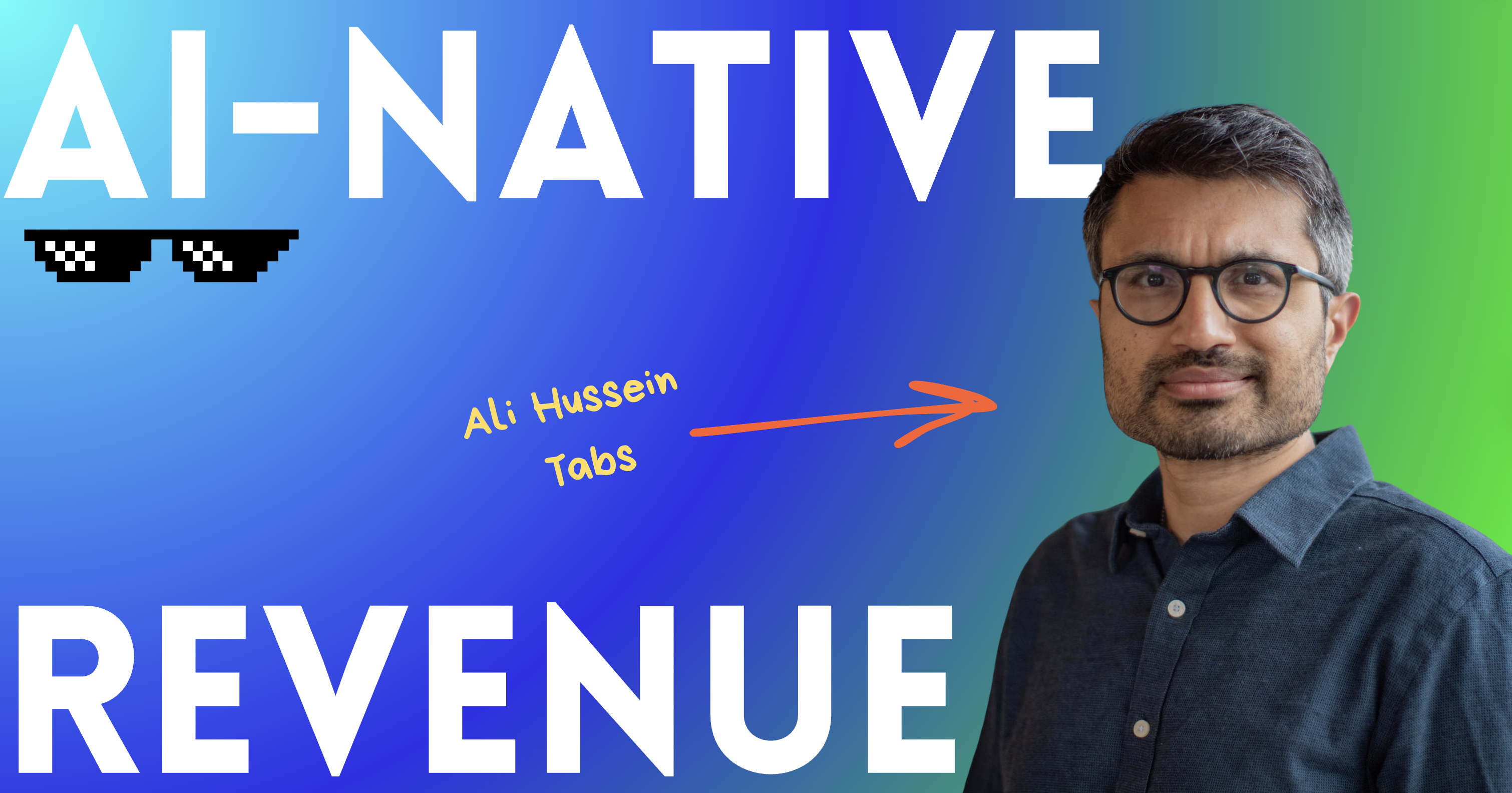
An interview with Ali Hussain, Co-Founder & CEO at Tabs. ⚡️ #
👋 Howdy to the 3,996 new legends who joined since our last edition! You are now part of a 468,789-strong tribe outperforming the competition together.
LATEST POSTS 📚
If you’re new, not yet a subscriber, or just plain missed it, here are some of our recent editions.

🗑️ [The Future New Media: a16z](https://www.opensourceceo.com/p/a16z-guest-post). How the famous VC firm has thrown out the old playbook.
⚡️ How Vanta Learned To Trust AI. Wiring AI into the one product where AI isn't supposed to be trusted.
🦠 The Black Death & How It Birthed Today's Prosperity. How one little flea, on one little rat, changed the course of history.
**PARTNERS **💫
This newsletter runs on beehiiv. So when we say the referral program works, it's not a guess, it's our actual growth engine. Readers share, hit milestones, earn rewards, and the list grows on autopilot. Pair that with their recommendation network and newsletters on beehiiv grow 2.75x faster. We're one of the data points. Worth a look if you're building something.
Get 30% off your first three months on beehiiv with the code: BILL30
Around 90% of AI projects fail because you don't have the right people. Aboard pairs powerful proprietary tools with senior engineers who’ve seen it all—and built most of it. We don't put AI in charge, we put it to work as a powerful aid in building reliable custom software for industry leaders in a fraction of the time.
Whether you’re a startup that needs to get to market or an enterprise with complex legacy challenges, Aboard delivers exactly what your business needs.
Interested in sponsoring these emails? See our partnership options here.
HOUSEKEEPING 📨
I faced an interesting predicament today. It’s a brisk 15 degrees Celsius today in Melbourne (59 to your Farenheiters), and I needed to rug up to take our dog, Ziggy, for his morning walk. Once dressed, I threw on a beanie, only to be told that I would either look like a dork or a criminal, depending on how I wore it.
I have never been called a dork, and I have been known to delve into a touch of criminality in the past, so I decide to go full criminal. I bought a gun, just in case the opportunity arises to do an actual crime, but alas, no opportunity availed itself to me. The gun is a lie, of course, but the beanie slurs were not. Enjoy today’s piece!
INTERVIEW 🎙️
Ali Hussain is the Co-Founder and CEO of Tabs, a New York-based AI-native revenue platform that automates the full contract-to-cash lifecycle: billing, collections, revenue recognition, and reporting. The company has raised $91M+ in total funding, including a $55M Series B led by Lightspeed in September 2025 and a 5x increase in invoice volume, crossing $1B+ in annualized billing for over 300 customers, including Rogo, Cursor, and Cortex.
Ali is one of those founders who came to the problem through genuine operational pain rather than a market map. He built the product category he needed but couldn't find: one that could read a contract the way a human does, understand what it commits the company to, and automate everything downstream from there. The unlock was AI, but the conviction behind Tabs predates it. What makes him interesting is the combination: the finance operator's instinct for where the real work happens, the builder's patience to wait for the technology to catch up, and an unusually clear view of where the agentic finance stack is headed and why legacy ERPs won't be the ones to take it there.
One thing is this fundamental belief that revenue is going to be predictable and consistent. The traditional wisdom was that you have a pricing strategy, a way you do business, a way you sell, and it's going to be consistent. That belief is just fundamentally broken. We are seeing immense amounts of variability and complexity, especially with AI right now. The standardization of revenue is something you've got to throw out the door.
Source: Tabs.
The way people price their products, the velocity of changes, how pricing gets contracted, the move towards usage and consumption models—all of it is shifting. The broken nature of the status quo is that we're still living with systems, processes, and in some cases people who are not ready to acknowledge that. On the other side, we're seeing new companies, especially AI companies, move fast in this new direction, but I've also been amazed by how quickly many legacy companies have adapted.
It's really a data problem. When you think about revenue, pricing, or commercial agreements, at the end of the day, it's as creative as the two companies involved want it to be, based on negotiating and signing a contract. The reason it's historically been broken is that when humans codify something, whether in a legal document or just typing it up and signing it, the ability to take that data and administer it, to automate things like billing from it, has been essentially impossible until recently.
The only way you could take that paper and extract what mattered was to have other accountants and humans literally read and type that information. LLMs and AI have created technology that can actually go in, absorb the information, and understand it in a way that was just not plausible until the last 24 months. People always ask how accurate AI is. I say, “Can I guarantee 100% always? No. But I can guarantee it's better in 2026 than many humans are at extracting that information and coming to the right conclusion.”
A few things. One is just that when you're building, getting really great companies to bet on you is hard. Revenue, accounting, billing, collections, RevRec—these are incredibly intimate, business-critical workflows that matter massively to companies. Convincing buyers and partners to be willing to bet on us was always the hardest part.
The second is that revenue as a category has a very large surface area. You have to extract contracts and read them, handle billing, collections, payments, reconciliations, a bunch of APIs, RevRec. Being able to build wide while knowing where to focus, not diluting the product's value, that level of prioritization while balancing such a big surface area is quite a hard problem.
One of the cool parts of building a product is that you sometimes get to use it yourself. As we started signing our first 10, then 50 customers, I was the one using and administering the product every day, and I realized how much easier this was than how I'd done it before. People often look to customer signals or willingness to pay. For me, it was the product's actual efficacy. ‘Is this a hell-yes experience? Could I live without it as an actual user?’ That was the tipping point. For Tabs itself, we signed customers, and they wanted to use it. That created the whole value proposition.
Trusted by the best.
At our seed, we got to meet a bunch of firms, and it was becoming very clear that Lightspeed was emerging as the top AI investor (they had invested in Anthropic around the same time), but a lot of it was also their FinTech group here in New York. Justin, who led the round, had spent a long time at Stripe and had thought deeply about this problem. He had a point of view on what a winner in this category would need to look like. It was a very clear meeting of minds on vision and philosophy. At the Series B, they had seen the business and watched us do what we said we would. |
We solved a genuinely hard problem from an AI-first standpoint. If you look at Lightspeed's research lab investments, these are companies redefining categories through an AI-first lens. In the 12 months since the seed, we have delivered. I think that created real conviction for them to double down and let us stay heads-down building rather than be distracted by future fundraising.
In some ways, I've been really intentional about keeping a lot of the same things, staying as close to the customer as possible. Just because we have more people doesn't mean I've become a people manager. That's the least of what I want to do. I've tried to maintain roughly the same number of direct reports I had at 15 people as I do now at 150.
What hasn't changed much is the amount of time I spend with customers: selling the product, learning pain points, understanding how it's used, and where we need to go next. What has changed is that we have a lot more people, so creating focus and direction matters more. As a company hits this kind of scale, you start working with specialists rather than generalists, people who know their domain deeply. Getting to go deeper on specialization in areas like customer success and security has been a core part of how I spend my time now.
Almost everywhere. Everyone in the company has AI tools, whether Claude or Cursor. Engineering has always been the earliest to adopt, but broadly, marketing is using it tremendously for content creation, targeting, and automation. Our AEs and solutions teams are building demos and ROI presentations. It's been an incredible enabler for our post-sales teams, helping them deal with large volumes of data and move customers off legacy systems.
Long life to the Agents.
Personally, aside from using Tabs, most of my other workflows—Slack, email, everything—originate in an LLM. It's how I gather my thoughts, do research, communicate, draft emails and notes to my team, and send structured post-call summaries. Our product team uses Claude to triage Slack and build out roadmap prioritization. AI is integral to almost every part of how we operate. With humans, too: we're a fast-growing company, not a 10-person AI-only outfit, but everyone should be at least 5x what they could do without AI, while still having genuinely talented people here.
A lot of the noise has been around how legacy systems become AI-native for automation, and I actually think that's the wrong frame. Finance teams are a combination of expertise (primarily humans), systems of record, and some type of services. Where I think it's headed over the next few years is that most organizations will still need experts at the top, but a lot of the systems and individuals driving the more tactical parts of finance will move over time to agentic workers. | Source: Tabs. |
A big part of what we think about at Tabs is where the inefficiencies of services and human capital are buried. It's less about just revenue and more about the jobs that need doing, teams that are adding bodies to billing and collections, or scrambling to hire revenue accountants when an audit shows up. The ERP will shrink quite a bit. What's replacing it is specialized agents that finance leaders get to administer: one for all things billing, one for revenue accounting, one for payroll, and one for FP&A. Technologies that start to look and feel more like people than something you log into and use your keyboard. That hands-on-keyboard model is slowly starting to shift and will continue to be less relevant in the years ahead.
Without sugarcoating it, it requires hard work. We are an in-person, five-days-a-week culture. There's no alternative. There is immense personal sacrifice, and I think in 2026, you can't be competitive any other way, given the pace of change.
Proud team.
The second thing is empowerment. The company is only as good as the people who have the agency to run. Talent density is incredibly important. Third is direction: working hard but also smart, towards the right goals. Focusing deeply on what matters and not trying to do too many things at once. One bigger-picture thing we've done well is knowing where AI is going to be better built by others and not over-engineering towards where the models are today, knowing that in 12 to 18 months it'll look completely different. Balancing that is a huge enabler for moving faster and smarter.
Sleep well; there's no alternative. Keeping that balance is really important. The second is being present in the moment, giving yourself the space with your team or with a customer to really take in what's going on. That means phones down. Living in the moment, you can't multitask.
That's one of the risks when you have an LLM, agents, Slack. You try to do so much because you've become highly optimized, but in the high-value moments—a customer meeting, a whiteboard session—you have to step away from reactive mode and into deep thinking. That's something I've really tried to change about how I spend time with my team, customers, and partners. Really taking those moments in, thinking deeply, and not just creating motion out of it but making sure you're using your time on the highest-value things. |
How AI is transforming company revenue in 2026- May, 2026How Ali Hussain Created and Scaled Tabs- August, 2025The Startup Revolutionizing B2B Revenue Automation- February, 2025Building with Tabs- November, 2024
And that’s it! You can follow Ali on LinkedIn or check out Tabs on their website to keep up with what they’re building!
BRAIN FOOD 🧠
TOOLS WE RECOMMEND 🛠️
Every week, we highlight tools we like and those we actually use inside our business and give them an honest review. Today, we are highlighting Framer*—the site builder trusted by startups to Fortune 500.
See the full set of tools we use inside of Athyna & Open Source CEO here.
**HOW I CAN HELP **🥳
Hiring global talent:If you’re hiringtech, business or ops talent and want to do it 80% less, check out my startup,Athyna. 🌏See my tech stack: Find our suite oftools & resourcesfor both this newsletter and Athynahere. 🧰Reach an audience of tech leaders:Advertisewith us if you want to get in front offounders, investors and leadersin tech. 👀