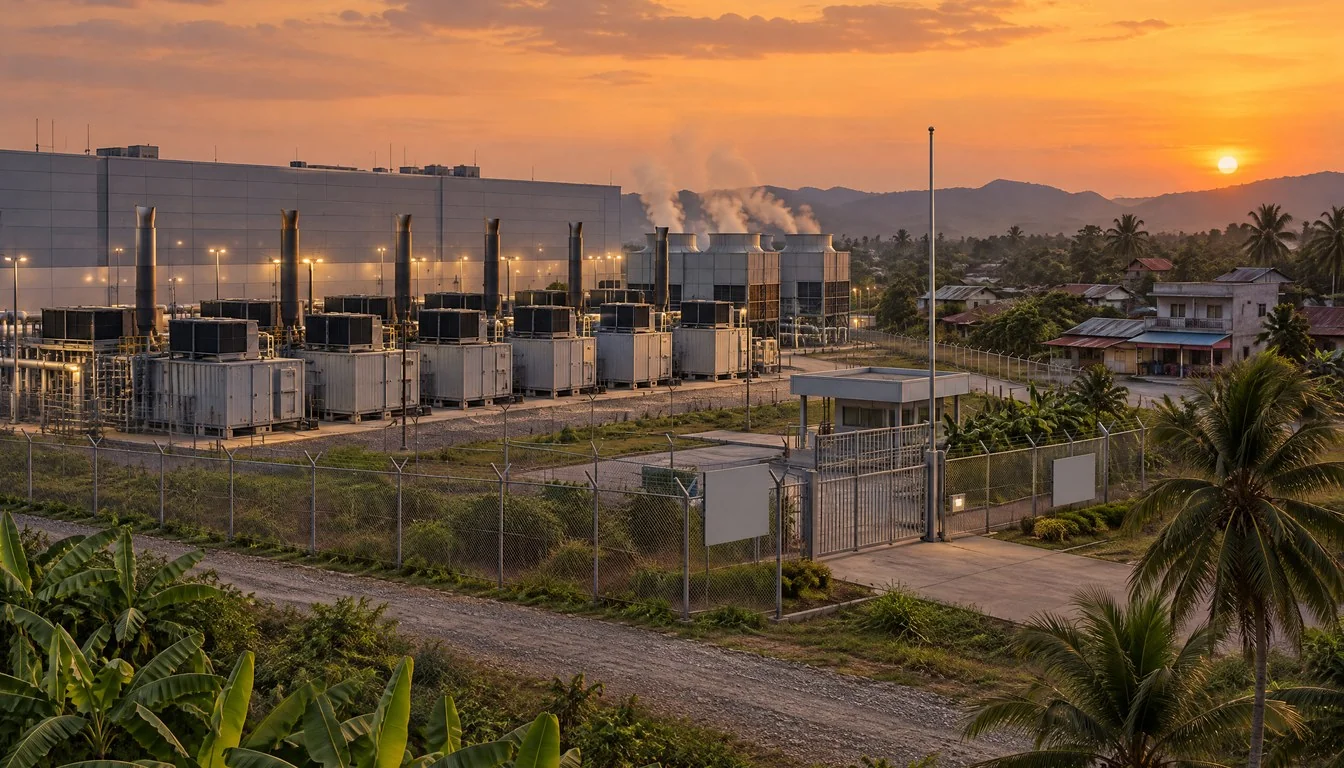
Thailand has put a number on data center noise. According to TechRadar, the Cabinet approved new environmental rules on November 10, 2026 that cap the data center noise limit at 70 A-weighted decibels (70 dBA) at the site or project boundary. TechRadar framed the figure with a familiar comparison: roughly the volume of a hair dryer. The harder question is whether that number protects the people who sleep a few hundred meters from a diesel generator hall.
The rules arrive as AI-driven demand pushes operators toward bigger campuses and as local opposition hardens in several countries. We covered the American side of that fight in our look at data center zoning measures on the midterm ballots. Thailand is taking a different route. It sets performance standards for noise, heat and water, then steers the largest projects into industrial estates.
This analysis walks through what the Cabinet actually approved, what the 70 dBA figure means in practice, where the gaps sit, and what the package could mean for operators and cloud buyers. We stick to what the reports confirm. Where the announcement leaves a detail open, we say so.
Don't miss new tech stories on Google
Add Shattered once in the Google app and our stories show up in your news suggestions.
What Thailand’s Cabinet Approved on November 10 #
The Cabinet signed off on a package of environmental rules for data centers on November 10, 2026. Danucha Pichayanan, secretary-general of Thailand’s economic planning agency, announced the noise standard after the approval, according to the reporting that followed. The headline figure is 70 dBA, measured at the site or project boundary.
The limit applies while uninterruptible power-supply systems or backup generators are running. That detail matters. Those are the machines most likely to produce sudden, loud, sustained noise, and they run when the grid fails or during testing.
Noise is only one pillar. The package also limits temperature increases in the surrounding area to 1 to 2°C, requires cooling water to be recirculated and tested before discharge, and pushes data centers drawing 20 megawatts (MW) or more into industrial estates, where they face stricter oversight. Projects that already held construction permits or Board of Investment (BOI) promotion approval before August 14, 2026 can proceed under transitional arrangements and get about a year to comply.
The rules do not name a company, a facility or a community. Reports on the announcement describe the standards in general terms, so any claim about a specific site would be speculation.
Thailand Data Center Rules at a Glance #
The table below collects every figure the reports confirm. We left out anything that was not stated, including penalties, inspection frequency and the exact start date of the one-year compliance period.
| Rule | Confirmed figure or requirement | Where it applies |
|---|---|---|
| Noise limit | 70 dBA | Site or project boundary, while UPS systems or backup generators run |
| Temperature rise | 1 to 2°C limit | Nearby surroundings |
| Cooling water | Recirculated and tested before discharge | All covered facilities |
| Large-site siting | Industrial estates required, stricter oversight | Data centers using 20 MW or more |
| Cutoff date | August 14, 2026 | Permit or BOI approval before this date qualifies for transition |
| Compliance window | About one year | Eligible pre-August 14 projects |
| Approval date | November 10, 2026 | Cabinet decision |
Seven lines is a short rulebook. It reads more like a framework than a finished regulation, and the missing details will decide how much the framework changes for anyone living nearby.
The Hair Dryer Comparison: Useful Shorthand, Loose Science #
The hair dryer line gives readers an instant reference. Most people have stood next to one, and they know it is loud but not painful. TechRadar leaned on that image, and it works as a headline.
It also needs a caveat. The reported comparison says a hair dryer sits at approximately 70 dBA, and readings vary by model and operating speed. Nobody has confirmed that every household dryer hits exactly 70. Treat the comparison as a rough anchor, not a measurement standard.
Where the comparison breaks down
A hair dryer is loud for a few minutes while you hold it near your head. A generator or UPS cooling system may run for hours during an outage or a test cycle. Duration changes how people experience the same decibel level, and a single number says nothing about it.
Then there is distance. You hold a dryer a few inches from your ear. The 70 dBA limit applies at the boundary of the project, which could sit far from the equipment and far from the nearest house. The comparison hides that gap, and the gap is the whole story.
Why a boundary reading is not a bedroom reading
A 70 dBA reading at the fence line tells you the level at one spot. A resident’s bedroom may be farther away, closer, shielded by buildings or exposed across open ground. A 70 dBA limit does not by itself establish how much noise nearby residents will experience. The outcome depends on measurement location, operating conditions and enforcement, as the reports on the announcement make clear.
How Decibels Work, and What 70 dBA Means for a Neighbor #
Decibels run on a logarithmic scale, which trips up intuition. A small numerical change hides a large physical one. The A-weighting in dBA tilts the measurement toward the frequencies human ears pick up best, so it approximates how loud a sound feels rather than how much raw energy it carries.
These are standard acoustic rules of thumb, not figures from the Thai announcement. They show why the measurement point and the distance to homes matter so much.
| Change in level | Effect on sound energy | Typical effect on perception |
|---|---|---|
| +3 dB | Roughly doubles | Just noticeable to most listeners |
| +10 dB | Ten times the energy | Usually heard as about twice as loud |
| -6 dB | About one quarter of the energy | Typical drop when a single point source’s distance doubles in open space |
| -10 dB | One tenth of the energy | Heard as roughly half as loud |
| Two identical sources | +3 dB over one source | A hall with several generators running together is louder than any single unit |
Two lessons follow. First, a fence-line reading of 70 dBA and a reading at a house farther back can differ by a lot, but only if open space, barriers or enough distance separate them. Second, adding units raises the total. A site that runs a bank of generators during a test can exceed what any one unit produces.
Real sites also bend these rules. Walls, berms, building layout, weather and ground cover all shift the result. That is why regulators usually pair a numeric cap with rules on where and when to measure.
Backup Generators and UPS Systems: The Noisy, Rare Hours #
Thailand tied its limit to the operation of UPS systems and backup generators. Those systems exist for the worst day, when mains power fails and the facility has to keep serving traffic. Operators also run them on a schedule to prove they work.
That focus makes sense for a noise rule. Generators produce some of the loudest and most abrupt sound on a campus, and residents often complain about test runs and unexpected start-ups. A cap on those machines goes after the most disruptive events.
It also leaves questions. The reports on the announcement describe the limit in terms of UPS and generator operation and do not detail how continuous cooling noise is treated. Fans and chillers run around the clock, and a steady hum at night can bother neighbors more than an occasional loud test. Whether the 70 dBA cap reaches that everyday noise is a detail worth watching when the implementing text appears.
Operators have tools to comply. Enclosures, silencers, vibration isolation and careful placement of equipment can cut the level at the boundary. Power-gear makers keep pitching smaller and longer-lived systems for AI sites, such as the UPS line that claims a 30% smaller footprint, though a smaller box says nothing about how loud it is. Noise has to be measured, not assumed.
The 20 MW Rule: Pushing Big Sites Into Industrial Estates #
Any data center using 20 MW or more must locate in an industrial estate and accept stricter oversight. This may do more for nearby residents than the decibel cap does. Distance is the cheapest noise control there is, and industrial zones usually sit apart from dense housing.
The approach changes the question. Instead of asking whether a hall of generators sounds acceptable beside a village, planners ask whether a heavy industrial user belongs in an area already zoned for that purpose. Neighbors still hear what leaks out, but fewer of them live within earshot.
Other places have seen what happens when siting goes the other way. Proposals near homes or protected land draw quick opposition, as with the 600MW London Green Belt project that angered locals. Thailand’s rule tries to settle the location question in advance for the biggest facilities.
One limit of the 20 MW threshold: it targets large sites. The reports we reviewed do not say how smaller facilities below that line are handled for siting. The noise, heat and water standards appear to apply broadly, but the stricter oversight tier belongs to the big projects.
Heat and Water: The Other Half of the Package #
Noise grabbed the headline, but the rules go further. They limit temperature increases in the surrounding area to 1 to 2°C. They also require cooling water to be recirculated and tested before discharge.
Both rules respond to a basic fact about data centers. Every watt of electricity that goes into servers comes out as heat, and cooling systems either move that heat into the air or into water. In a warm climate, cooling is a major design driver, so a cap on local temperature rise and a water-quality check shape how operators build.
Recirculation reduces fresh water draw. Testing before discharge addresses what leaves the site. The reports do not give numeric thresholds for the water tests, so we cannot say how strict they are. They also do not say how the 1 to 2°C figure gets measured, whether at the boundary or at some distance, or over what averaging period.
Cooling claims deserve scrutiny in this setting. We looked at one vendor’s 70% energy-saving claim that came with no water figure. Under Thailand’s package, a missing water number becomes a compliance problem, not just a marketing gap.
Transitional Arrangements: Who Gets a Year #
Projects with construction permits or BOI investment-promotion approval issued before August 14, 2026 may proceed under transitional arrangements. Those projects have approximately one year to comply with the new environmental requirements. The reports do not specify the date the clock starts, so we avoid guessing an end date.
The cutoff predates the Cabinet decision by almost three months. That gap is typical of grandfathering rules. It protects investors who committed capital under the old regime and avoids a rush of last-minute filings after the policy became public.
For residents, the transition period cuts both ways. Existing and already-approved sites keep operating, and some will keep making whatever noise they make today until the window closes. After that, they must meet the standards, though the reports do not describe what happens to a site that misses the deadline.

For operators, a year is workable for acoustic fixes like enclosures and barriers. It is tighter for anything that requires rebuilding cooling loops or relocating a large site. Companies with approvals in hand will likely audit their boundary noise first, since that is the cheapest check to run.
Enforcement: The Part the Announcement Leaves Open #
A noise limit lives or dies on how it is checked. The reports confirm the number and the boundary measurement point. They do not describe who measures, how often, with what equipment, under what operating conditions or with what penalty for a breach.
Those gaps matter more than the decibel figure. If operators self-report during scheduled tests, a generator can pass on a quiet afternoon and still disturb neighbors during a real outage. If regulators measure only on complaint, quiet communities get less protection than vocal ones. And if the standard covers testing but not emergencies, the loudest events may escape.
Residents also need a way to raise problems and see the results. Public monitoring data, a complaint channel and published inspection findings turn a rule into something communities can use. None of that appears in the confirmed details, which does not mean it is absent, only that the reports do not mention it.
The honest conclusion is that nobody can yet say whether this rule will make life better near a data center. The claim that the 70 dBA limit will materially improve living conditions remains unconfirmed.
Market Impact: What Operators and Cloud Buyers Should Expect #
For operators, the package adds cost and planning constraints but also adds clarity. A numeric noise cap, temperature limit and water rule give engineers fixed targets. Investors usually prefer defined standards over open-ended local negotiations, even when the standards are tough. The industrial-estate requirement for 20 MW sites will steer big builds toward designated zones. That could concentrate demand for land, power and grid connections in fewer places. It may also speed approvals there, since the zoning question gets answered early, though the reports do not promise faster permitting.
Cloud buyers feel the effect indirectly. Compliance costs can feed into colocation and capacity pricing, and a cutoff date can shift which projects reach the market first. Projects approved before August 14 hold a head start because they get the transition window. Later entrants face the full rules from day one.
Our cloud computing coverage tracks how these regional rules affect capacity planning. The practical advice for enterprise teams with Thai workloads is simple: ask providers whether their facilities qualify for transition or must meet the standards now, and ask how they test generators.
How Thailand Compares With Other Data Center Crackdowns #
Governments are reaching for different tools. Some limit growth through grid access. Norway’s grid operator d data center deals, a move we covered in Norway’s 4,200 MW grid . Others use local votes and zoning, as seen on American ballots. Thailand is regulating operating performance and location together.
The approaches differ in what they protect. Grid limits protect the power system. Zoning protects neighborhoods through land use. Performance standards like Thailand’s try to protect the environment around a site without halting construction. Each has weak points. Performance rules depend on measurement, zoning depends on politics and grid s depend on utility capacity.
Public sentiment forms the backdrop. Our look at voter opposition to AI data centers shows how quickly local objections can become political. Thailand’s Cabinet acted through rules, not ballots, but the underlying pressure is similar: residents want to know what a new facility will do to their street. Boundary-line noise limits are not new in general. Regulators have applied them to factories, quarries and power plants for years. What is new is applying one explicitly to a building type that most people used to think of as quiet.
What Is Confirmed, What Is Not, and What Would Make the Limit Work #
Sorting facts from assumptions keeps the debate honest. The table separates the two.
| Claim | Status | Note |
|---|---|---|
| Cabinet approved rules on November 10, 2026 | Confirmed | Reported by TechRadar and others |
| 70 dBA at site or project boundary | Confirmed | Applies during UPS or generator operation |
| 20 MW or more must use industrial estates | Confirmed | Stricter oversight for these sites |
| 1 to 2°C nearby temperature limit | Confirmed | Measurement method not detailed |
| Pre-August 14, 2026 projects get about a year | Confirmed | Start date of window not specified |
| Limit will materially improve living conditions | Unconfirmed | Depends on measurement, conditions, enforcement |
| Every hair dryer produces exactly 70 dBA | Unconfirmed | Comparison is approximate and varies by model and speed |
| Any named company, facility or resident affected | Unconfirmed | None identified in the reports |
Several steps would turn the rule into real relief for neighbors:
- Publish the exact measurement protocol, including where, when and under what load levels the boundary reading gets taken.
- Clarify whether the cap covers continuous cooling noise as well as UPS and generator operation.
- Require independent or public noise monitoring at large sites, not only operator self-reporting.
- Set a clear penalty and remediation path for breaches.
- Add a residential-receptor check for sites near homes, in addition to the boundary limit.
None of these items appears in the confirmed reporting. They are our suggestions based on how noise rules tend to succeed or fail elsewhere.
Predictions: Where Thailand’s Rules Go Next #
These are our judgments, not reported facts. We have no inside information on how Thai agencies plan to implement the package.
- Implementing detail will matter more than the headline. Expect agencies to issue measurement guidance that clarifies where and when the 70 dBA reading applies. The wording of that guidance will decide whether the cap bites.
- Operators will test early. Companies with pre-August 14 approvals will likely run boundary noise surveys during the transition year to find problem equipment before regulators do.
- Acoustic hardware will get more attention. Generator enclosures, silencers and vibration control will move up the procurement checklist for new Thai builds.
- Industrial estates will draw the big projects. The 20 MW rule makes estates the default home for large facilities, which should concentrate planning conversations there.
- Neighbors will test the rule through complaints. The first real signal will come when a resident near a site reports a problem and officials respond, or fail to.
The takeaway: Thailand has set a clear number and a clear map for where big data centers belong. It has not yet shown that the number protects the people living next door.
Frequently Asked Questions #
What is Thailand’s new data center noise limit?
The Cabinet approved a limit of 70 dBA at a data center’s site or project boundary, applying when UPS systems or backup generators operate. TechRadar reported the approval, which came on November 10, 2026.
Is 70 dBA really as loud as a hair dryer?
Reported comparisons put a hair dryer at approximately 70 dBA, but readings vary by model and operating speed. No source confirms that every dryer measures exactly 70.
Will the limit make life quieter for people near data centers?
That is unconfirmed. A 70 dBA limit does not by itself establish what residents will hear. The result depends on where the measurement is taken, how the facility is running and how well the rule is enforced.
Which data centers must move into industrial estates?
Facilities using 20 MW or more must locate in industrial estates and face stricter oversight, according to reports on the Cabinet decision.
Do existing projects have to comply right away?
No. Projects with construction permits or BOI investment-promotion approval issued before August 14, 2026 may proceed under transitional arrangements and have approximately one year to comply.
What else do the rules cover besides noise?
They limit nearby temperature increases to 1 to 2°C and require cooling water to be recirculated and tested before discharge.
Who announced the standard?
Danucha Pichayanan, secretary-general of Thailand’s economic planning agency, announced the noise standard after the Cabinet approved the rules.
Do the reports name specific companies or sites affected?
No. The reports describe the rules in general terms and do not identify any specific data center company, facility or resident.