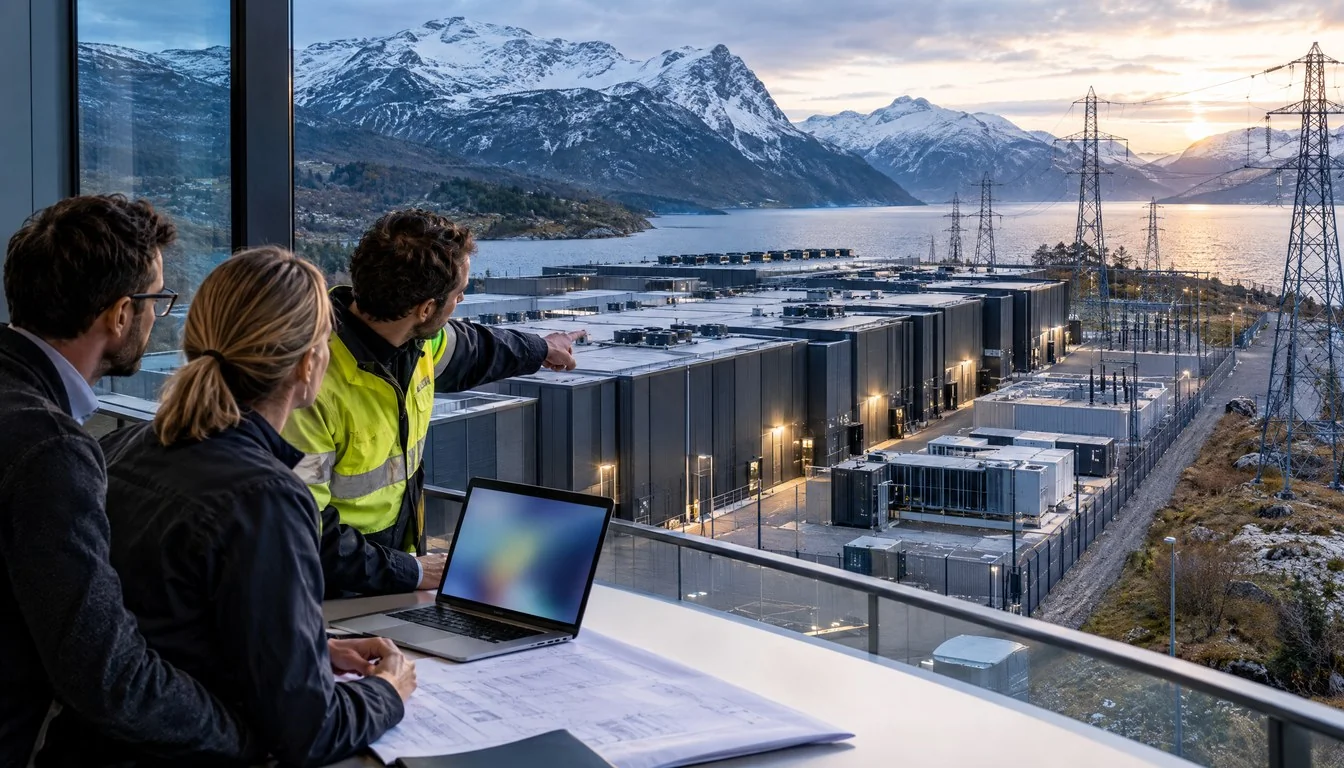
Norway moved on November 9, 2026 to slow the rush of data center projects onto its power grid. Grid operator Statnett temporarily suspended new grid-capacity reservations for data centers, and the Norwegian government said it will explore a licensing regime that decides which facilities deserve scarce power. TechRadar framed the story around a line from digitalisation minister Torgeir Micaelsen: “We want data centers in Norway, but we can’t have all types of data centers.”
The headline version of this story, a country that has banned AI facilities until late 2027, overstates what happened. The suspension is narrower than a ban, and Statnett says it expects to lift it no later than August 1, 2027. Existing connections keep running. Projects that already hold the required technical approvals can still connect. What stops is the intake of new capacity requests and the processing of certain approval applications.
For anyone who buys, builds or trains on AI compute, the practical question is simple. Which workloads will Norway want to host once the licensing rules arrive, and which will it turn away? This analysis lays out what is confirmed, what is not, and how the compares with the moves we covered in our earlier report on the Statnett and in other jurisdictions. It also covers market impact, historical context and five predictions. For wider model and infrastructure coverage, see our AI and machine learning hub. Don't miss new tech stories on Google
Add Shattered once in the Google app and our stories show up in your news suggestions.
What Statnett Actually Suspended on November 9 #
Statnett is Norway’s transmission system operator, and its decision has three parts. First, it suspended new grid-capacity reservations for data centers. Second, it d the processing of new applications for facility-functionality approval under Section 14 of Norway’s Regulations on System Responsibility in the Power System. Third, it halted work on already submitted approval applications for facilities that would connect directly to the 420 kV grid.
The 420 kV detail matters. That is the top of the national transmission hierarchy, the level where very large loads plug in. A hyperscale campus or a dense GPU cluster that wants a direct connection at that voltage now waits, even if it already filed paperwork. Smaller facilities that connect lower in the network are not named in the announcement, so we stay general about them.
Statnett described the suspension as temporary and gave a ceiling, not a fixed date. It expects the to end no later than August 1, 2027. A ceiling means the could lift sooner if the government’s licensing work moves fast. It also means developers cannot plan around an early reopening, because nothing in the announcement promises one.
Confirmed vs Unconfirmed: A Fact Check of the Headlines #
Early coverage ran several claims together. The table below separates what the Statnett announcement and the government statements confirm from what the sources do not support. We use this split for every number and date in the rest of the piece.
| Claim | Status | What the sources say |
|---|---|---|
| Statnett d new data center capacity reservations | Confirmed | Effective on November 9, 2026 |
| Processing of Section 14 approval applications d | Confirmed | Covers new applications under the System Responsibility regulations |
| Already submitted 420 kV approvals frozen | Confirmed | Applies to facilities connecting directly to the 420 kV grid |
| ends by August 1, 2027 | Confirmed as a latest date | Statnett expects the suspension to end no later than that day |
| Existing connections unaffected | Confirmed | Running facilities keep their grid access |
| Pre-approved facilities may still connect | Confirmed | Those with the required technical approvals can proceed |
| A complete halt on all new data center development | Unconfirmed | The measures target capacity reservations and certain approvals, not every project |
| A lasting until late 2027 | Unconfirmed | The stated deadline is August 1, 2027 at the latest |
The gap between a halt and a on new reservations is not pedantry. A blanket ban would strand projects mid-construction and trigger a different legal fight. A queue freeze hits developers who have not yet secured power, and it spares those with approvals in hand, which is a narrower group than the headlines imply.
The 26,000 MW Queue Behind the #
Energy minister Terje Aasland supplied the number that explains the timing. He said Statnett had received applications for 26,000 MW of new capacity in 2026, and data centers made up 75% of those requests. Run the arithmetic and data centers account for roughly 19,500 MW of the queue. That is a rough calculation from the two confirmed figures, not a number the government published.
A queue that large says something about demand. The sources do not say how many of those requests reflect firm construction plans and how many are early placeholders, so we avoid guessing. What the numbers do show is that demand for grid access far outran what a single operator can approve in one year. Norway chose to stop the line first and rewrite the rules second.
The second consequence is political. When three of every four requested megawatts go to one customer class, other grid users have reason to ask what is left for them. Aasland’s figure gives the government a simple talking point about who dominates the line.
Norway’s Planned Data Center Licensing Regime #
The government announced plans to explore a licensing regime for the establishment and operation of data centers. The word explore is doing real work. No draft law exists in the sources we reviewed, no fee schedule, and no list of criteria beyond the broad categories. This is a direction of travel, and the details will come through consultation.
What the government did say is who the regime should serve. The proposed licensing is meant to support data centers that serve defense, police, emergency preparedness, health services, mobile networks and the financial system. Micaelsen said the scheme would favor facilities that meet national and critical-infrastructure needs. The government also said it will weigh requirements that support digital security and preparedness, and that contribute to AI-computing capacity in Norway, the Nordic region and Europe.
Read together, those lines describe a two-tier idea. Tier one is infrastructure the state depends on, which gets priority. Tier two is AI compute that benefits the region, which can qualify if it meets security and preparedness conditions. Everything else faces a harder case. That includes speculative colocation space and, as the next section explains, cryptocurrency mining.
Why Crypto Data Centers Fall Outside the Public Interest #
The government indicated that cryptocurrency data centers would not be considered to serve the public interest. That is the clearest exclusion in the announcement and the one most likely to survive into the final rules. Mining facilities draw continuous power at scale and, in the government’s framing, offer little the state needs in return.
The exclusion also sets a template. Once a licensing regime defines public interest by use case, regulators can sort workloads by purpose. Defense and health sit at the top. Mining sits at the bottom. The hard part is the middle, where general-purpose cloud, AI training and AI inference all live. The government has not said where those fall beyond the regional AI-capacity language.
Gas Plants and Carbon Capture: Who Pays for the Grid #
Two cost ideas stand out. The government said new data centers should pay the grid costs they cause. It also said facilities may be required to build gas-fired generation, potentially with carbon capture and storage. Both ideas shift risk from ratepayers to developers.
Requiring on-site or dedicated generation is a heavy ask in a country known for hydropower. It signals that the government sees new load as something the existing system cannot absorb without new supply. It also puts Norway in a strange position, since gas plus carbon capture is expensive and still rare at this scale. The government said may, so we treat it as an option on the table and not a rule.
Developers elsewhere have already moved toward self-supply. Our report on Anthropic’s reported $3.4 billion gas power deal showed an AI lab buying generation capacity directly, and we also covered data center operators hunting for used turbines at $1.3 million per megawatt. Norway’s idea differs in one respect. There the developer chooses to self-supply. In Norway, the state may require it as a condition of getting a license.
What the Means for AI Model Builders and Compute Buyers #
Norway has pitched itself as a home for AI compute, so the lands squarely on the model-building world. Labs and cloud buyers that planned Norwegian capacity for training runs or inference clusters now face an uncertain start date for any project that has not secured power. The announcement names no companies and no facilities, and we do not speculate about which projects are affected.
Training clusters face the sharpest squeeze
Large training clusters need the biggest and steadiest power feeds, which pushes them toward the direct high-voltage connections that Statnett just froze. A lab hoping to bring up a new site in 2027 should assume it cannot rely on a fresh 420 kV approval until the suspension lifts. Teams with existing approvals sit in a much better position.
Inference capacity may fit the licensing logic better
Inference serves users in real time, so it can sit in smaller sites closer to demand. The government’s language about AI-computing capacity for Norway, the Nordic region and Europe could favor that kind of regional serving capacity, though nothing in the announcement says so directly. Buyers should treat this as a reading of the signals, not a promise.
Hardware supply adds a second constraint. As we reported when HBM sold out as permitting rules threatened US expansions, memory and chips are already tight. A grid in one country will not free up GPUs for another, but it can strand ordered hardware with no powered home. Procurement teams should check delivery schedules against realistic energy dates.
Market Impact: Developers, Colocation and Power Suppliers #
No official source has quantified the financial effect, and we will not invent a figure. The direction is easy to describe though. Developers without secured power lose their place in line and must wait for the rules. Developers with approvals gain relative value, because their sites become scarcer. Colocation landlords with powered, permitted shells hold a stronger hand.
Power suppliers face the opposite pull. A frozen queue delays the new demand that might have justified fresh generation or grid upgrades. At the same time, a requirement to build gas-fired plants would create demand for turbines, engineering and carbon capture work. Which effect wins depends on rules that do not exist yet.
Capital markets will read the as a signal about political risk. Investors who underwrite data center projects price in permitting and power access. A regulator that rejects some types of data centers tells them that approval is no longer a technical formality. Expect lenders to ask for evidence of public-interest fit, not just a signed power agreement.
How Norway Compares With Texas, Australia and the US #
Norway is not alone. Governments and operators on three continents are rationing power for AI. The approaches differ in who acts and how they sort applicants. The table summarizes what we have covered, using only figures from our published reports and the Norwegian announcement.
| Jurisdiction | Mechanism | Who acts | Sorting principle |
|---|---|---|---|
| Norway | on new capacity reservations, licensing planned | Statnett and the national government | Public-interest use, ability to pay for grid impact |
| Texas | Data center debate with 13 GW exposed | Texas officials (see our report) | Grid exposure of AI firms |
| Australia (NextDC) | Operator s uncontracted projects | The company itself | Contracted customers first |
| United States (federal) | Permitting bill with a 31%-90% cut estimate | Congress | Faster approvals, not rationing |
| US local votes | Ballot measures and zoning fights | Voters and councils | Community consent |
Texas is the closest parallel on scale. Our report on the Texas data center and its 13 GW exposure shows the same tension between load growth and reliability. The difference is the sorting rule. Texas centers on how much load the grid can carry. Norway proposes to sort by purpose.
Australia shows the market route. When NextDC d uncontracted projects, a private operator did the rationing and put contracted customers first. Norway’s version moves that choice from the operator to the state. That shift matters because it lets regulators prefer defense or health tenants over the highest bidder.
Historical Context: From Cheap Power Pitch to Grid Queue #
The Nordic countries spent years marketing themselves to data center builders. The standard pitch combined abundant renewable power, a cool climate and political stability. That pitch worked, and the 26,000 MW queue is the delayed result. Aasland’s figure covers applications received in 2026.
AI changed the math. AI-driven demand arrives faster than grid reinforcement can follow. The mismatch between how quickly developers can order compute and how slowly transmission capacity grows is the structural reason for s like this one, though the Norwegian announcement does not spell that out.
Public mood has moved too. Our coverage of the 76% of voters who oppose AI data centers in US polling shows how quickly the politics turned. Norway’s response comes through the grid operator and the national government, while US fights have played out largely through local votes.
What Officials Said and How to Read It #
Micaelsen’s line is the sentence most outlets quoted: “We want data centers in Norway, but we can’t have all types of data centers.” It works as a policy summary. The first half keeps the door open. The second half announces a filter. The government has said who passes the filter in broad terms, defense, health, police, emergency preparedness, mobile networks and finance, but not how it will treat commercial AI hosting.
Aasland’s contribution was the data. By pointing to 26,000 MW of requests and the 75% data center share, he framed the as a response to volume, not hostility. That framing helps the government defend the move to the industry and to foreign investors. It argues that the grid simply ran out of room to say yes to everyone.
Statnett’s own wording stresses timing and process. It gave a ceiling date, protected existing connections and carved out pre-approved facilities. Those choices read as an attempt to limit legal exposure and keep investors calm, while the government sorts out the licensing design.
A Planning Checklist for AI Teams With Norwegian Plans #
Teams that had Norway on their site shortlist can act now without waiting for the licensing text. The steps below follow directly from the confirmed facts. They are our recommendations, not guidance from Statnett or the government.
- Confirm your approval status. Facilities that already hold the required technical approvals may still connect, so find out in writing whether your project counts.
- Check the connection level. If your design needs a direct 420 kV connection and the approval is still pending, Statnett has frozen that processing.
- Map your workload to the public-interest list. Defense, police, emergency preparedness, health, mobile networks and finance sit at the front of the proposed regime. If you host any of those tenants, document it.
- Price in grid costs and possible on-site generation. The government said new facilities should pay for the grid costs they cause and may have to build gas-fired generation. Model both before you sign land or hardware deals.
- Keep a second location ready. A ceiling of August 1, 2027 is a latest date, not a promise of an early reopening.
The same logic applies to buyers of capacity, not just builders. A lab that leases space from a Norwegian operator should ask the operator which parts of its pipeline already have approvals. Contracts that tie delivery dates to power availability deserve a second read, because a frozen queue can push a handover date back even when the building itself is finished.
Finally, watch how the security language develops. The government tied its licensing ideas to digital security and preparedness, and those words often turn into audit requirements, ownership rules or data-residency conditions. A model provider that serves regulated customers may find those conditions easier to meet than a general-purpose host, which could turn compliance into a selling point inside Norway.
Five Predictions for Norway’s Data Center Rules #
These are our analysis, not reported facts. We base them on the confirmed announcement and on patterns in other markets.
- Crypto mining gets formally excluded. The government already signaled it, so we expect the final licensing text to say so directly.
- The runs close to its ceiling. Licensing law takes time, and a ceiling of August 1, 2027 gives officials little reason to hurry.
- Grid-cost payment becomes the main filter. Making developers pay the costs they cause is simpler to enforce than a purpose test, so it will likely do most of the sorting.
- Regional AI capacity gets a defined lane. The explicit mention of Norway, the Nordics and Europe suggests a category for AI compute that meets security conditions.
- Other Nordic and European grid operators copy parts of it. Once one regulator publishes a workable sorting rule, neighbors facing the same queues tend to borrow it.
What to Watch Between Now and August 2027 #
Four events will tell developers whether the is a short interruption or a lasting change. The table lists them with what each would signal. None carries a confirmed date beyond the August 1, 2027 ceiling.
| Milestone | Timing | Why it matters |
|---|---|---|
| Government publishes licensing proposal | Not announced | Shows how commercial AI hosting is classified |
| Consultation round with industry | Not announced | Reveals how much developers can reshape the criteria |
| Statnett lifts the suspension | No later than August 1, 2027 | Marks when new reservations can resume |
| Rules on gas generation and carbon capture | Not announced | Sets the real cost of a new Norwegian site |
| First licenses awarded | Not announced | Shows which tenants the state actually prefers |
For teams that must decide now, the safest plan is to separate projects by approval status. Sites with technical approvals in hand can proceed. Sites without them should model a delay of up to the August 2027 ceiling and keep alternative locations warm.
Frequently Asked Questions #
Has Norway banned new data centers?
No. Statnett suspended new grid-capacity reservations and certain approval processing. Existing connections and facilities that already hold the required technical approvals are not affected.
When does the Statnett suspension end?
Statnett expects it to end no later than August 1, 2027. The announcement gives a latest date, not a fixed one, so it could end sooner.
Why did Norway act now?
Energy minister Terje Aasland said Statnett received applications for 26,000 MW of new capacity in 2026, and data centers made up 75% of them. The queue outgrew what the grid can serve.
Which data centers would a licensing regime favor?
The government named defense, police, emergency preparedness, health services, mobile networks and the financial system. It also said it will consider requirements that support digital security and AI-computing capacity in Norway, the Nordic region and Europe.
Are cryptocurrency data centers affected?
The government indicated that cryptocurrency data centers would not be considered to serve the public interest, which points to exclusion from any priority category.
Will new data centers have to build their own power plants?
The government said they may be required to build gas-fired generation, potentially with carbon capture and storage, and that they should pay the grid costs they cause. It has not set final rules.
Does this affect AI model training in Norway?
It affects any new project that needs a fresh grid reservation or a new 420 kV approval. Training sites with existing approvals can still connect, and the announcement names no companies.