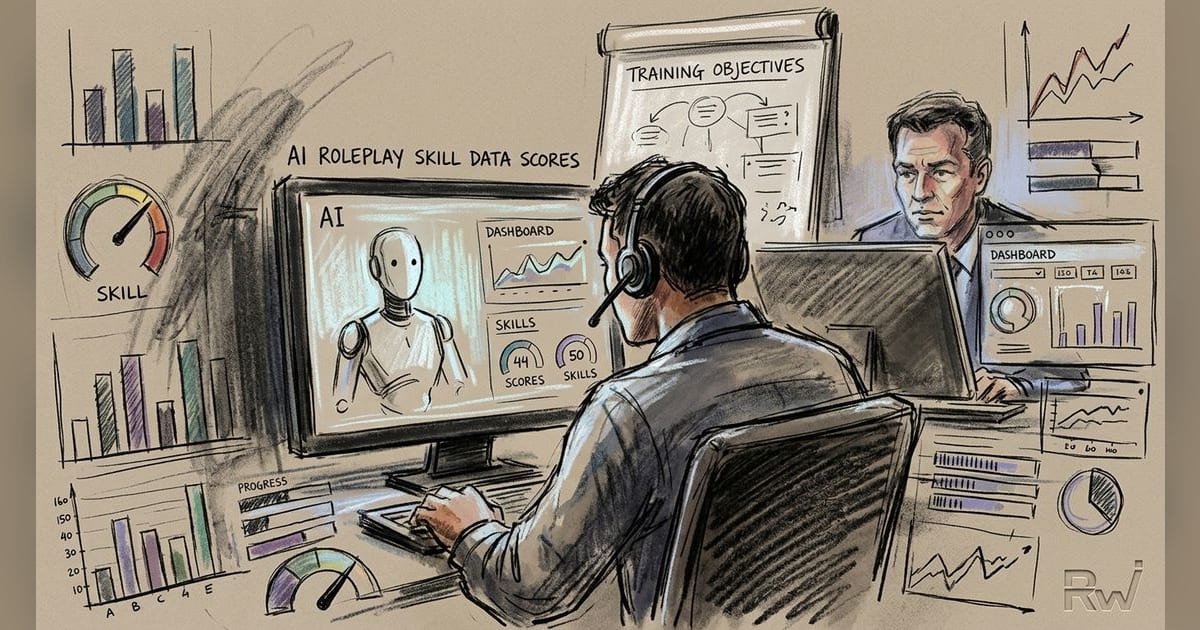
Synthesia launched Roleplay Sessions on Wednesday, July 22, a move by co-founder and CEO Victor Riparbelli to push the AI video maker into live workplace coaching and employee performance measurement.
The product gives employees an AI avatar with which to rehearse sales calls, customer complaints, performance reviews, and other difficult conversations. The avatar responds and pushes back in real time. An AI coach then asks the employee to assess the exchange, scores the attempt against a skills rubric, and recommends changes before another try. Managers receive dashboards that show scores, skill gaps, and individual transcripts, according to Synthesia's product materials.
TechCrunch reported that Roleplay is the first product under a broader Sessions platform. Synthesia plans to apply the format to job interviews and candidate screening, extending the product from training into areas that can influence hiring and workforce decisions.
Riparbelli's next enterprise move
Roleplay Sessions follows the same practical instinct that produced Synthesia's first successful pivot.
Riparbelli grew up in Denmark, studied computer science at the IT University of Copenhagen, and spent a semester at Stanford. He later moved to London, where he met computer-vision researcher Matthias Niessner. Riparbelli has said Niessner's early synthetic-video research made video generation look like a new form of computing rather than a production trick.
Riparbelli founded Synthesia in 2017 with Steffen Tjerrild, Niessner, and Lourdes Agapito. Synthesia initially sold AI dubbing and visual effects to film studios and advertising agencies. That work proved difficult to scale, and Synthesia eventually shifted toward enterprise users who needed video but lacked production budgets or in-house video skills.
Those inquiries came from large employers that wanted training and onboarding videos but lacked production budgets or in-house video skills. Synthesia followed that demand and built a browser-based system for creating presenter-led videos with AI avatars. The shift placed enterprise training, rather than entertainment, at the center of Synthesia's business.
Roleplay Sessions is another move toward the less glamorous part of the market where Riparbelli has repeatedly found demand. Synthesia already helps employers produce training content. Roleplay gives Synthesia a way to observe what happens after an employee watches it.
The product turns practice into a data layer
Riparbelli's case for Roleplay starts with a limitation in his existing product. Video can explain how to handle an angry customer or run a discovery call, but watching does not establish that an employee can perform the task.
"We learn the best by actually practicing something rather than just reading it," Riparbelli told TechCrunch.
Synthesia lets enablement managers construct scenarios around their own materials, personas, industries, and scoring criteria. Employees speak with an avatar, receive multi-dimensional scores, and can repeat the session. Results can be exported or passed into a learning-management system through SCORM.
Synthesia says a pilot at an unnamed Fortune 10 customer found that 68% of participating representatives voluntarily returned for another practice session. That figure describes return behavior, rather than proof that Roleplay improved sales or management outcomes.
The deeper product is the manager dashboard. Synthesia says supervisors can examine score distributions, individual attempts, transcripts, and skill breakdowns across a workforce. That gives buyers a measurable output for training budgets that are often evaluated through course completion rates and employee surveys.
It also raises the stakes of the product. A training tool that records conversations and ranks employee performance can shape coaching, promotion, and staffing decisions. Buyers will need clear rules governing who can inspect transcripts, how long records are retained, and whether automated scores are appropriate for employment decisions. Synthesia's product materials describe dashboards, transcripts, and skill breakdowns; they do not by themselves answer how each employer will govern the resulting personnel data.
The Series E strategy reaches the product
Roleplay Sessions is the first clear product expression of the strategy Riparbelli sold investors six months ago. In January, Synthesia raised a $200 million Series E led by GV at a $4 billion valuation. Evantic, Hedosophia, NVentures, Accel, Kleiner Perkins, NEA, PSP Growth, Air Street Capital, FirstMark, and MMC Ventures also participated. Synthesia says the financing brought its total funding to $536 million.
At the time, Riparbelli said Synthesia would use the capital to move from static, one-way content toward conversational agents for workplace learning. Roleplay delivers that shift while keeping Synthesia attached to the training departments, sales teams, and enterprise systems where it already sells video software.
That distribution matters because AI roleplay is already becoming a crowded category. Communication-coaching developer Yoodli raised a $40 million Series B in December 2025, while video platform Kaltura introduced avatar-based enterprise roleplay in April 2026.
Synthesia enters with an installed base of enterprise video customers, avatar and voice technology, localization tools, and integrations with existing training workflows. The reasoning system behind Roleplay comes from OpenAI, according to TechCrunch, which means Synthesia's defensibility rests heavily on scenario design, scoring, analytics, deployment, and the training data customers accumulate inside the product.
Riparbelli has spent years arguing that useful enterprise workflows will matter longer than viral AI demonstrations. Roleplay Sessions puts that thesis under a stricter test. Synthesia must show that its scores correspond to better workplace performance, while giving employers enough control to keep coaching data from becoming an opaque personnel rating system.