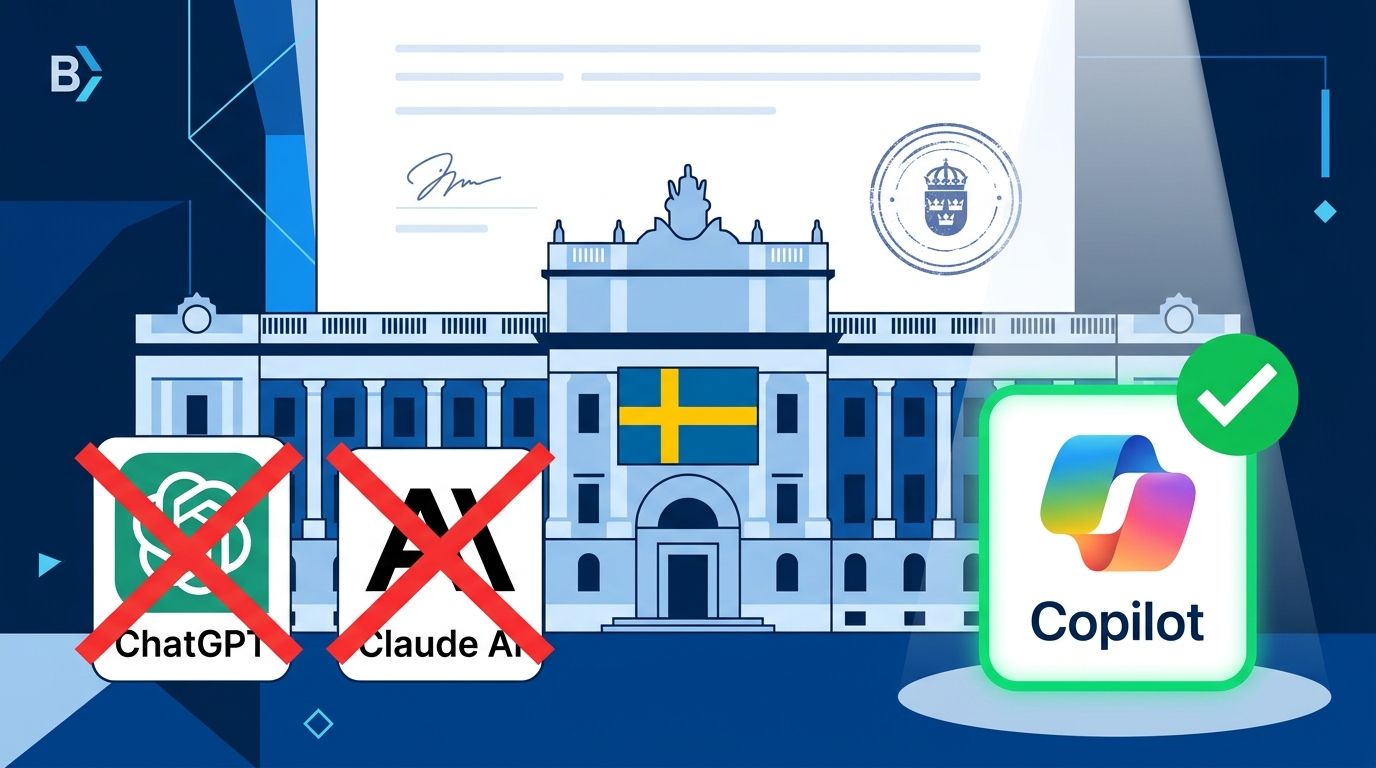
Sweden’s Government Offices banned ChatGPT and Claude from civil servant work computers today, October 23, 2026 — and the only AI tool left standing is Microsoft Copilot. Digitalization Director Mikael Wettercrantz announced the restriction on the government’s internal network, citing a concern that using AI services “without an agreement could have consequences for our information security.” The Swedish Tax Agency and the National Board of Institutional Care had already blocked AI services independently. Sweden’s Enforcement Authority is now considering its own restrictions.
Copilot Gets the Pass — Here’s Why #
This is not a ban on AI. It is a vendor decision. Microsoft Copilot cleared the government’s security review and earned approval; ChatGPT and Claude did not. The distinction matters because it tells you exactly what the Swedish government is measuring.
Microsoft 365 Copilot holds ISO 42001 certification for AI management systems, re-audited in March 2026 with zero non-conformities. For government-grade deployments, it is available in a GCC-High tier that meets FedRAMP High, DFARS, ITAR, and CMMC requirements. Enterprise Data Protection means Microsoft does not use tenant prompts or responses to train foundation models. Data stays tenant-isolated, encrypted, and auditable. Sweden already runs deep Microsoft 365 licensing across government — Copilot slots in as an extension of existing enterprise contracts rather than a new vendor relationship.
OpenAI and Anthropic have not built equivalent government-grade compliance infrastructure. That is a business development gap, not a fundamental security flaw. However, in procurement terms, the gap is decisive. Governments do not approve tools without contracts, data processing agreements, and compliance certifications. Microsoft had those. The others did not.
This Is a Pattern, Not an Outlier #
Sweden is following a playbook that other institutions have already run. The Democratic National Committee barred staffers from ChatGPT and Claude in April 2026, approving the same narrow category of Microsoft tooling. The UK Ministry of Defence and German Bundeswehr have imposed general restrictions on public LLMs for sensitive work. According to a tracker of enterprise AI bans, government and regulated-industry restrictions have accelerated sharply in 2026.
The pattern is vendor selection, not AI rejection. Governments are building approved lists with formal contracts. Everything outside that list gets blocked — not because it is inherently dangerous, but because it lacks the compliance paperwork. EU AI Act enforcement started in August 2026, with fines up to €35 million or 6% of global turnover for non-compliant AI use. The Swedish Transport Administration found staff using roughly ten different unauthorized AI services, some involving sensitive government data. That kind of unauthorized sprawl is exactly what these bans target.
The CLOUD Act Problem Nobody Wants to Acknowledge #
The Hacker News thread on this story hit 227 points and 86 comments, and the sharpest observation came quickly: replacing OpenAI and Anthropic with Microsoft does not solve the US data access problem. The CLOUD Act applies to every US-incorporated company — Microsoft, OpenAI, Anthropic alike. If US law enforcement demands data from Microsoft’s servers, Microsoft must comply, just as OpenAI or Anthropic would.
Sweden’s decision is about GDPR compliance and vendor contracts, not genuine data sovereignty. That is a legitimate reason to act — uncontracted AI tools processing government data may violate GDPR Article 28, which requires formal data processing agreements. However, framing this as a security measure obscures what is actually happening: a procurement decision that happens to benefit the incumbent enterprise vendor. True sovereignty would require European-hosted, European-governed AI infrastructure. Sweden is not there.
The Shadow AI Risk Is Real #
Bans create pressure, and pressure finds outlets. When workers find Copilot inadequate, the instinct is to pull out a personal phone and ask Claude anyway. The Swedish Transport Administration’s discovery of ten unauthorized AI services proves the demand existed before any official tool was approved. Remove the approved alternatives and you do not eliminate usage — you just lose visibility into it.
Security teams building enterprise AI policies face the same tension. Blocking tools without providing capable alternatives does not reduce AI use. It pushes that use onto personal devices, off corporate networks, and out of audit logs. Sweden has a Copilot license and a ban. Whether that ban holds depends entirely on whether civil servants find Copilot good enough to stop reaching for something else.
Key Takeaways #
- Sweden’s ban is a vendor selection: Microsoft Copilot is approved; ChatGPT and Claude are not. The difference is enterprise contracts and compliance certifications, not fundamental security architecture.
- OpenAI and Anthropic face a growing procurement gap. ISO 42001, FedRAMP equivalents, and government data processing agreements are becoming table stakes for public sector access.
- Switching from Claude to Copilot does not solve data sovereignty — the CLOUD Act applies to Microsoft too. This is GDPR compliance enforcement, not independence from US jurisdiction.
- Banning tools without capable alternatives creates shadow AI. The security problem does not disappear; it becomes invisible and unauditable.
- If you build software for government clients, assume approved vendor lists will tighten. Design around configurable AI backends, not hardcoded provider dependencies.