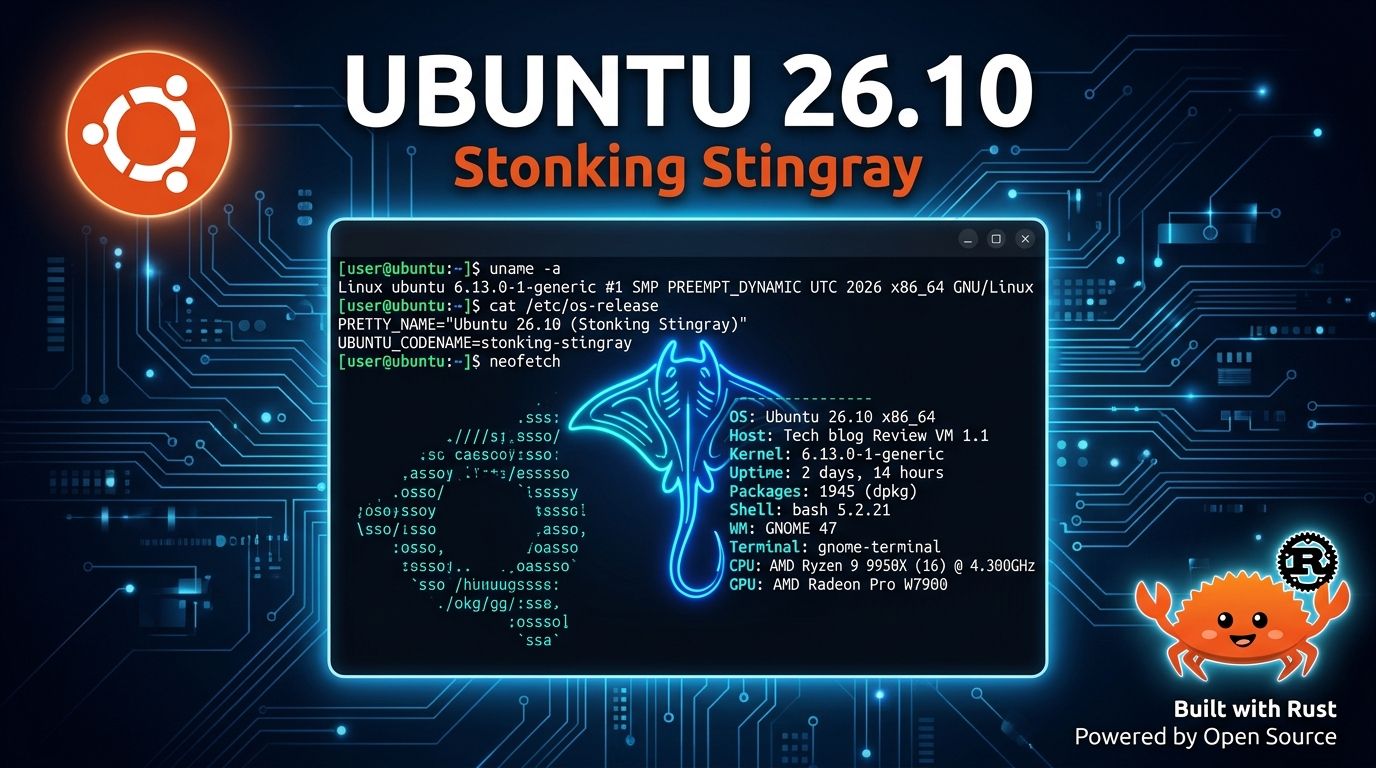
Ubuntu 26.10 “Stonking Stingray” shipped October 15, and this one is worth paying attention to. Three things happened at once: the years-long migration to Rust-based coreutils is complete, APT now signs packages using quantum-resistant cryptography, and there is a local AI dictation tool that keeps all audio on your machine. Most Ubuntu releases are incremental. This one closes loops that have been open for years.
Rust Coreutils: The Finish Line #
Since Ubuntu 26.04 LTS, most GNU coreutils had already been replaced by uutils, the Rust reimplementation. But three commands stayed on GNU: cp, mv, and rm. The reason was concrete — uutils had TOCTOU (time-of-check to time-of-use) race conditions in file copy operations. uutils 0.9.0, released May 2026, introduced a TOCTOU-resistant copy module. That was the unlock. Ubuntu 26.10 ships 100% Rust coreutils.
GNU coreutils is not removed — it becomes an opt-in package. But the default has flipped.
An independent test of 162 common shell commands found identical behavior in 150 cases. The 12 differences are narrow: version string output no longer says “GNU,” a few error messages are worded differently, and some Unicode edge cases behave slightly differently. If your build scripts parse --version output looking for “GNU,” they will break. If you have set -e scripts that depend on specific exit codes from error conditions, test them first.
This is not a language preference argument. An audit found 44 CVEs that the move to memory-safe implementations addresses. The migration delivers real security improvement.
Myna: Local AI Dictation That Does Not Phone Home #
Ubuntu 26.10 introduces Myna, an opt-in speech-to-text feature. It works as push-to-talk dictation: hold a hotkey, speak, release, and the transcribed text appears at your cursor. All processing happens on-device. Audio is held in a memory buffer and discarded when the session ends. Nothing leaves your machine.
Under the hood, Myna supports three engines — Parakeet, Whisper, and FunASR — and three model sizes: lightweight, default, and quality. It runs on NVIDIA GPUs, Intel NPUs, and standard CPUs. It is not pre-installed and needs to be enabled separately in Ubuntu 26.10.
What Myna does not do: no wake words, no continuous listening, no voice commands, no translation, no speaker identification. It is dictation and only dictation. Canonical keeps the first version narrow in scope.
Compare this to Apple Intelligence, which routes processing through Apple’s Private Cloud Compute infrastructure, or Microsoft Copilot+, which ties local inference to specific NPU hardware and Windows. Myna runs locally on any supported hardware with no opt-out clause, because there is no cloud component to opt out of. That is a deliberate architectural decision. Myna is a technology preview — not a finished product — but the privacy architecture is the right foundation.
Post-Quantum APT: Sequoia PGP Is Now Default #
APT now verifies repository signatures using Sequoia PGP, a Rust-based OpenPGP implementation, instead of GnuPG. The sq and sqv tools replace gpg and gpgv as the default. GnuPG is still available — it is not removed.
Sequoia supports ML-DSA and ML-KEM, the post-quantum algorithms NIST standardized in 2024. The quantum threat to RSA is not immediate, but supply chain security is exactly where you want quantum-resistant cryptography in place before you need it. “Harvest now, decrypt later” attacks are a real concern for data signed or encrypted today.
Ubuntu 26.10 also ships OpenSSL 4, adding Encrypted Client Hello (ECH), expanded QUIC support, and post-quantum improvements. OpenSSL 4 is a major version with breaking API changes — if you have custom SSL code or third-party libraries pinned to OpenSSL 3 APIs, test before upgrading.
Developer Toolchains #
The full toolchain lineup shipped in Ubuntu 26.10:
- Python 3.14.7 — bugfix release
- Rust 1.97.1 — LLVM miscompilation fixes
- Go 1.27 — generic methods finalized, GODEBUG settings
- Zig 0.16 — now in default repos, no PPA required
- GCC 15.2.0 — C++ modules support
- LLVM/Clang 22.1.8 — ARM, RISC-V, x86 CPU extensions; improved WebAssembly debugging
- OpenJDK 25.0.4 — stability improvements; version 27 available separately
- ROCm 10.0 — adds gfx950 (MI350/MI355) targets, new HIP libraries
Go 1.27 generic methods are the headliner for backend developers. Zig 0.16 landing in the default repos — no PPA, no manual setup — is a quiet but welcome change for systems programmers. ROCm 10.0 adds the gfx950 GPU targets needed for AMD’s MI350 and MI355 accelerators, plus new libraries including composable-kernel, hipsparselt, and migraphx.
Should You Upgrade? #
Upgrade your development workstation if you want the latest toolchains, want to try Myna for dictation, or need ROCm 10.0 for AMD AI work.
For production servers, stay on Ubuntu 26.04 LTS, which is supported until 2031. You do not need the OpenSSL 4 API changes or coreutils edge cases in production pipelines. Known issues: AMD dual-GPU laptops may experience display freezes from panel self-refresh, Snapdragon X Elite Wi-Fi has a suspend reconnection bug, and Intel AX211 Wi-Fi shows instability on some systems.
Ubuntu 26.10 has a 9-month support window through July 2027. The next LTS is Ubuntu 28.04, due April 2028. The download is available now from ubuntu.com. For the full list of changes, the official release notes are thorough.