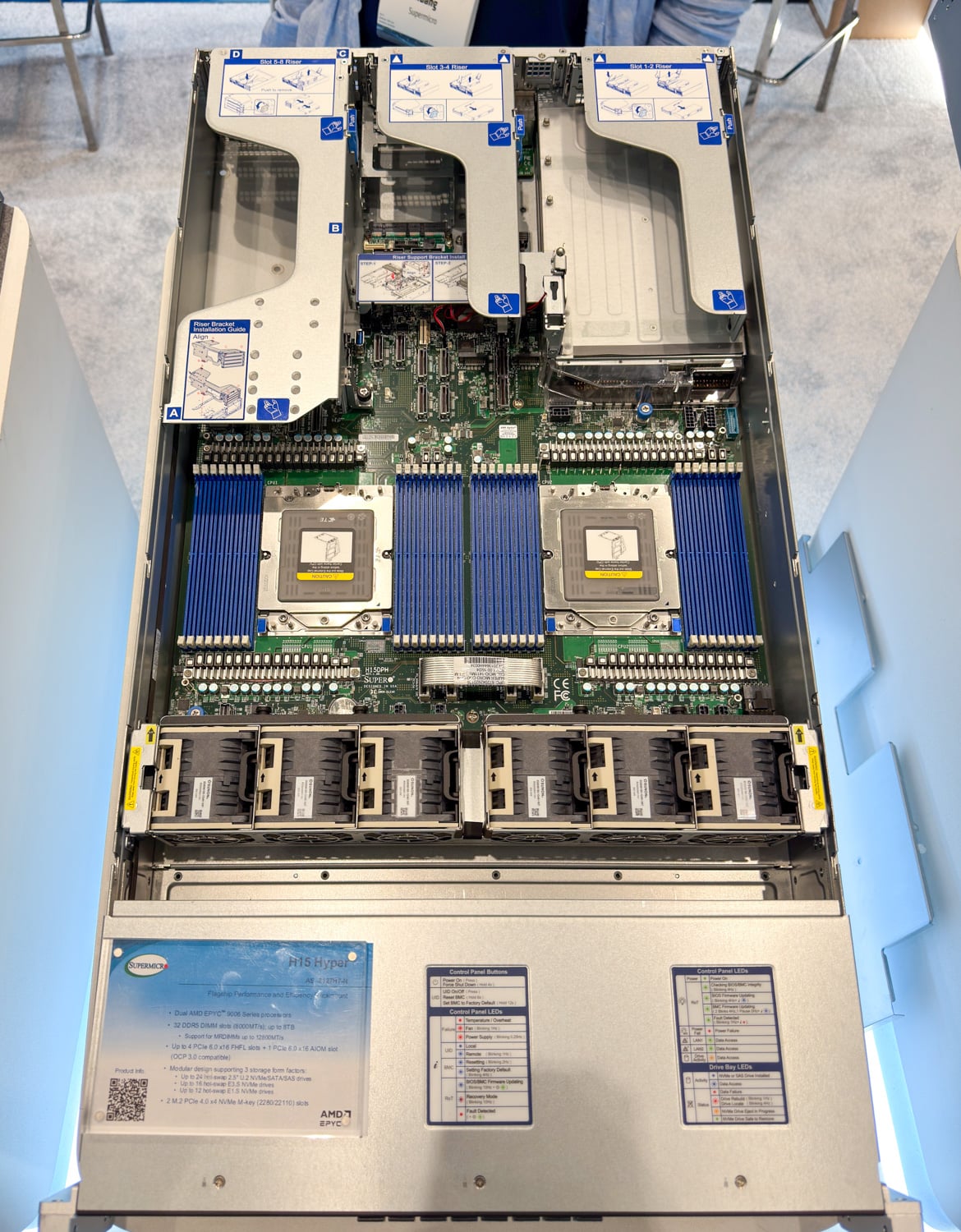
Supermicro introduced its new H15 server portfolio, built around 6th Gen AMD EPYC 9006 Series CPUs. These servers are designed to work with AMD Instinct GPUs and AMD Pensando networking solutions. In addition, Supermicro is expanding its AMD GPU offerings with new PCIe GPU servers built for AMD Instinct MI350P GPUs and the previously announced Supermicro AMD Helios rack-scale platform, which incorporates AMD Instinct MI455X GPUs. This announcement includes details about the CPU platform, GPU and networking hardware, and the rack-scale system that integrates these components, targeting agentic AI, cloud, enterprise, and HPC workloads.
H15 Architecture and CPU Platform
The H15 architecture is based on Supermicro’s Data Center Building Block Solutions (DCBBS), which standardizes modular rack-scale deployment across its server range rather than designing each chassis individually. H15 systems support 6th Gen AMD EPYC 9006 Series processors with up to 256 cores and 512 threads per socket, which Supermicro says deliver up to 1.7x the generational performance of the prior lineup while offering more memory and I/O bandwidth. The company’s key message is simple: increased cores and memory bandwidth per socket let users run more AI agents or enterprise workloads per node without surpassing power limits, a critical factor as data center power availability often restricts rack capacity rather than compute density.
Six System Types Across the H15 Portfolio
Supermicro classifies the H15 lineup into six system categories, each tailored for specific deployment scenarios. The Hyper platform is the flagship dual-socket model, designed for enterprise applications, AI inference, virtualization, and cloud workloads, and features a thermal design capable of supporting top-tier AMD EPYC processors. CloudDC is available in both single- and dual-socket versions and adheres to the Open Compute Project’s Data Center Modular Hardware System (DC-MHS) standard, enabling interoperability with other OCP-compliant data center components rather than restricting users to a Supermicro-specific rack system.
GrandTwin is a high-density 2U, four-node system designed for scale-out workloads like object storage, virtualization, cloud services, and HPC. FlexTwin offers a more compact 1U, two-node, dual-CPU setup with liquid cooling, tailored for cloud-native and hyperscale environments where rack density and power efficiency take precedence over node flexibility. Supermicro’s Petascale Storage series rounds out its non-GPU portfolio with high-capacity all-flash platforms in 1U and 2U form factors, supporting up to 4.8PB per system for AI data lakes, large-scale analytics, and HPC storage. These platforms are built on software-defined storage rather than fixed hardware RAID.
The H15 8U 10-node SuperBlade is the rack-scale blade system in the portfolio, supporting single- and dual-socket blade configurations in air- or liquid-cooled options. It is designed for mixed CPU and GPU deployments used in HPC, AI inference, agentic AI, and enterprise computing, providing high blade density without requiring a full GPU rack.
New PCIe GPU Servers for AMD Instinct MI350P
Supermicro introduced two 5U PCIe GPU servers, the AS-5126GS-TNRT and AS-5126GS-TNRT2, featuring AMD Instinct MI350P PCIe GPUs. Each system can support up to 10 GPUs within a standard 5U air-cooled chassis, maintaining compatibility with data centers that already support such cooling and power configurations and avoiding the need for liquid cooling. The MI350P GPU provides up to 144GB of HBM3e memory and supports low-precision AI numeric formats, making it suitable for both inference and training workloads where memory capacity, rather than raw compute power, is often the limiting factor.
Open Ethernet Networking via Pensando Pollara 400
Supermicro’s MI350P systems utilize the AMD Pensando Pollara 400 AI NIC, an open Ethernet networking card designed for AI infrastructure. It manages front-end, storage, and scale-out traffic in MI350P deployments. Since it operates over standard Ethernet rather than a proprietary interconnect, Pollara 400 enables customers to scale their cluster from a single server to multi-rack setups without being locked into a closed networking stack. This flexibility is a key point that Supermicro and AMD highlight as a competitive advantage over interconnect options limited to a single GPU vendor’s ecosystem.
Supermicro AMD Helios: 72-GPU Rack-Scale Platform The Supermicro AMD Helios Platform, created in partnership with AMD, is a liquid-cooled, 72-GPU rack system designed around AMD Instinct MI455X GPUs, 6th Gen AMD EPYC processors, AMD Pensando networking, and the AMD ROCm software suite. It targets large-scale AI training and high-throughput inference for organizations working with frontier-scale models and can scale from a single rack to larger multi-rack AI clusters. Helios and the new PCIe GPU servers serve different deployment needs: MI350P PCIe systems for enterprises expanding GPU inference or training within existing air-cooled setups, and Helios for organizations constructing dedicated, liquid-cooled AI clusters on a much larger scale.
Supermicro President and CEO Charles Liang explained that the H15 launch emphasizes building infrastructure tailored for performance, scalability, and efficiency, especially as agentic AI adoption increases. He highlighted the DCBBS architecture as key to achieving high performance while enabling flexible rack-scale deployment. Additionally, he mentioned Supermicro’s global services and U.S.-based supply chain as vital supports for customers deploying and scaling AI infrastructure.
AMD’s senior vice president and general manager of Compute and Enterprise AI, Dan McNamara, emphasized that enterprises scaling agentic AI require infrastructure that provides performance, efficiency, and deployment flexibility. He described how combining AMD’s EPYC CPUs, Instinct GPUs, and Pensando networking with Supermicro’s modular server and rack-scale designs can accelerate AI infrastructure deployment while enhancing resource utilization, energy efficiency, and total cost of ownership.