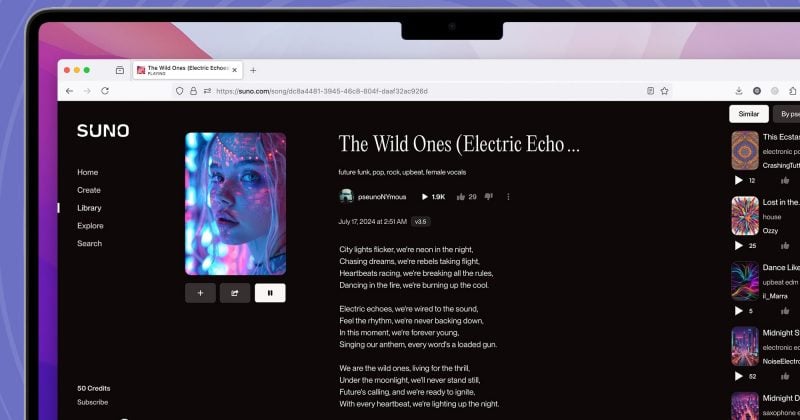
The AI music startup more than doubled its valuation in seven months while Sony and UMG seek to expand their infringement claims to over 61,000 additional recordings.
Suno, the AI music generation platform that lets anyone create songs from text prompts, just closed a funding round north of $400 million at a $5.4 billion valuation. That’s more than double the $2.45 billion price tag it carried just seven months ago after its $250 million Series C in November 2025.
The round was led by Menlo Ventures, where partner Amy Wu Martin apparently got hooked on the product by making AI-generated songs for her son. She led the firm into the Series C last fall and then came back for seconds. Bond Capital, IVP, Forerunner, Lightspeed, and Matrix also participated.
A growth story with a legal asterisk #
The numbers backing up this valuation are genuinely impressive. Suno has roughly 2 million paying subscribers and is pulling in approximately $300 million in annual recurring revenue. Users are spending an average of 55 minutes per session on the platform.
For context, Suno raised $125 million in May 2024 at a valuation of around $500 million. So in roughly two years, the Cambridge, Massachusetts-based company went from $500 million to $5.4 billion. The Recording Industry Association of America filed a lawsuit against Suno in June 2024, representing Sony Music, Universal Music Group, and Warner Music Group. The core allegation: Suno used copyrighted recordings to train its AI models without authorization.
The lawsuit hasn’t exactly gone away. UMG and Sony recently sought to expand their claims to include more than 61,000 additional recordings. Suno is opposing the expansion.
Warner Music Group, for its part, took a different path. It settled with Suno in November 2025 and entered into a licensing agreement.
Why this matters beyond music #
The expansion request covering 61,000 additional recordings isn’t just a legal formality. It’s a signal about how aggressively the labels intend to pursue this.
Co-founded by CEO Mikey Shulman, CTO Georg Kucsko, and President Martin Camacho, Suno appears to be betting that the industry will ultimately prefer revenue-sharing to litigation.
What investors should watch #
The pace of Suno’s valuation growth, from $500 million to $5.4 billion in about two years, shows that investors are pricing in massive upside despite legal uncertainty.
The Warner settlement suggests the industry is already bifurcating. Some labels will fight, others will negotiate. The companies that secure licensing deals early will have a structural advantage over competitors who don’t, because they’ll be able to operate without the legal cloud.
The $300 million ARR figure is worth watching closely. If Suno can maintain its growth trajectory while absorbing licensing costs, it validates a business model that other AI creative platforms will try to replicate. If licensing costs prove too burdensome, it raises questions about whether AI-generated content can be profitable at scale when creators of training data demand their cut.
Disclosure: This article was edited by Editorial Team. For more information on how we create and review content, see our