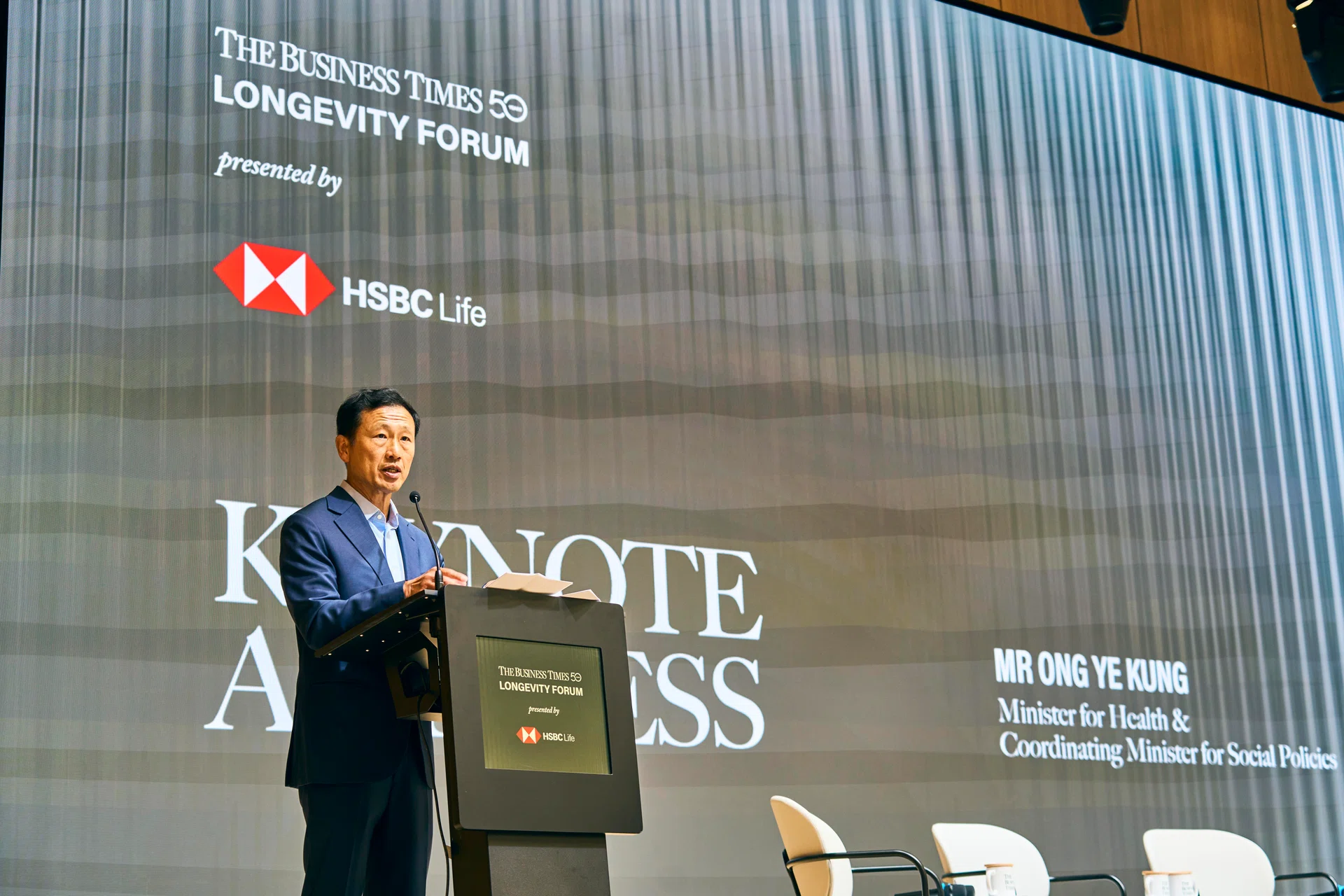
He highlights biomedical sciences, health regulation, nutrition and AI as key growth areas
[SINGAPORE] As Singapore becomes a super-aged society, the Republic should seize opportunities to build a longevity economy by strengthening sectors such as biomedical sciences, nutrition and artificial intelligence, Minister of Health Ong Ye Kung said on Saturday (Jul 25).
Speaking at The Business Times Longevity Forum, presented by HSBC Life, Ong said Singapore’s ageing population will create significant economic opportunities as older generations become wealthier and spend more on retirement living, investment products, insurance, tourism, wellness and healthcare.
Citing a global McKinsey study, he noted that baby boomers – those born between 1946 and 1964 – spend about three times as much as Gen Z travellers, born between 1997 and 2012, underscoring the spending power of older consumers.
Ong also pointed to the rapid expansion of the global wellness industry, noting that it had grown from about US$4 trillion a decade ago to US$7 trillion in 2024, and is expected to approach US$10 trillion by the end of the decade.
But Ong stressed that not every commercial opportunity in healthcare should be pursued.
“Healthcare is fundamentally an essential public service, with a strong imperative to ensure quality, accessibility and affordability for our patients and families, especially as the population ages,” he said.
“So, the wrong kind of growth can seriously undermine the public and social objective of healthcare.”
Ong reiterated his longstanding warning against overly generous health insurance, saying it can create a “buffet syndrome” that encourages the overconsumption of diagnostic tests, medication and medical procedures.
“Anxious patients who are worried about small discomforts may undergo numerous expensive diagnostic scans, which can be unnecessary and do more harm than good,” he said.
If unnecessary treatment and over-servicing become widespread, Singapore would create neither better health nor greater wealth, but simply higher costs, Ong added.
Where the opportunities are #
Noting that biomedical R&D, as well as manufacturing, are key priorities under Singapore’s national Research, Innovation and Enterprise 2030 programme, Ong highlighted the sector’s strong presence in Singapore.
The Republic is home to more than 80 leading biomedical companies’ regional headquarters, 60 manufacturing plants and 30 R&D centres. The biomedical manufacturing sector generated more than S$30 billion in output in 2024.
Building on these strengths, he said Singapore will take steps to strengthen its position as a destination for clinical trials.
For instance, pharmaceutical companies often face challenges working across multiple public healthcare providers. To address this, Singapore has streamlined the contract review process across institutions, introduced a harmonised budget template, and rolled out a fast-track ethics review lane at SingHealth.
Health product regulation is another area of opportunity, Ong said, noting that the Health Sciences Authority’s approvals are recognised by more than 10 overseas regulators.
“This means that securing approvals here can open doors to markets across the region and beyond. Singapore can become a gateway to many other markets for medicines and medical devices,” he said, adding that this would enable patients in Singapore to gain earlier access to new treatments than those in many other markets.
Ong also pointed to nutrition and food science, saying Singapore can become an R&D hub and manufacturing base for innovative food products that support healthy ageing.
AI is also expected to play a growing role in healthcare by improving hospital operations, supporting clinical decision-making and identifying individuals who may benefit from preventive care, he added.
Beyond these areas, Ong called for a stronger partnership between the government and private sector.
“We cannot just leave it to the market. In healthcare, it just doesn’t work,” he said.
“It has to be a conscious effort from both the commercial sector and government to forge a meeting of minds. Then we can grow the longevity economy in a way that directly reinforces the public objective of healthcare.”
Ong said the government must also “lean forward” by working with industry to shape markets, rather than regulating from a distance.
This includes setting clear public health objectives and policy frameworks such as Healthier SG, Age Well SG and Nutri-Grade labelling, while sharing problem statements, supporting responsible innovation and partnering enterprises to address the challenges of an ageing population.
He added that Singapore has never pursued economic growth at all costs, noting that healthcare requires a careful balance between commercial opportunities and the public good.
“The government needs to partner the commercial sector, leverage its energy, creativity, innovation and investment, while keeping the longevity economy anchored on dignity, on affordability, and on its public purpose and better lives for the people,” he said.
Decoding Asia newsletter: your guide to navigating Asia in a new global order. Sign up here to get Decoding Asia newsletter. Delivered to your inbox. Free.
Copyright SPH Media. All rights reserved.