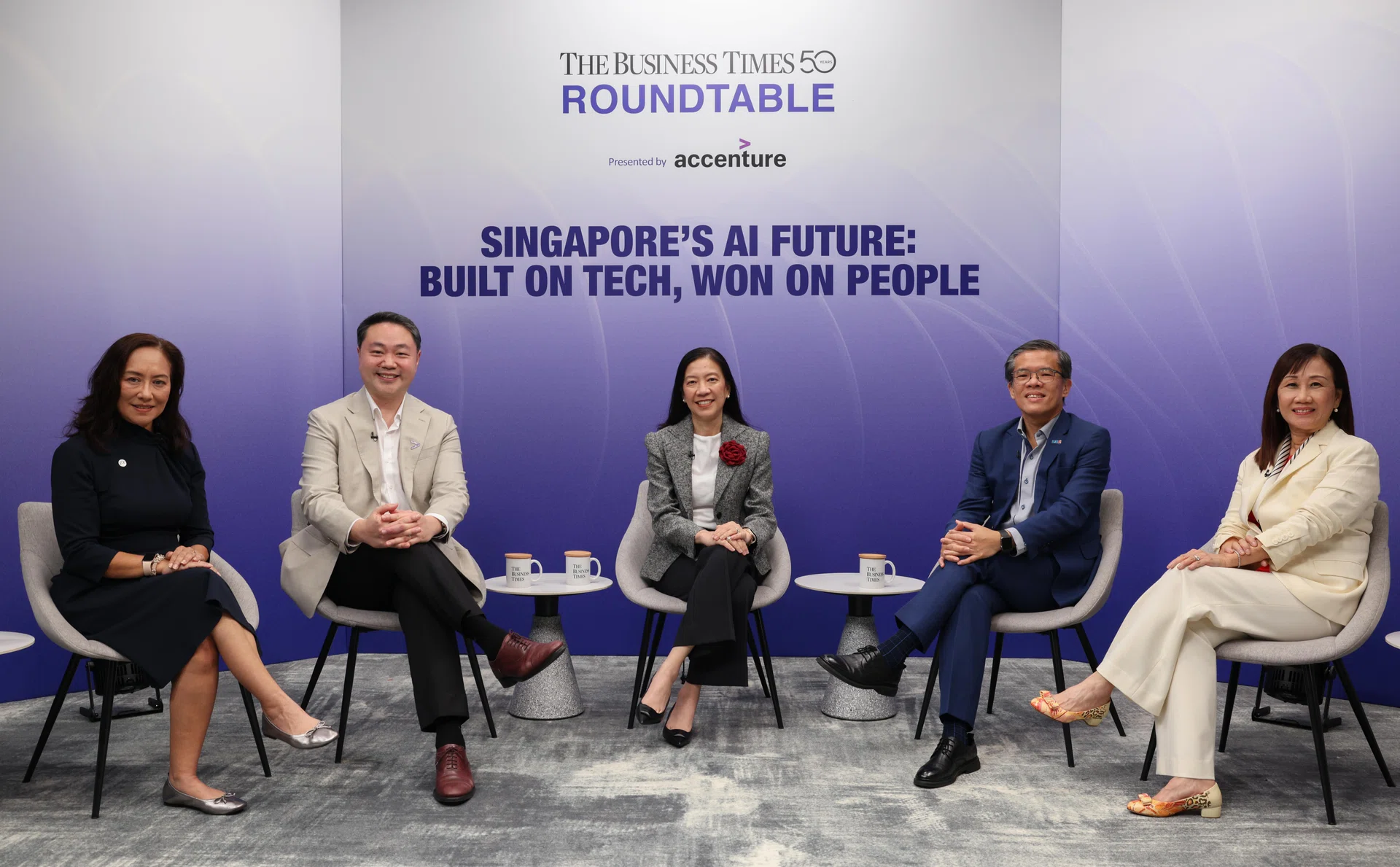
Roundtable panellists say implementation must be accompanied by job redesign, training and complementary skills
[SINGAPORE] While businesses are implementing artificial intelligence and more workers are using AI tools, true transformation is still lacking, said participants at a roundtable on Thursday (Aug 27).
The roundtable was titled Singapore’s AI Future: Built on tech, won on people, and was organised by The Business Times in partnership with Accenture.
Panellists called for employers to create the right conditions to scale the technology, and for employees to pair AI use with domain knowledge and core skills.
According to an Accenture report, 90 per cent of organisations have moved to implement AI, but nearly half (46 per cent) of technology leaders say their company has yet to redesign a single role. Meanwhile, almost half (48 per cent) of entry-level workers say they are AI confident – but most report beginner-level understanding of the skills employers need.
A Singapore Business Federation (SBF) survey of about 500 companies found that only 30 per cent of participants adopted AI. Breaking that down further, adoption stands at about 76 per cent for large companies, 62 per cent for medium-sized ones, and only 24 per cent for smaller companies, according to the apex business chamber’s chief executive officer Kok Ping Soon.
“Even of those companies who reported that they have adopted AI, many are still using off-the-shelf tools,” added Kok. “Those that are deeply integrating it into their processes is only about 4 per cent.”
Not just the roll-out #
Mark Tham, country managing director at Accenture Singapore, raised several examples of what he sees as “transformation”.
In one instance, a major port operator looked at ways to drive better operations, such as by automating cranes. This then allows them to think about reskilling crane operators to become specialists in controlling a fleet, he suggested.
Last year, Accenture collaborated with the National Library Board on the ongoing Albatross File exhibition, which explores the road to Singapore’s separation from Malaysia through newly declassified documents. They created an AI-powered “chatbook”, where visitors could ask questions, allowing the library board to “teach history outside of a classroom setting”.
But Tham also flagged that few “frontrunner companies” have successfully scaled AI across the enterprise.
The ones that have been able to do so are those that focus on the investment in workforce transformation, for the same amount of investment put into AI lifecycle engineering, he added.
Tham named a few reasons why organisations struggle to scale successfully.
One is the lack of a solid data foundation, which he said is a key success factor and the “first step of the equation”. There is also technical debt – the cost in money and effort required for a company to keep its IT systems up-to-date and capable of meeting business needs – and inorganisation.
Legacy operating constraints could also exist, where operating models are old and need to change, he said. And the “joints” between people, data, workflows and models could also need to be addressed.
Kok agreed with Tham that whether a company has a manageable dataset is one factor that determines its ability to scale AI. He raised an example of a local third-party logistics company, which redesigned core work processes and integrated a digital system into its logistics to track workers and assets, “even before AI was fashionable”.
Then, when the new technology arose, it implemented a virtual assistant for business intelligence, resulting in a 20 per cent increase in revenue, a 30 per cent increase in profit, and a reduction in route planning time from 15 minutes to about three minutes. “The lesson here is that for any company to succeed in transforming their business with AI, it is not going to be one leap,” he said.
Kok also highlighted two other deciding factors for scaling AI: whether the company has a process worth redesigning; and whether it has management ownership of the outcome.
On the last point, he noted that many companies begin their AI adoption with their IT departments.
But to be successful, the business owner must understand what processes need to be changed, and human resource leaders must then be brought in to discuss the changes in workforce capabilities required to keep pace.
He also highlighted the need to invest time, in order to achieve the desired outcomes.
Citing a study by the Ministry of Trade and Industry, Kok noted that improved productivity and profit usually do not come within the first four years of AI adoption, as time is needed for data to be cleaned and processes to be improved.
Dilys Boey, chief executive of the new Skills and Workforce Development Agency (SWDA), said: “Employers do need to move away from the mindset of plug and play, that there’s really talent out there because every other organisation is building up capability.” Instead, they should each be investing in training, she added.
For the small and medium-sized enterprises that lack resources or capabilities to do so, the government can step in to provide support – not just financially, but also through access to good training programmes and consultants that can help them navigate the journey of job design, Boey said.
Context required #
Boey also said that government agencies such as SWDA support individuals by building better tools to help them navigate and access training programmes.
They also work with training providers to ensure that these programmes are industry relevant, job relevant and function relevant.
But individuals have a stake in “building (their) own career resilience”, and should take responsibility for identifying and filling their own skills gaps, as well as working with employers to use these skills at work.
“I think we need to understand assessments of AI skills in the context of firm adoption of AI,” she said.
She pointed out that some employees likely experiment with AI tools in the course of their work – such as using simple, day-to-day productivity tools to research a wider swathe of information, put together initial drafts and create graphics – even if their firms have yet to adopt it.
“Maybe that’s where the confidence comes in assessing that they understand some of the basic tools,” she suggested.
Still, to adopt AI more pervasively, workers must have a “broad suite of skills”. This includes functional and business-related domain skills as well as AI skills, including related areas such as governance and ethics.
Critical core skills are a third part of the combination, where humans must be able to define the problem, verify AI’s output, challenge assumptions it produces, and make decisions and take ownership and accountability for the outcomes.
Kok agreed as he made the point that AI fluency “is not just about knowing how to prompt, but knowing how to verify the sources, challenge it when need be, and understand where human judgment is still needed”.
On the other hand, some employees may still feel fear and anxiety in picking up AI.
DBS’ head of group human resources, Lee Yan Hong, described AI as an enhancer to drive growth, which in turn will create more jobs.
“We save people, not jobs,” she said.
The bank’s AI strategy is formed around three pillars, she said.
First, communicate with clarity, authenticity, transparency, and purpose.
This means articulating that AI can take over “toil”, freeing up time for them to spend on “more human” tasks such as customer service. It also means highlighting the bank’s commitment to upskilling and reskilling.
Also important is to shape the narrative, Lee said.
Shifting the question from “What is AI doing to you?” to “What is AI doing for you?”, can help to build their confidence in using it, she added.
It also helps to communicate to staff that they are in control, she said. In building AI agents, giving instructions and determining the output, a person is “completely in the loop”, said Lee. “I am not only in the loop. I am in the lead.”
Second, make AI pervasive. This means ensuring that everybody has access to tools, which has a “multiplying effect”, and empowering staff to change or redesign processes, and to upskill and reskill themselves.
The bank has now incorporated AI into several functions.
The technology reduces the time corporate bankers spend on creating credit memos, freeing up time to engage customers.
At its call centre, AI is used to retrieve information from DBS’ databases and transcribe and summarise conversations.
The human resources team has also built a generative AI-powered coaching tool, to democratise access to coaching, Lee said.
And third, bring your people along.
DBS uses a “five E” framework to do this: excite, which it does through festivals and leaderboards; enable, by providing tools; educate, whether on the job or through training programmes and roadmaps; empower, by letting them change workflows and reorganise; and embed, by ensuring everybody is involved and creating guardrails.
By implementing these pillars, it is able to ensure that the AI journey is sustainable, Lee said.
Decoding Asia newsletter: your guide to navigating Asia in a new global order. Sign up here to get Decoding Asia newsletter. Delivered to your inbox. Free.
[Artificial Intelligence](https://www.businesstimes.com.sg/keywords/artificial-intelligence?ref=article-bottom-keyword)

[Singapore manpower](https://www.businesstimes.com.sg/keywords/singapore-manpower?ref=article-bottom-keyword)

[Jobs and skills](https://www.businesstimes.com.sg/keywords/jobs-and-skills?ref=article-bottom-keyword)

[Singapore jobs](https://www.businesstimes.com.sg/keywords/singapore-jobs?ref=article-bottom-keyword)

[Science & technology](https://www.businesstimes.com.sg/keywords/science-technology?ref=article-bottom-keyword)

[Singapore's AI future](https://www.businesstimes.com.sg/singapores-ai-future?ref=article-bottom-keyword)
Copyright SPH Media. All rights reserved.