Businesses, workers and the government share responsibility to ensure everyone benefits from AI
[SINGAPORE] Featuring both private and public sector leaders, *The Business Times *roundtable on Singapore’s artificial intelligence future explored topics ranging from protecting “first rung” workers to measuring jobless growth.
These are edited excerpts from the event on Thursday (Aug 27).
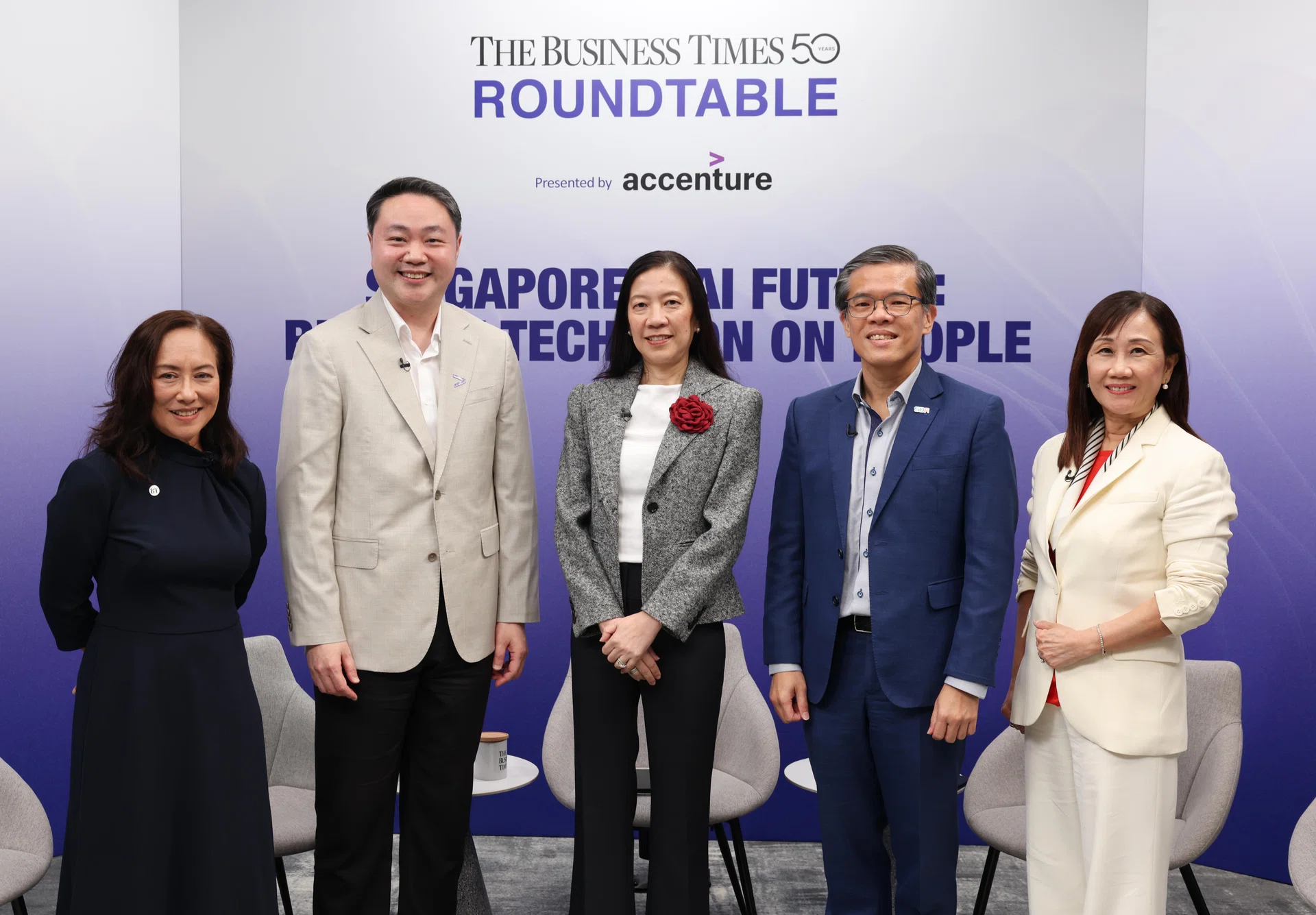
ROUNDTABLE PANELLISTS
- Kok Ping Soon, chief executive officer, Singapore Business Federation;
- Mark Tham, country managing director, Accenture Singapore;
- Dilys Boey, chief executive, Skills and Workforce Development Agency;
- Lee Yan Hong, head of group human resources, DBS;
- Moderator: Claressa Monteiro, head of audio, The Business Times.
Claressa Monteiro: We talk about whose responsibility it is to adopt AI, and the answer is obviously “everyone’s”. As a shared responsibility of business, government, and individual, how do we protect that first rung?
**Kok Ping Soon: **Because AI is so easily available, workers can get into a state of “cognitive surrender”. Because you don’t need to think, the answers generally look so pretty and correct, you just run with it. This is why I am very concerned about that first rung of the ladder.
Firms are profit-maximising. Work that we used to get junior developers to do, we now get AI to do instead. What we are worried about is that firms can get an immediate improvement in efficiency, but they are going to lose that pipeline of talent.
Go back to our days – we prepared slides, we read through so many documents. From this, we understand the context, spot the patterns, tune our judgment. That is how we all learn.
A study by the Ministry of Trade and Industry found that the first batch of workers benefiting from AI are the higher-skilled, higher-paid ones aged 35 to 44. Why? Because they have already gotten the experience, and now AI is highly complementary.
In this shared responsibility, employers have to be more far-sighted – look at how to redesign jobs even for junior workers to ensure they can go through the learning process and learn how to challenge AI.
Structured apprenticeships would help, and that’s where the government can come in. It does not make sense for private companies to hold so many juniors if they do not need them, so government support is needed. And don’t just use government funding for general training.
Maybe our universities also need to relook at their curricula. For a four-year course, the last year could be a structured apprenticeship in a company.
Monteiro: Transformation is supposed to be human-led. But for a CEO who wants to act on it, what does that actually mean?
**Mark Tham: **The AI lifecycle engineering – data engineering, operations, technology, ecosystem – is the easy part. There is no lack of information.
But the attention must also be on organisational change. Know your organisational strategy, understand your workforce, the culture, the workflows that are going to be re-engineered, as well as risk and governance, because trust is very important and you need to put in the right guardrails.
CEOs need to think of these two dimensions together, not one over the other, and not one as an afterthought. From their faces, sometimes I can see they have not really thought about people. You need to talk to your people at town halls, and say, “We are doing this with your interest at heart”, and demonstrate why.
This is so important because ultimately, humans are the ones who provide the context. You don’t want a situation where humans feel: “Why should I train a machine that is going to replace me?”
Monteiro: Young Singaporeans believe the AI ambition is achievable, but doubt it’s being pursued in a genuinely people-centric way. What does that gap tell you, and what needs to happen next?
**Dilys Boey: **An SWDA sentiment survey found that the anxiety rests with the younger workforce. For late careerists – the Gen Xers – there was some level of positivity. Maybe it’s a function of Gen X being a latchkey generation that went from landlines to pagers to smartphones. We have a perspective of mastering technology.
For early careerists, the concern was not about the AI tools or the technology itself, but cognitive decline. “Will I be able to apply my creativity? Where are the jobs?” I think these are questions progressive employers need to think about.
A lot of tech, infocomm and computer science graduates want to go into big tech firms and big banks, but a lot of innovation is happening in progressive mid-sized companies. Maybe we need to build more visibility and confidence in those job opportunities.
Quite a number of universities are already embarking on project-based, industry-driven use cases where students work with industry to solve problems.
To scale AI, more corporate companies must commit to not just delivering learning for their employees, but building talent that can then be effectively released to mid-sized companies that do not have the capability to train or put in place apprenticeship programmes on their own.
SWDA is embarking on this by building up our SkillsFuture Queen Bees. When ecosystem partners are uplifted, the companies themselves also benefit.
The government also works with a pool of career advisers, coaches, and with the unions and private providers, to help individuals navigate the job market.
We are building up the job bank, encouraging employers to post jobs, and making it more transparent so individuals know where the opportunities are. So we build up the digital tools as well as enablers.
Monteiro: The concept of “no jobless growth” is great, but how are we measuring that?
**Boey: **It’s really a function of the whole economy coming together. But from a workforce perspective, we are already tracking things that companies are putting in place.
For example, a recent Ministry of Manpower study looked at the number of companies that are already embarking on job redesign. On top of that, a measure that is less explicit in the macro view is individuals’ own skill stock, and how we are developing our skills to keep relevant for that next move, next role, whether within the company or outside of the company.
**Kok: **One indicator we watch closely is the employment rate of our graduates six months after graduation. We saw that dropped from about 87 per cent in 2022 to about 74 per cent in 2025. We cannot blame this entirely on AI, but it is inescapable that AI is coming at a time when the job market for young graduates is pretty weak and under pressure.
I don’t think the outcome is to preserve every entry level task, but we should certainly preserve entry level learning pathways.
The challenge at the economy level is that job displacement and job creation don’t move at the same speed. You’re going to see displacement come first before job growth. And even in job growth, there is always the question of whether, at the individual level, the match is correct. So there are things we have to watch quite carefully.
Lee Yan Hong: There’s always internal mobility. They can rotate to other jobs. Don’t worry about just the job when you get in, and shortchange yourself for other opportunities. In a year, about 50 per cent of our vacancies at DBS are filled internally, with upskilling and reskilling.
This requires managers to have the mindset to accept candidates who are not 100 per cent ready – maybe 60 per cent, 70 per cent ready – to try the new job.
**Tham: **Singapore’s National Youth Plan includes an AI-enabled portal to tailor and offer “job tasting”, so that at a very young age, they can start to think about possibilities. Job hunting doesn’t come only when you graduate.
Monteiro: If you could ask every Singapore business leader to do one thing differently starting Monday morning, what would it be?
**Lee: **Seize the opportunity. The AI story is not a tech story; the AI story is a human story. It is a tapestry of ingenuity, adaptability, resilience, and growth. Use AI to create capacity and grow your business and bring your people along. The winners will be those who use AI to maximise human potential.
Kok: The one question you shouldn’t ask is which AI tool to buy. Instead, ask yourself what is one business problem that you want to solve, that is costly or frustrating, internally or to customers.
After that, bring the business leader, the technology lead, and the HR lead into a room. Break down that process and those tasks and ask yourselves which parts you can eliminate, consolidate, or reduce. Then decide what AI can do and what a human can do. Put a 90-day plan in place and actually start doing it.
Break it down, start with one business outcome and one workflow, and scale from there.
Boey: For those charging ahead with AI adoption, schedule a meeting to talk to the employees who are not yet on board, and to understand their sentiments.
For those who have not yet adopted AI, schedule a meeting with groups across business units. Find out what are some of their day-to-day business issues that they face and biggest business problems that they want to solve. With collective wisdom, with those who are a bit more savvy with the tech tools and those who understand the business, put minds together and figure out how to solve that problem.
**Tham: **On Monday morning, what I would say is: “AI is human in the lead.”
That is so important. When you reflect on this statement, it sets the right tone for organisations to reimagine AI transformation. Any innovative AI must have the human in the lead. As long as we do that, we will do it right.
Decoding Asia newsletter: your guide to navigating Asia in a new global order. Sign up here to get Decoding Asia newsletter. Delivered to your inbox. Free.
[Artificial Intelligence](https://www.businesstimes.com.sg/keywords/artificial-intelligence?ref=article-bottom-keyword)

[Singapore manpower](https://www.businesstimes.com.sg/keywords/singapore-manpower?ref=article-bottom-keyword)

[Singapore jobs](https://www.businesstimes.com.sg/keywords/singapore-jobs?ref=article-bottom-keyword)

[Jobs and skills](https://www.businesstimes.com.sg/keywords/jobs-and-skills?ref=article-bottom-keyword)

[Science & technology](https://www.businesstimes.com.sg/keywords/science-technology?ref=article-bottom-keyword)

[Singapore's AI future](https://www.businesstimes.com.sg/singapores-ai-future?ref=article-bottom-keyword)
Copyright SPH Media. All rights reserved.