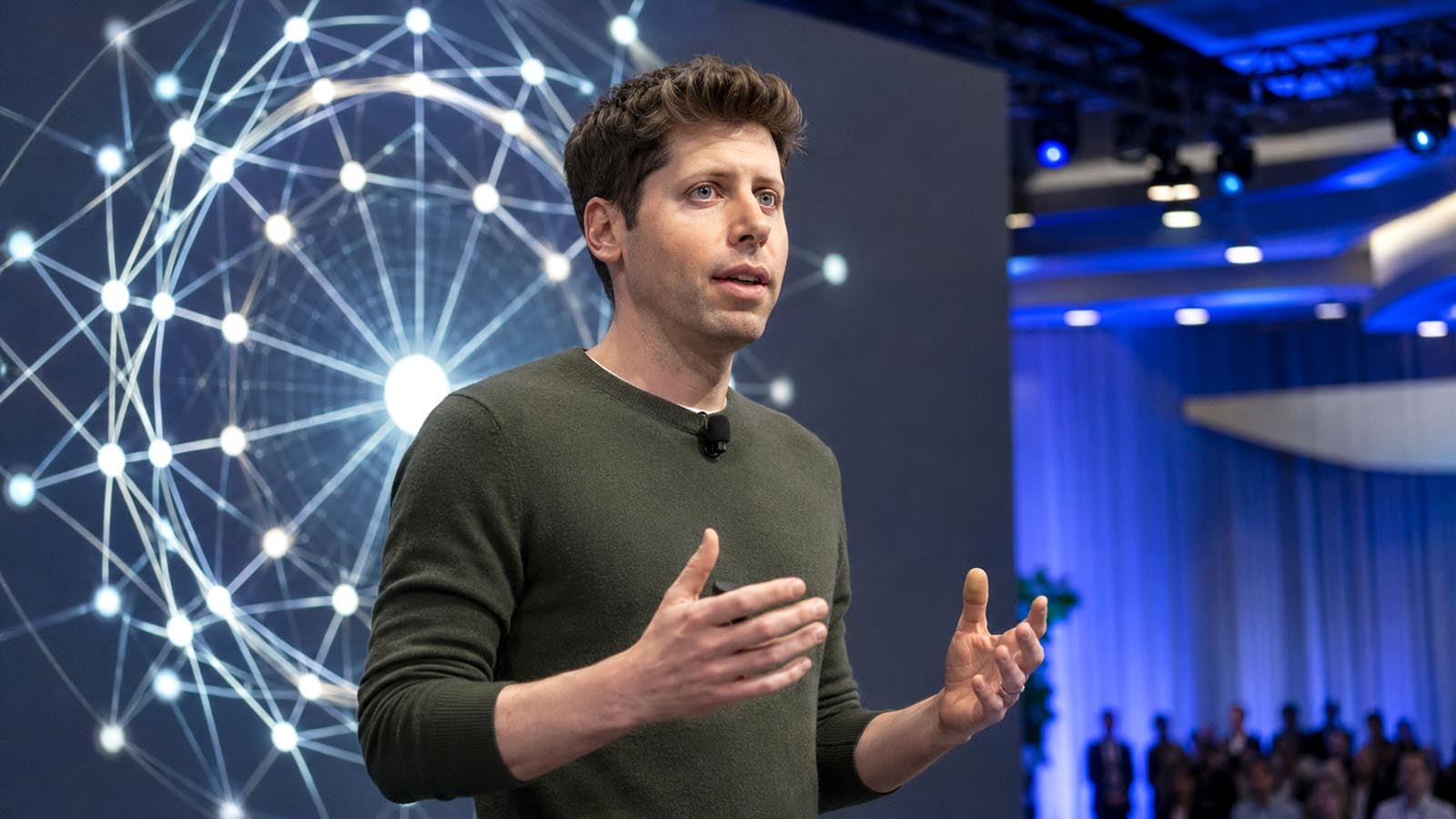
OpenAI CEO Sam Altman has declared that humanity is already living through the artificial intelligence singularity, bringing an idea long associated with science fiction into an urgent debate over the pace of machine intelligence and society’s ability to keep up.
“We are now, like, in the singularity. This is the moment,” Altman said during a July 25 appearance on Ti Morse’s Relentless podcast, describing it as the realization of an idea that had seemed almost too improbable to take seriously a decade earlier.
Altman said he expected the shift to be “hugely positive” for the world, though his declaration was not backed by a scientific test showing that machines had surpassed humans across every intellectual task or could independently create more powerful systems without human direction.
His comments point instead to a gradual transformation already taking shape, as increasingly capable tools help researchers move faster, shorten development cycles and make yesterday’s breakthroughs feel ordinary within months.
The ‘Gentle Singularity’ was already underway
Altman laid out that argument in his June 10, 2025 essay, The Gentle Singularity, writing that humanity was already “past the event horizon” and that the technological takeoff had begun.
Rather than predicting a sudden break with normal life, he described a quieter transition in which families, jobs and daily routines would remain recognizable even as powerful systems reshaped software, scientific discovery and, eventually, robotics.
One of Altman’s key points was that remarkable advances would quickly become familiar, with tools that initially appeared astonishing soon becoming basic infrastructure and driving demand for the next wave of progress.
Altman also acknowledged that current systems are not autonomously rewriting their own code, though he described AI-assisted AI research as an early form of recursive self-improvement.
What is the singularity threshold, and have we reached it?
The singularity describes a theoretical threshold at which a superhuman system can improve the technology behind its own intelligence, creating a cycle in which each breakthrough helps produce the next at an accelerating pace.
Mathematician I.J. Good called this an “intelligence explosion” in 1965, while computer scientist Vernor Vinge later used the term “singularity” to describe a boundary beyond which technological change becomes too rapid and complex for humans to easily predict.
No single test would prove that the threshold had been crossed. More convincing evidence would be systems that consistently outperform specialists across a wide range of fields, carry out advanced AI research with little human guidance and produce stronger successors in ever-shorter development cycles.
By that standard, there is no clear evidence that current systems have reached the singularity.
Although today’s models can solve difficult problems, write software and support scientific research, their performance remains inconsistent. They still make basic errors, struggle with long-term planning and depend heavily on people to set their goals, provide the necessary infrastructure, oversee their training and decide how and when they are deployed.
A true singularity may still be distant, but its effects could emerge much sooner. Faster discovery could transform medicine, engineering and productivity, while also disrupting jobs, concentrating power and making oversight harder.
For now, the evidence points to a period of rapid acceleration rather than a confirmed leap beyond human control, with AI systems advancing quickly but still dependent on humans for their goals, infrastructure, training and deployment.