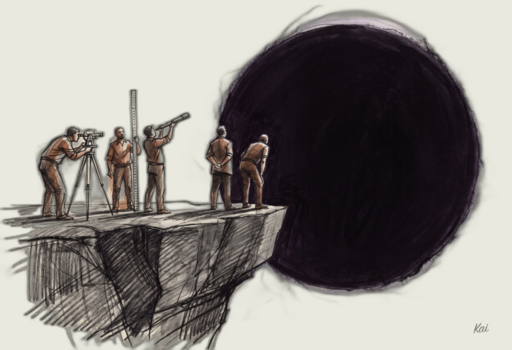
The word singularity gets thrown around constantly right now. I don't think most of the people using it could tell you what it means.
It gets used as a synonym for AGI. Also for ASI. Also for "the day AI gets really good," or "the day the robots take over," or just a vague wave at some future where things are weird.
It's none of those. It has a real meaning, and the real one is better.
That's it. It's a claim about us, not about the machine.
Most people think Kurzweil. The Singularity Is Near came out in 2005 and sold a lot of copies.
He was about fifty years late.
The first use I know of is from 1958. Stanislaw Ulam wrote a tribute to John von Neumann after he died, and he was remembering their conversations:
One conversation centered on the ever accelerating progress of technology and changes in the mode of human life, which gives the appearance of approaching some essential singularity in the history of the race beyond which human affairs, as we know them, could not continue. Stanislaw Ulam, Tribute to John von Neumann, 1958
The end is the part that matters. Beyond which human affairs, as we know them, could not continue. That's a much bigger claim than technology speeding up.
Von Neumann wasn't predicting AI. He was pointing at a horizon.
Vernor Vinge taught math and computer science at San Diego State. He also wrote science fiction. In 1993 he gave a paper at a NASA symposium called The Coming Technological Singularity, and that's where this stops being a passing remark and turns into an argument.
His opening is about as blunt as it gets:
Within thirty years, we will have the technological means to create superhuman intelligence. Shortly after, the human era will be ended. Vernor Vinge, The Coming Technological Singularity, 1993
But here's the line that matters, and the reason he picked that word:
In physics, a singularity is where your equations stop giving answers. Vinge is saying the same thing happens to our models of the future once something smarter than us is doing the driving. You don't get bad predictions. You get none.
I like this a lot, because it's a claim about us. It's an admission that we go blind.
One more thing about Vinge's version. He didn't assume it comes from AI. He listed four ways superhuman intelligence might show up:
Three of those still have humans in them. That's a wider frame than the one that survived.
There's a third name here, and he's the one who explains the mechanism.
In 1965 I.J. Good, a statistician who worked with Turing at Bletchley Park, described an "ultraintelligent machine." A machine good enough at design to build a better machine than itself. Which builds a better one. Which builds a better one.
That's why people expect this to arrive suddenly instead of gradually. The loop feeds itself.
So: von Neumann saw the horizon. Good explained how we'd get there fast. Vinge said what it actually is.
Here are the ones I've settled on. I go deeper on them in My Updated Definitions of AGI vs. ASI. Both of those describe a machine. You could put one on a bench and measure it.
The singularity isn't that kind of claim at all. AGI and ASI are about the machine. The singularity is about us, and specifically about the moment we stop being able to see what's coming.
Which means you can have one without the other.
You can have AGI and no singularity. I think this is the part people miss. Something as good as a human expert at every cognitive role would rearrange the entire economy, and we could still reason about it, because we already know what human experts do. It's a world with a billion more professionals in it. Enormous. Also forecastable.
ASI is where it breaks. Once something can do any cognitive role better than any human ever has, it stops being a tool you point at problems and starts being the thing that decides. And you don't get to predict what a smarter thing decides. That would require being as smart as it.
It's one of the coolest ideas in the space, and it gets flattened into a buzzword constantly.
Knowing where it came from helps, because it tells you this isn't a product of the current hype cycle. Von Neumann was talking about it in the fifties. Vinge wrote it up in 1993. Nobody was raising a round.
And knowing it's a different thing from AGI or ASI changes what you're arguing about. When someone says we're close to the singularity, the question isn't how good the models are. It's whether we're near the point where our models of the future stop working.
That's a different question. It's also a lot more unsettling.