For practitioners building voice agents or embodied interfaces, the key takeaway from this update is architectural: a modular local speech pipeline that decouples VAD, STT, LLM, and TTS can now run fully on desktop hardware and serve any Responses-API-compatible client, including a physical robot. Hugging Face's speech-to-speech library provides the reference implementation, and the pattern generalizes well beyond robotics.
What happened
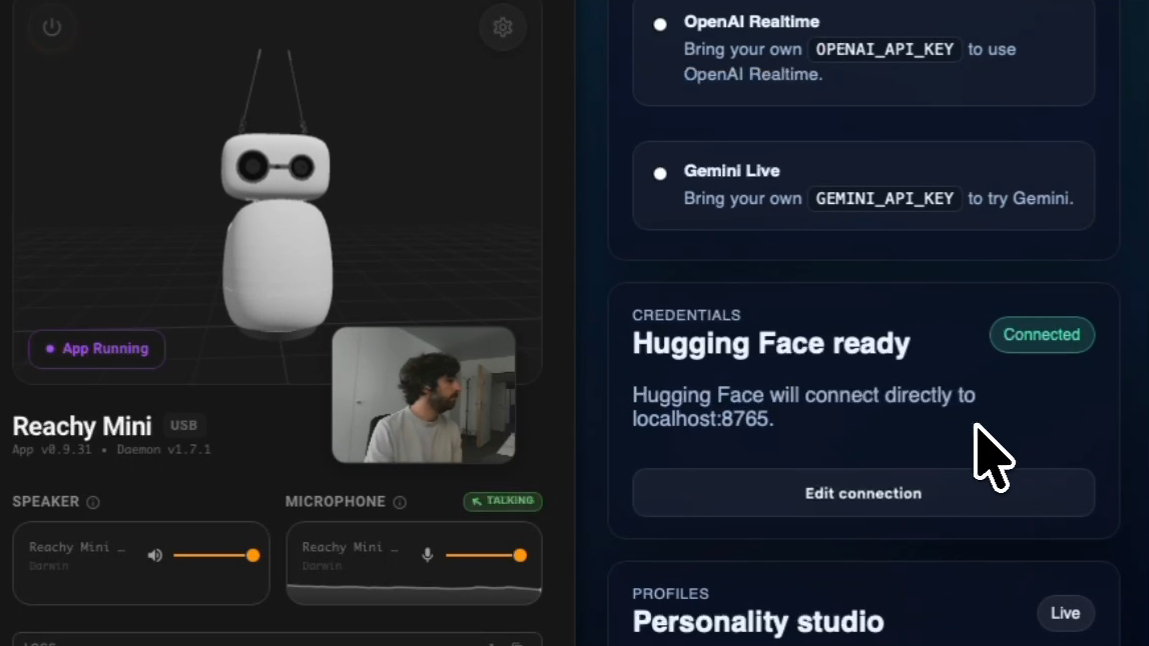
Hackaday (June 28, 2026) covers a Hugging Face blog post (published May 27, 2026) showing how to run fully local conversational AI on Reachy Mini, a desktop robot kit by Pollen Robotics with Hugging Face managing the software ecosystem. The setup enables expressive conversational behaviors - head movements, antenna wiggles, interruptible low-latency responses - with no cloud dependency.
The pipeline The stack is: Silero VAD v5 (voice detection) -> Parakeet-TDT 0.6B v3 (speech-to-text) -> LLM (large language model) -> Qwen3-TTS (text-to-speech). Hugging Face's speech-to-speech library exposes this cascade as a /v1/realtime WebSocket compatible with the Responses API protocol. The LLM layer is fully decoupled: it can run in-process (MLX on Apple Silicon, Transformers on CUDA) or as a separate server via llama.cpp or vLLM. The Hugging Face blog recommends Gemma 4 via llama.cpp as the primary LLM; Qwen3-4B-Instruct-2507 is a well-supported alternative. Parakeet-TDT and Qwen3-TTS also support hosted Hugging Face Inference Endpoints or any OpenAI-compatible API, letting teams mix local and remote components to balance cost, latency, and capability.
Practitioner implications
The modular Responses API protocol is the key design choice: it decouples the LLM from the audio pipeline so teams can upgrade or swap the model without rewriting the voice loop. For latency-sensitive deployments, running the LLM out-of-process (llama.cpp or vLLM server) prevents memory contention with STT and TTS. For privacy-first use cases, all four stages can run on hardware the operator controls. The GitHub repos (pollen-robotics/reachy_mini_conversation_app and huggingface/speech-to-speech) provide working reference code. The pattern extends to any interactive agent: kiosk, customer-service robot, on-device assistant.
What to watch
Track how the pipeline handles real-world acoustic conditions (background noise, accents) as Parakeet-TDT 0.6B v3 is optimized primarily for English. Watch for new STT or TTS model drop-ins on the Hugging Face Hub that integrate without code changes. Monitor latency benchmarks as Qwen3-TTS and larger LLMs are tested on consumer GPUs.
Key Points #
- 1Fully local VAD-STT-LLM-TTS pipelines are now practical on desktop hardware, removing API cost and data-residency concerns for interactive voice agents.
- 2The Responses API protocol decouples the LLM from the audio pipeline, letting teams swap models or mix local and hosted inference without rewriting the voice loop.
- 3The Reachy Mini stack (Silero VAD v5, Parakeet-TDT STT, Gemma 4 or Qwen3-4B LLM, Qwen3-TTS) is a transferable reference architecture for any embodied or kiosk conversational agent.
Scoring Rationale #
A practical, well-documented demonstration of a fully local VAD-STT-LLM-TTS pipeline on a low-cost desktop robot, with real reference code and a transferable architecture pattern. Relevant for practitioners building interactive agents or edge voice systems; not a paradigm shift but the open-source implementation and Responses API design make it more reusable than a typical product demo.
Practice interview problems based on real data
1,625 SQL & Python problems across 15 industry datasets — the exact type of data you work with.