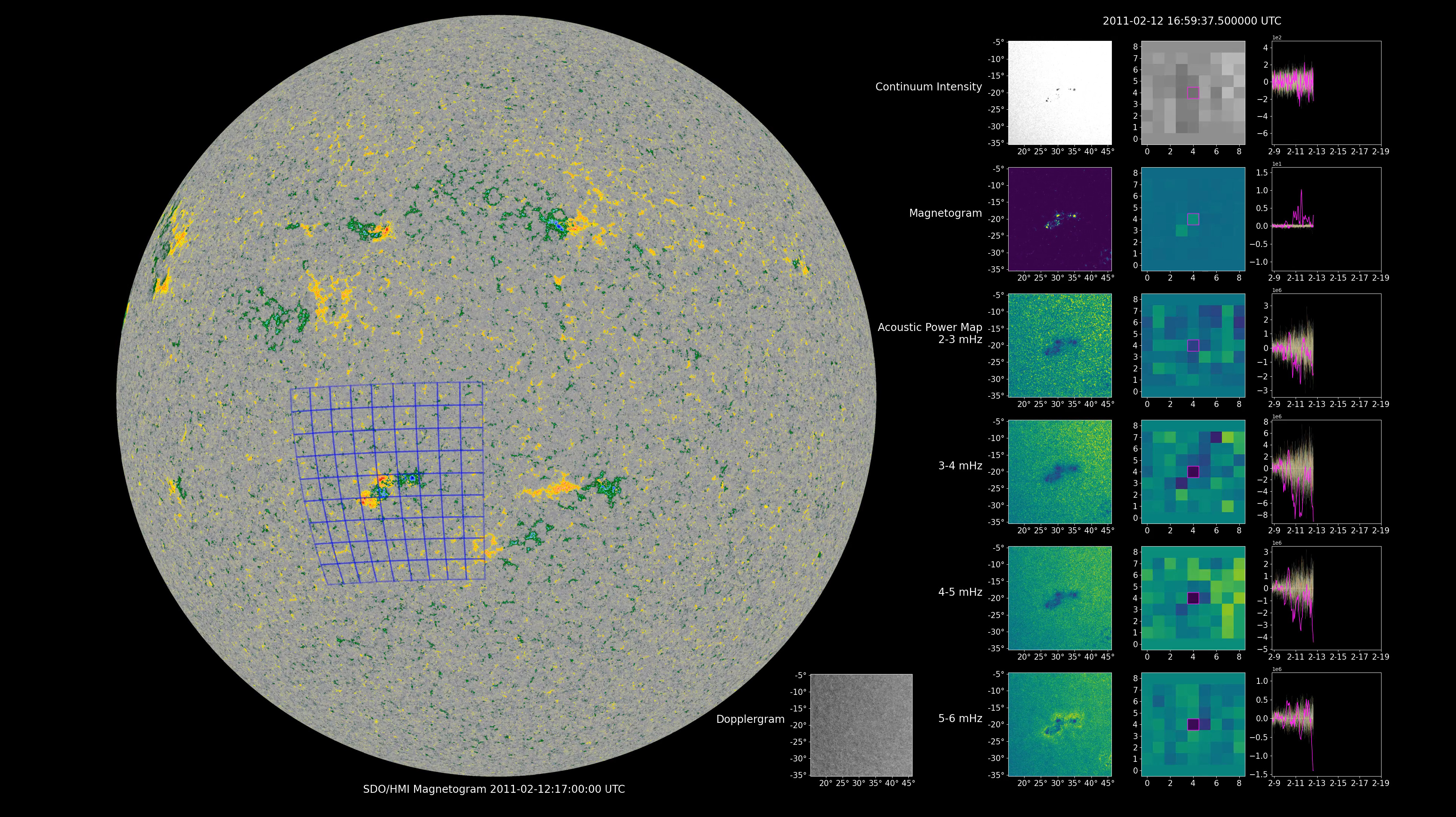
NASA said on August 14 that researchers in its COFFIES center developed a sliding-window Transformer to forecast solar active-region emergence from Solar Dynamics Observatory measurements. The research evaluates a 12-hour forecast window across 46 observed active regions; its best configuration produced an average 4.73-hour warning, but NASA says the system is not ready for operational real-time forecasting.
NASA published new details on August 14 about a machine-learning approach designed to detect the emergence of solar active regions before they become visible as sunspots. Researchers from New Jersey Institute of Technology, Princeton University and NASA Ames developed the system through COFFIES, a NASA-funded center studying magnetic fields and flows inside and outside the Sun.
What the model actually predicts
COFFIES is the research center, not the name of the model. The model uses a sliding-window Transformer architecture to forecast changes associated with active-region emergence. NASA describes the inputs as subtle time-dependent changes in acoustic activity and magnetic-field measurements from the Helioseismic and Magnetic Imager aboard the Solar Dynamics Observatory. The paper frames the target as the evolution of continuum intensity, which falls as a large active region begins forming visible sunspots.
That distinction matters. The system does not directly predict a solar flare, coronal mass ejection or geomagnetic storm. It tries to identify an earlier precursor: the appearance of an active region that may later produce disruptive space weather.
The 12-hour figure needs context
The study evaluates forecasts up to 12 hours ahead using observations from 46 active regions. Its best-performing configuration reported an average advance warning of 4.73 hours, an RMSE of 0.1189 and a 10.6% improvement over the researchers’ LSTM baseline. The authors also report that the more sensitive Transformer produced greater variance than smoother baseline models.
Those are experimental results, not an operational service guarantee. NASA says the model is not ready for real-time forecasting and needs validation across many more known solar events. The 12-hour figure is the forecast window; it should not be read as a consistent 12-hour warning for every active region.
Why the result is useful for ML practitioners
The work illustrates a familiar early-warning trade-off. Removing a temporal smoothing layer and adding early-detection biases helped the model respond sooner to small precursor signals, but also increased noise. In a production warning system, that gain would need to be evaluated alongside false alarms, calibration, missing data, inference latency and integration with existing forecasting operations.
For now, the result is best viewed as a research step toward earlier active-region monitoring. It may eventually give forecasters more lead time to study regions that could become storm-producing, but it does not yet provide advance warning of a specific severe solar storm.
Key Points #
- 1The COFFIES research team evaluated a sliding-window Transformer on observations from 46 solar active regions.
- 2The best configuration reported a 4.73-hour average warning and 10.6% lower RMSE than its LSTM baseline within a 12-hour forecast window.
- 3NASA says the model is not ready for operational real-time forecasting and requires broader validation.
Scoring Rationale #
Earlier active-region detection could improve future space-weather monitoring, but the model was evaluated on 46 historical regions, has a sensitivity-versus-variance trade-off and is not operational.
Sources #
Primary source and supporting public references used for this report.
Practice with real Ride-Hailing data
90 SQL & Python problems · 15 industry datasets
250 free problems · No credit card