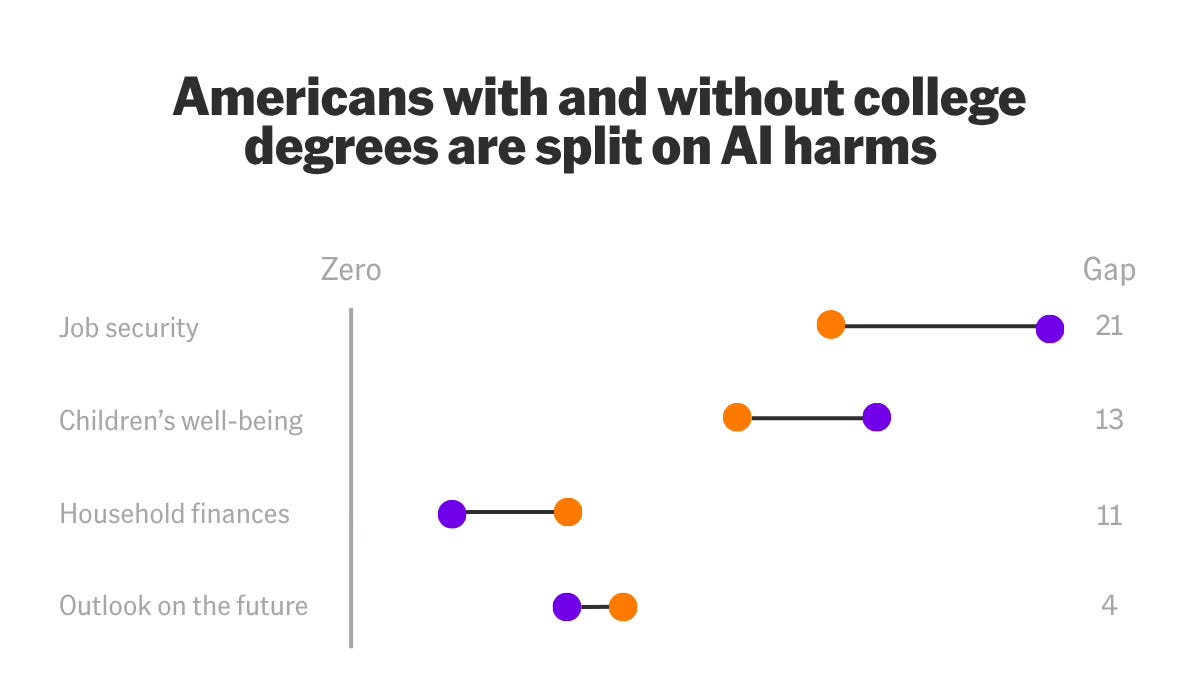
Americans with and without college degrees split on AI harms and interventions
While concern about AI is high across the board—66% in our latest survey—the ways that people see the technology impacting their lives, both good and bad, depends on their level of education. Based on pooled data from Americans on AI surveys conducted June 25-30 and July 9-13, we’ve found that people with a college degree are more likely than those without to say that AI is negatively impacting jobs and kids, while those with a high school degree or less are relatively more likely to say that AI is negatively impacting household finances.
This division of issues along educational lines, often referred to as education polarization, or the diploma divide, has contributed to the realignment of American political coalitions in the modern era.
Results
Some more things we’re seeing when we dig into differences among education levels:
Americans with a college degree are more excited (31%) about AI’s growing role in society compared to people with a high-school degree or less (22%).Americans with a college degree are more likely to say they’re already seeing people saving time because of AI (57%) than those with a high-school degree or less (39%).Americans with a college degree are more likely to believe AI will lead to scientific or medical breakthroughs (74%) than people with a high-school degree or less (58%).Americans with a college degree are more likely to say AI is already behaving in ways their developers didn’t intend (36%), compared to people with a high-school degree or less (24%).** Americans with a college degree are more likely to say the government isn’t doing enough to address AI’s impacts**on things like the environment, children, and workers (54–59%), compared to Americans with a high-school degree or less (33-35%).
Another presentation of these first-look findings is in the deck below.
Our Take
In reaction to these research findings, Colin Bortner, Athena Insights’ head of research, said:
Much of the recent debate about AI’s impacts has focused on jobs and kids. Those concerns show up at every education level, but they are strongest among college graduates. Household finances, on the other hand, are less of a concern among college-educated Americans than among Americans with a high-school education or less. A debate about the impacts of AI that focuses on jobs and kids but neglects household finances, and other pocketbook issues, risks over-indexing on the concerns of college graduates and ignoring other important American constituencies.
Other News
A few items from the past two weeks that speak to what we found:
A June
pollfrom Reuters found similar divisions along education lines related to concerns about job loss.Last week, the governor of New York, Kathy Hochul, signed the nation’s first statewide moratorium on new data center development. Our polling shows that,by 20 points, Americans want government to do more to address AI’s impacts on the environment, including data centers.A new model released by Beijing-based Moonshot AI, Kimi K3,
reportedlymatches the capabilities of leading U.S. AI models for a fraction of the price, forcing a reckoning in Silicon Valley. The public, however, is divided on whether or not the government should be doing more to protect America’s competitiveness on AI, with only28% saying the government is doing too little.
Methodology: For the most recent wave of Americans on AI, Athena Insights surveyed 1,055 US adults from July 9-13, 2026, using NORC at the University of Chicago’s AmeriSpeak panel, a probability-based panel designed to be representative of the U.S. household population. Results are weighted to U.S. population benchmarks; the full-sample margin of error is +/- 4.2 percentage points.
The “diploma divide” results are based on pooling our wave 1 and wave 2 results. The pooled waves are independent samples of the same population (panel rotation excludes wave 1 respondents from wave 2), and we combine into an average across the two fielding windows, using fixed-share blend of each wave’s calibrated estimates, with wave-as-stratum variance. This approach gives n = 2,869 and a full-sample margin of error of +/- 2.6 points.
Full topline, crosstabs, methodology, data, and visualizations are available at Americans On AI.