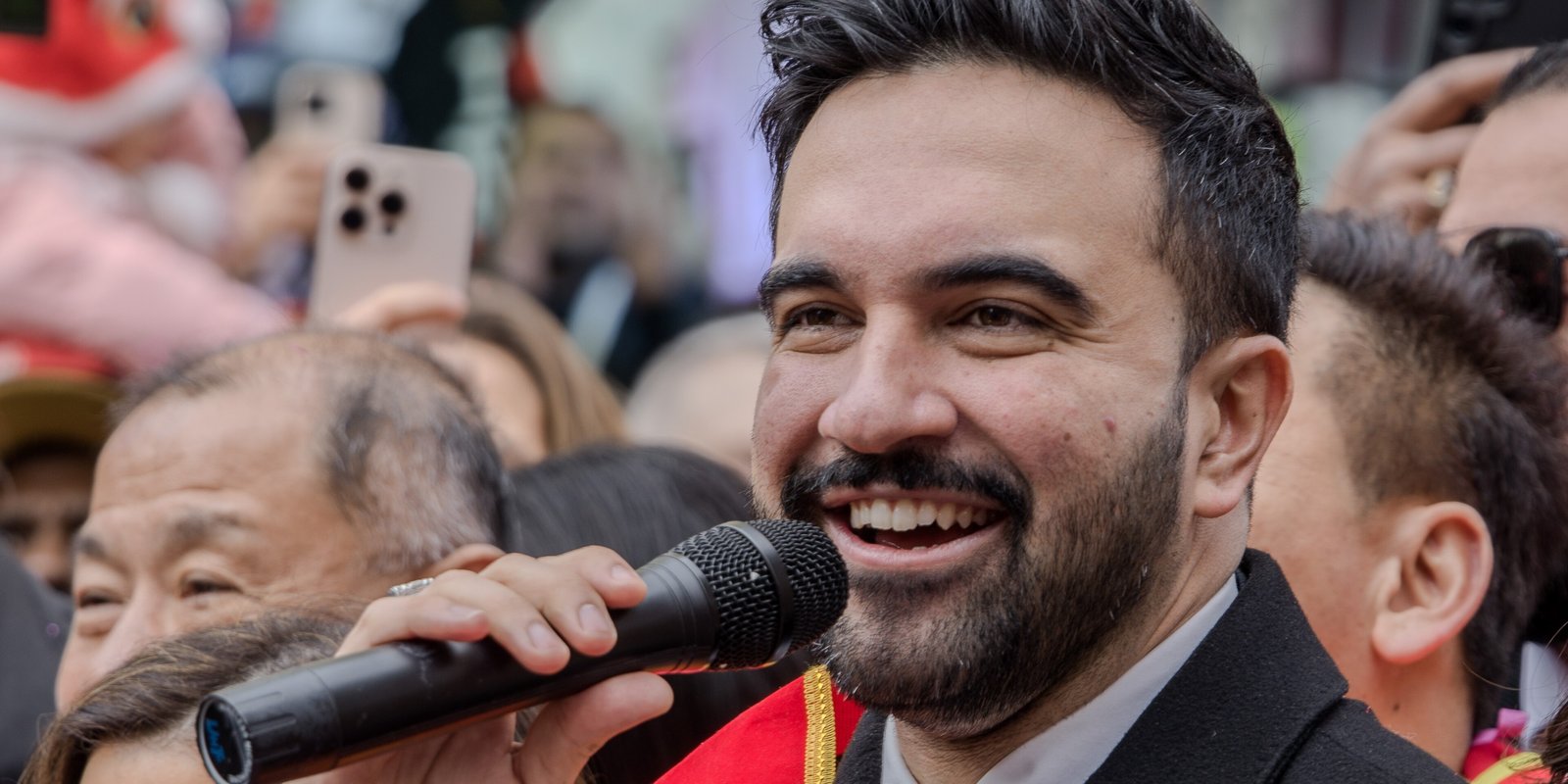
New York City Mayor Zohran Mamdani at Chinese New Year celebrations in Manhattan in March 2026. File photo. Image: [Tony Northrup](https://commons.wikimedia.org/wiki/File:Zohran_Mamdani_at_2026_Chinese_New_Year_Celebrations_in_Manhattan,_New_York_City_05.jpg) / Wikimedia Commons, [CC BY-SA 4.0](https://creativecommons.org/licenses/by-sa/4.0/), cropped

New York City wants to make it illegal for companies to leave you stuck talking to a chatbot. The city’s Department of Consumer and Worker Protection (DCWP) [proposed rules](https://rules.cityofnewyork.us/rule/automated-customer-service-systems/) on Tuesday that would require businesses using AI chatbots or automated phone lines to say so up front, and to give customers a one-step way to reach a human, with fines of up to $3,500 a violation for companies that don’t.
The target is what the city calls customer service “doom loops”. Mayor Zohran Mamdani’s administration says that, once adopted, the rules would make New York the first US city able to enforce this kind of protection.
What the rules would require #
The proposed rule text covers any system where “all or substantially all” of the communication comes from technology rather than a person: AI chatbots, older rules-based bots and automated phone menus.
- Disclosure: at the start of every conversation, customers must be told clearly that they are dealing with an automated system, not a human.
- No doom loops: a business that says it offers customer service must deliver it in “a reasonable and timely manner”. Repeatedly and unreasonably sending people to menus that don’t answer their question, or replying with “unresponsive, irrelevant, or erroneous information”, would count as a deceptive and unconscionable trade practice.
- A way out: a business using a bot is presumed to be breaking the rule unless customers get a single-step route to a human, such as “Press 0” or “Say or type ‘agent’”, with the estimated wait and no extra questions. If nobody is available, it must offer an alternative, such as a phone number or live chat with opening hours, a callback or an email address, with a promised response time.
- Honest contact pages: no labelling a phone line or email address “customer service” if nobody answers there.
You can’t blame the bot #
A separate section would make clear that technology is no defence: a business could not escape liability under any city consumer rule by arguing that a technology made the claim or carried out the violation. The DCWP’s explanation points to Air Canada, which tried to disown what its own chatbot told a customer.
Businesses would also have to keep three years of records, including logs of whether each customer was offered a human and got one.
The DCWP cites a Gartner survey that found chatbots resolved as few as 17% of billing disputes, and notes that California, Maine, New Jersey and Utah already require some form of bot disclosure.
“We are not waiting for Washington” #
Breaking the rules would cost $525 for a first violation, $1,050 for a second and $3,500 for a third within two years. Because the rules sit under the city’s Consumer Protection Law, they would apply to businesses dealing with New York City customers, not only companies based there. Mamdani said in the city’s announcement:
When corporations force you to fight your way through an endless doom loop of AI-generated responses to speak to another human being, they’re stealing your time, money, and patience.
Zohran Mamdani, Mayor of New York City
DCWP Commissioner Samuel Levine, who ran the US Federal Trade Commission’s consumer protection bureau until 2025, said bad customer service can be “all the difference between refilling a critical prescription, rehabilitating a student loan, or recovering a large refund.” He added: “We are not waiting for Washington to come to the rescue of working people.” Stephanie Nguyen, a former FTC chief technologist now at Columbia Law School, said:
Chatbots can create the illusion of help while trapping consumers in endless doom loops of wrong answers and unresolved problems.
Stephanie T. Nguyen, Columbia Law School
It is the latest AI move from New York City, whose council subpoenaed Elon Musk’s SpaceXAI last month to testify about AI safety. It also follows US states taking AI companies on directly under consumer law, such as the eight states suing OpenAI over ChatGPT’s safety claims.
How to have your say #
Anyone can comment on the NYC Rules website or by emailing [email protected] until November 19, 2026, when a public hearing will be held by phone and video at 11am New York time (16:00 UTC). The DCWP will then review the comments before finalising the rules; it has not said when they would take effect.
Why it matters #
Companies are replacing customer service staff with AI faster than the bots are getting good at the job, and until now customers have had little say in it. A New York City rule would not reach chatbots serving people elsewhere, but it would give one of the world’s biggest consumer markets the power to fine companies whose bots trap their customers, and a template other cities could copy.
Sources: NYC Department of Consumer and Worker Protection, proposed rule: Automated Customer Service Systems; DCWP notice of public hearing and proposed rule text (PDF).