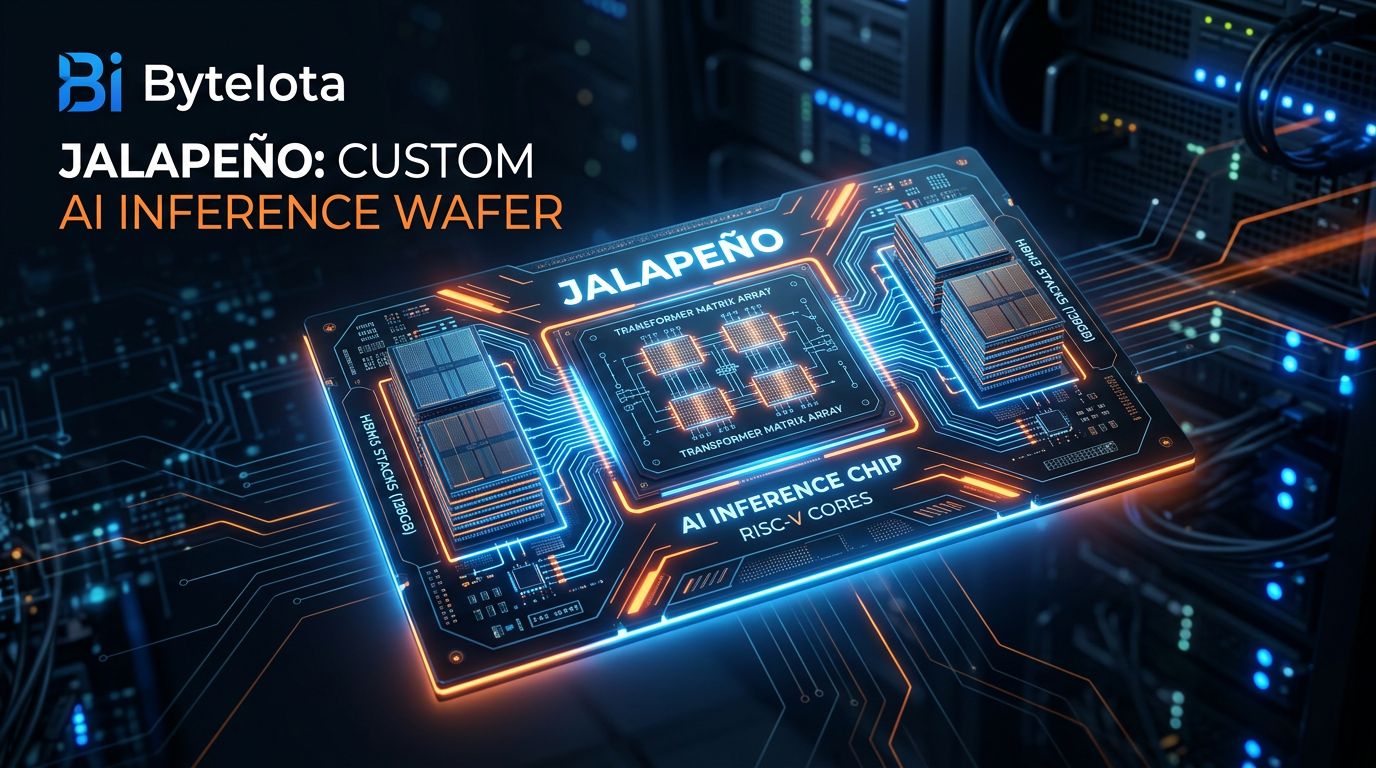
OpenAI and Broadcom unveiled Jalapeño on June 24 — OpenAI’s first custom inference chip, built in nine months, targeting 50% lower cost per token than Nvidia GPUs. The hardware won’t touch production until late 2026, and any savings won’t reach your API bill for 12 to 18 months after that. But if the claim holds, Jalapeño is the most significant structural change to AI API economics since GPT-4 launched. Here’s what you actually need to know — and what to do while you wait.
What Jalapeño Actually Is #
Jalapeño is not a GPU. It’s an ASIC — an Application-Specific Integrated Circuit built to do one thing: run finished LLM models fast and cheaply. OpenAI and Broadcom designed it from scratch around the specific patterns that transformer inference generates: dense matrix multiplications, high-volume memory reads, low-precision arithmetic, and serving thousands of concurrent users simultaneously.
The specs that matter: manufactured at TSMC’s 3nm node, with a reticle-limited die of roughly 840mm² — that’s as large as EUV scanners can physically print in a single shot. Eight HBM stacks sit on a silicon interposer in 2.5D packaging, minimizing the distance between memory and compute, which is where most inference latency lives. The architecture is a systolic array, the same pattern Google used for TPUs: a grid of processing elements that pass data in rhythmic lockstep, tuned for matrix math.
What Jalapeño doesn’t do: train models. Nvidia GPUs still own that workload. And Jalapeño won’t appear on AWS, Azure, or GCP — it’s internal OpenAI infrastructure, not a commercial product. Tom’s Hardware has the full architecture breakdown for those who want to go deeper on the silicon.
The 50% Cost Claim — and the Caveats #
Broadcom CEO Hock Tan told Bloomberg the chip delivers roughly 50% cost savings per inference token compared to current Nvidia GPUs. OpenAI says engineering samples are already running GPT-5.3 Codex workloads at production frequency and power. VentureBeat noted that OpenAI’s own models helped accelerate parts of the chip design process — a detail worth filing away for what it says about where AI tooling is headed.
Now the caveats: these are self-reported, pre-production claims that haven’t been independently benchmarked. The chip deploys late 2026 at gigawatt scale, with Microsoft buying approximately 40% of initial production. Benefits flow through to API customers over a 12 to 18 month horizon as capacity scales. Plan around that timeline, not the announcement date.
The Software Cut You Might Have Missed #
Here’s the story that deserves more attention: around July 1, The Information reported that OpenAI engineers separately cut inference costs by more than 50% through software optimization alone. Anonymous user traffic dropped from tens of thousands of Nvidia GPUs to just a few hundred. The techniques — quantization, KV caching, smarter batching, model routing — aren’t exotic. The scale of the gains is.
This matters for two reasons. First, the software optimization is already underway, before Jalapeño ships. Second, if hardware and software gains stack — and there’s no structural reason they can’t — the inference cost floor is moving faster than most developer budget models account for.
OpenAI Isn’t Alone in This Race #
Google has TPU v7 Ironwood in production with 4.3 million units projected for 2026. Amazon’s Trainium 3 is ramping. Microsoft has Maia 200. Meta has MTIA. DeepSeek announced its own inference chip. Three of the four most consequential AI organizations now have inference-specific silicon programs underway, with the fourth in progress.
Custom ASICs are growing at 44.6% CAGR versus 16.1% for merchant GPUs. Analysts project NVIDIA’s inference market share falling from over 90% today to 20 to 30% by 2028, even as Nvidia responds with Vera Rubin. The custom silicon race is settled as a strategy — the question now is execution and, more importantly for developers, whether competitive pressure forces the savings downstream.
What Developers Should Do Today #
Operationally, nothing changes. You don’t need to migrate anything, update any toolchain, or change any API call. Jalapeño is OpenAI’s infrastructure, not yours.
Update your 3-year TCO models. Build in 30 to 50% inference cost reduction over that period, not flat pricing. The software gains are already happening; the hardware gains are on a credible timeline.Design for model routing. Systems that can route requests to cheaper models for simpler tasks — and reserve expensive models for where they’re needed — will benefit most when prices fall. Build that flexibility now.Maintain multi-model optionality. An OpenAI that controls chips, models, products, and the enterprise deployment layer is more vertically integrated than it was last year. That’s not a reason to avoid the platform — it’s a reason to ensure you havearchitectural optionality at the model layer.
The real question isn’t whether inference gets cheaper — between the software optimization already underway and Jalapeño on deck, it will. The question is whether OpenAI passes those savings through to API customers or captures them as margin. Watch the next GPT pricing update. That’ll tell you more than any chip announcement.