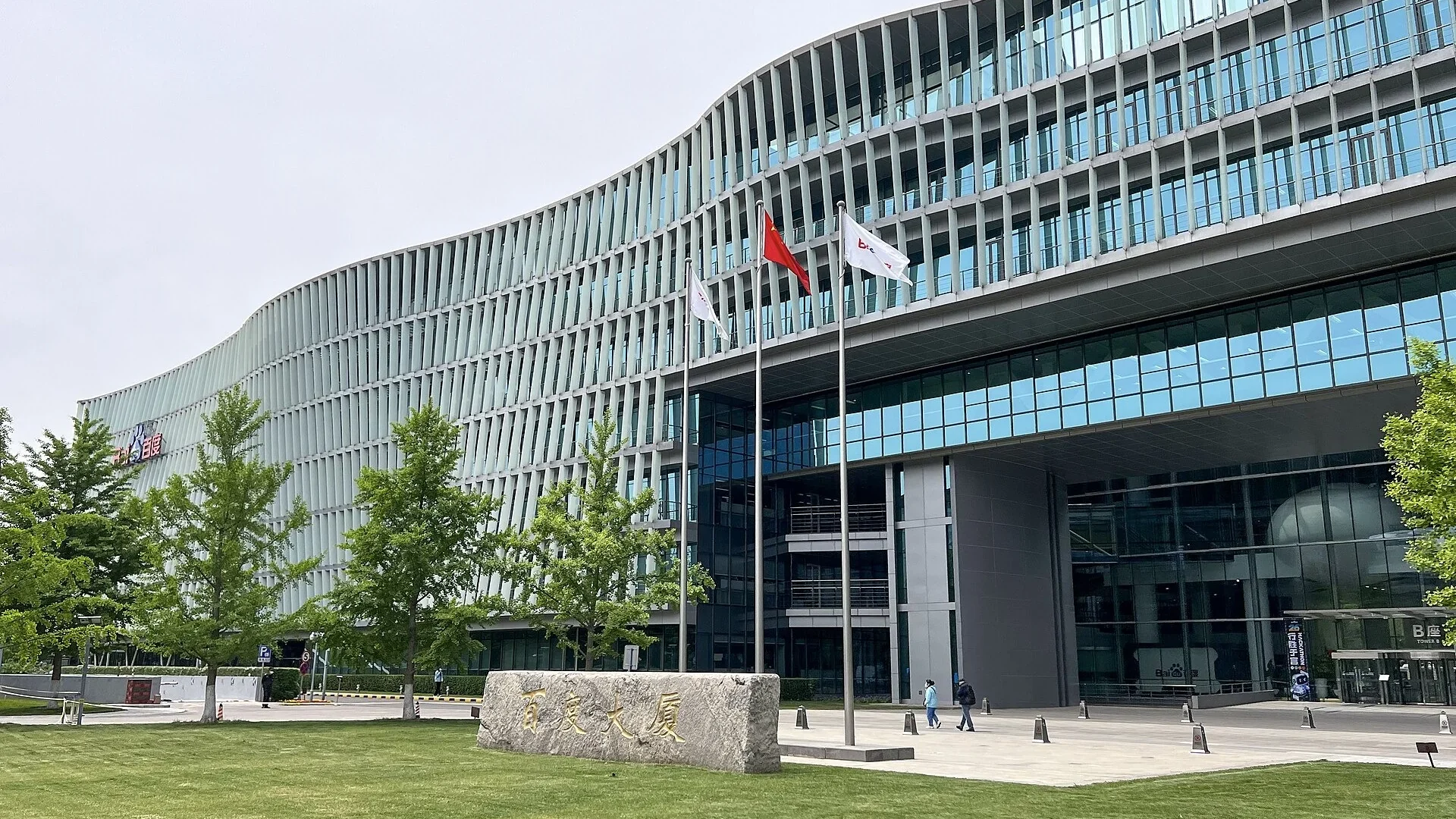
Baidu released ERNIE-5.5-Flash-Base on Nov. 5, 2026, a sparse mixture-of-experts model with 280 billion total parameters and 14 billion activated per token, according to coverage of the weights release. Three months earlier, Alibaba’s Qwen team published Qwen3.8-27B, a dense model with 27 billion parameters that release trackers list under Apache 2.0. Both count as open-weight AI models. They ask opposite things of your hardware.
The bigger model reads less memory per token. At FP8, ERNIE’s 14 billion active parameters pull about 14 GB of weights through the processor for every generated token, while the 27B dense model pulls about 27 GB. Yet ERNIE needs roughly ten times more room just to sit in memory (280 billion parameters against 27 billion). That gap between total and active parameters is the number model cards bury and buyers misread.
Licenses decide whether you may ship a model. Architecture decides whether you can afford to run it. Readers weighing the legal side should start with the license terms behind these families. On the engineering side, five releases from Moonshot AI, Baidu, Alibaba and DeepSeek show the split better than any diagram.
Don't miss new tech stories on Google
Add Shattered once in the Google app and our stories show up in your news suggestions.
What Open-Weight AI Models Actually Ship #
An open-weight release hands you the trained parameters as downloadable files, plus a config and a tokenizer. It rarely hands you the training data, the training code or the data-filtering recipe. That is why the label differs from open source in the strict sense. You can run, quantize and fine-tune the model on your own machines, but you cannot rebuild it from scratch.
Meta made the practical case for downloadable weights in 2024. In its Llama 3.1 announcement, the company wrote that “Unlike closed models, Llama model weights are available to download.” The same post added that “Developers can fully customize the models for their needs and applications, train on new datasets, and conduct additional fine-tuning.” Those two sentences still describe the core appeal. Control over the file means control over latency, data flow and cost.
Licensing language matters just as much as the files. In a separate 2024 post on Segment Anything Model 2, Meta said that “In keeping with our approach to open science, we’re sharing the code and model weights with a permissive Apache 2.0 license.” The company added in the same post: “We’re releasing SAM 2 under an Apache 2.0 license, so anyone can use it to build their own experiences.” That is a vision model, not a language model, but the licensing logic carries over. A permissive license removes the legal questions so the engineering questions can start.
Three license families show up in the November 2026 releases. MIT and Apache 2.0 sit at the permissive end. Custom licenses sit at the other end and attach conditions such as revenue ceilings, attribution lines or excluded regions. Each of the five models in this comparison lands in one of those buckets, and the bucket often matters more than the benchmark.
Weights also come in different states of completion. A base checkpoint is pretrained only. It predicts the next token well but follows instructions poorly until someone fine-tunes it. A post-trained checkpoint has already been tuned to chat, call tools and refuse unsafe requests. Baidu’s ERNIE line shows both states in one month: the Base weights arrived on Nov. 5, and the first post-trained model built on them, ERNIE 5.5 Flash Preview, followed on Nov. 11.
The word open also hides a timing problem. Labs often announce a model, open the hosted API and publish weights days or weeks later. Moonshot’s Kimi K3.1 Pro is the live example. The model launched on Oct. 23, 2026, while several secondary sources place the weights on Hugging Face in early November. The Moonshot pages we could fetch do not themselves confirm a download, so the license file in the repository is the only authority worth trusting.
Dense vs Mixture-of-Experts: Two Ways to Spend Parameters #
A dense transformer uses every parameter for every token. A mixture-of-experts model splits its feed-forward layers into many expert blocks and routes each token to a handful of them. The router decides per token and per layer, so a different small slice of the network answers each time. Quality scales with the whole parameter pool, while per-token compute scales only with the slice that fires.
Total parameters: what you store
Total parameters set the size of the download and the memory you must reserve before the first token. Every expert has to be resident in fast memory, or at least reachable, because the router may call any of them on the next token. A 280B model therefore needs a 280B-sized home whether it uses 14B per token or 140B.
This is the figure that drives hardware purchases. It also drives the number of machines. Once a model outgrows one server’s memory, you shard it across several, and network links between those machines start to shape latency. Storage cost scales linearly with total parameters and with the precision you pick: two bytes per weight at BF16, one at FP8, roughly half a byte at 4-bit.
Active parameters: what you compute
Active parameters set the work done per token. Generation speed on a single stream is usually limited by how fast the machine can read weights from memory, so fewer active parameters means faster tokens and lower energy per answer. Baidu’s own spec for ERNIE-5.5-Flash-Base lists 14 billion activated per token out of 280 billion, an active share of 5 percent.
Qwen’s giant release hints at a similar ratio. The model name, Qwen3.8-2.4T-A95B, follows a common naming convention where the A suffix marks active parameters, which would put roughly 95 billion active out of 2.4 trillion, about 4 percent. That reading comes from the name alone, so treat it as an inference until Alibaba publishes the card. A dense 27B model, by contrast, activates 100 percent of itself on every token.
The trade-off is plain. Dense models are simple to deploy, easy to quantize and predictable under load. Sparse models deliver more capability per unit of compute but charge a memory tax, complicate batching and demand careful expert placement across GPUs. Which side wins depends on whether your bottleneck is memory capacity or memory bandwidth, and the sections below put numbers on both.
Open-Weight AI Models at a Glance: Five Contenders Side by Side #
The table below lines up the newest checkpoint from each lab as of Nov. 20, 2026. Cells marked n/c are not confirmed in the vendor pages and release trackers we could verify, and we left them blank rather than guess. Anyone who wants GLM and Mistral in the same grid can pull them from this broader open-weight spec sheet.
| Spec | Kimi K3.1 Pro | ERNIE-5.5-Flash-Base | Qwen3.8-27B | Qwen3.8-2.4T-A95B | DeepSeek V4.1 Flash 1017 |
|---|---|---|---|---|---|
| Maker | Moonshot AI | Baidu | Alibaba (Qwen) | Alibaba (Qwen) | DeepSeek |
| Release date | Oct. 23, 2026 (API) | Nov. 5, 2026 | Aug. 5, 2026 (reported) | Aug. 12, 2026 on Hugging Face (reported) | Oct. 17, 2026 |
| Architecture | Sparse MoE per secondary coverage | Sparse MoE | Dense | Sparse (A95B suffix) | n/c |
| Total parameters | 3-trillion class | 280B | 27B | 2.4T | n/c |
| Active parameters per token | n/c | 14B | 27B (all) | About 95B (from the name) | n/c |
| Context window | 1M tokens | 128K trained, up to 1M for fine-tuning and inference | n/c | n/c | 1M tokens (API, early Nov.) |
| Pretraining data | n/c | 33.5T tokens | n/c | n/c | n/c |
| License | Custom Kimi K3.1-Pro License | ERNIE 5.5 Flash Base Model License Agreement v1.0 | Apache 2.0 | Custom Qwen terms | MIT |
| Region limits | None reported | EU, UK and South Korea excluded | None | None reported, read the terms | None reported |
| Commercial condition | Reported: separate deal for hosting businesses above $20M in 12 months | Free up to $50M related annual revenue, notice and attribution required | None beyond Apache 2.0 notices | Reported separate terms for some high-revenue use | Keep the MIT notice |
| Weight formats | Reported on Hugging Face in early Nov. | FP8 and BF16 on Hugging Face | n/c | On Hugging Face (reported) | MIT-licensed weights reported |
| Hosted access | Kimi API, Kimi Code, Microsoft Foundry catalog | Baidu Qianfan (Preview model) | QwenCloud, Alibaba ModelStudio | QwenCloud, Alibaba ModelStudio | DeepSeek API as deepseek-flash |
| Checkpoint type | Post-trained, with a 2 to 3 times faster Highspeed variant | Pretrained base only | n/c | n/c | Post-trained, native multimodal |
Three patterns jump out. First, only ERNIE publishes both total and active counts in a way we could confirm, which makes it the cleanest test case for the memory-versus-compute argument. Second, license strictness runs opposite to parameter count: the two smallest permissive entries are MIT and Apache 2.0, while the biggest weights carry custom terms. Third, DeepSeek discloses the least about size, so any sizing exercise for V4.1 Flash 1017 has to start from the hosting vendor’s own instance guidance.
One caution about the Kimi column. Moonshot’s own pages describe K3.1 Pro as a 3-trillion-parameter-class model with a 1-million-token context window. Its predecessor K3 is listed on Moonshot’s website at 2.8 trillion parameters. We left the active count as n/c for K3.1 Pro because no confirmed source gives that number for the newer model.
Kimi K3.1 Pro: The 3-Trillion-Class Sparse Giant #
Moonshot announced Kimi K3.1 Pro on Oct. 23, 2026, calling it the first model of the K3.1 series and its most capable open-weight system in the 3-trillion-parameter class. It carries a 1-million-token context window and targets long-horizon coding, 3D creation, financial research and agentic tasks. A companion model, K3.1 Pro Highspeed, launched the same day and advertises 2 to 3 times the speed of the standard version.
The release followed Kimi K3 by about three months. K3 arrived in July 2026 as the then-largest Moonshot model, and Moonshot’s forum shows both models still running side by side. One Oct. 27 to 31 forum notice said K3 had lost its partial mode, while K2.8 and K3.1 kept it. That reads like a normal staged migration, not a retirement of K3, and no source confirms K3 has been withdrawn.
Serving a model this large strains even its maker. According to a single report of Moonshot’s Sept. 9 announcement, the company d new memberships on kimi.com and kimi.ai because K3’s size demanded more inference capacity, while pay-as-you-go API access stayed open. Treat that as reported, not confirmed by a second source. It still illustrates the memory tax in practice: a model with trillions of resident parameters ties up a lot of accelerators even when only a small slice fires per token.
The license is where Kimi diverges from DeepSeek. Secondary trackers describe a custom Kimi K3.1-Pro License that allows use, copying, modification, fine-tuning, distribution and sale without a fee. The reported catch is twofold. Model-as-a-service businesses above $20 million in revenue over any 12-month period would need a separate Moonshot agreement, and products above 100 million monthly active users or $20 million in monthly revenue would have to display the Kimi K3.1-Pro name. Those thresholds appear in several trackers but not in a Moonshot page we could fetch, so read the repository license before you budget around them.
Timing of the weights also needs care. Trackers disagree on the date, with early November reports citing Nov. 2, Nov. 4 or Nov. 6 to 7. A Gigazine headline from Oct. 24 said a free release was scheduled for Nov. 4, which fits the middle of that range. For deployment planning, the practical point is that the full-precision files for a 3-trillion-class model run to several terabytes, a size only a multi-node cluster can host.
For most teams, then, Kimi K3.1 Pro behaves like a hosted model with an open-weight escape hatch. You consume it through Moonshot’s API, Kimi Code or a cloud catalog, and keep the right to self-host later if volume or compliance demands it. That is a real option, though not one most buyers will exercise at this size.
ERNIE 5.5 Flash: 280B Total, 14B Active, One Big Region Carve-Out #
Baidu’s Flash line is the cleanest example of a mid-size sparse model. ERNIE-5.5-Flash-Base has 280 billion total parameters and 14 billion activated per token, trained on 33.5 trillion tokens. Its training context is 128K, and Baidu says it supports up to 1 million tokens for fine-tuning and inference. The weights sit on Hugging Face in FP8 and BF16.
The Base checkpoint is pretraining-only. That makes it a starting point for teams that want to run their own post-training, not a drop-in chat model. Baidu released the first post-trained model on that base, ERNIE 5.5 Flash Preview, on Nov. 11, 2026. Baidu says it writes code, uses tools, iterates on game creation, builds 3D models and produces videos. It reached developers through the Qianfan platform’s API on the same day.
The license is the sharpest edge. The ERNIE 5.5 Flash Base Model License Agreement v1.0 makes research, education and personal use free. Commercial use stays free for products with related annual revenue of $50 million or less, subject to a one-time notice to Baidu and a Powered by ERNIE credit. Above that revenue line, prior written permission is reported to be required. The terms also exclude the European Union, the United Kingdom and South Korea, which makes the Base weights unusable for any team that serves users there.
Baidu says the Preview weights will be open-sourced under Apache 2.0 soon, according to its own release page, and some secondary sources point to Nov. 25. As of Nov. 20 that release has not happened, so the Preview cannot be called an Apache model yet. If the promise holds, the license picture changes sharply, because Apache 2.0 carries no regional exclusions. Other labs also tie large launches to permissive terms, as with the open-source release of Tencent’s Hy4 model under Apache 2.0, and the pressure on custom-license holders is rising.
Baidu’s own results hint at how much demand sits behind hosted open models. Its Q3 2026 release said revenue from external customers’ token usage on the Qianfan model-as-a-service platform rose 1,159 percent year over year. The company also introduced Token Exchange at Baidu World 2026, a marketplace that connects model providers with customers. A 14-billion-active model suits that business well, since cheap tokens per second are exactly what a marketplace sells.
Qwen3.8: One Family, a Dense 27B and a 2.4T Giant #
Alibaba’s Qwen line shows the dense-versus-sparse split inside a single family. Qwen3.8-27B appeared on Aug. 5, 2026 as a 27-billion-parameter dense model, and trackers list it under Apache 2.0. A week later, on Aug. 12, Qwen3.8-2.4T-A95B showed up on Hugging Face, and the broader Qwen3.8 family is labeled custom in at least one comparison rather than Apache 2.0 across the board.
That mixed picture is the main lesson. One comparison of Chinese AI models and two other trackers say smaller Qwen models carry Apache 2.0 while newer flagship or specialized releases may use Qwen-specific terms, including a separate license for some high-revenue or model-hosting uses. The sentence Qwen is Apache 2.0 therefore holds for the 27B model and fails for the giant. Always check the license file attached to the exact checkpoint you download.
Newer names are already in circulation. A secondary guide describes Qwen3.8-Max as a current flagship and says Qwen4-Max-Preview is available in a two-week preview, which would put the next generation within days of the Nov. 20 date. Both claims come from one source, so we keep them out of the spec table. What the official Qwen Code docs do confirm is a fast cadence: the tool lists qwen3.5-plus, qwen3.6-plus and qwen3.7-plus side by side in its November model menu.
Qwen Code deserves a mention for how it handles model choice. The open-source coding agent from Alibaba’s Tongyi Lab, first announced on Jan. 30, 2026, now signs in with Qwen subscriptions, QwenCloud token plans and third-party providers, including DeepSeek, Kimi, MiniMax and OpenRouter, according to a single docs summary dated mid-November. The original free OAuth tier, reportedly 1,000 requests a day, was discontinued on April 15, 2026, per the same docs. Alibaba has effectively moved from giveaways to a menu of paid routes.
For sizing, the 27B dense model is the practical star. At 4-bit it fits in about 13.5 GB of weights, which leaves headroom on a single prosumer machine for context and runtime overhead. The 2.4T giant is a different animal: at FP8 its weights alone take about 2.4 TB. Teams comparing the family against rivals can read the DeepSeek, Qwen and Mistral price and parameter comparison for the cost side.
Pricing for hosted Qwen is thin in the verified record. One tracker lists Qwen3.8-Flash at $0.15 per million uncached input tokens and $0.47 per million output tokens in Alibaba’s Singapore international region, and another lists Qwen4-Max at $1.50 input and $4.50 output. Both are single-source and unconfirmed by Alibaba pages, so check the QwenCloud price list before you budget.
DeepSeek V4.1 Flash 1017: The MIT Entry With a Moving Alias #
DeepSeek has the simplest license in this group and the least detailed spec sheet. DeepSeek-V4.1-Flash-1017, an Oct. 17, 2026 update to the V4.1 Flash line, is listed under the MIT License in two independent trackers. MIT lets you use, copy, modify, distribute, sublicense and sell the model so long as you keep the copyright and permission notice. No revenue cap, no regional carve-out, no attribution banner.
The release history moves fast. DeepSeek announced general availability of DeepSeek-V4-Pro on Aug. 13, 2026, across its app, website and API under the API name deepseek-v4-pro. V4.1 Flash followed on Sept. 10 with native multimodal visual understanding. The 1017 checkpoint arrived five weeks later and is served through the API as deepseek-flash. DeepSeek also added web search and web-page fetching to its API by the end of October.
Alias handling is the operational trap. When V4.1 Flash launched on Sept. 10, DeepSeek retired DeepSeek V4 Flash and V4 Flash Vision Exp, and the old API names deepseek-v4-flash and deepseek-v4-flash-vision-exp were temporarily routed to the new model for compatibility. Temporary routing means a silent behavior change for any app that never pinned a version. Teams that called the old names got a different model overnight.
DeepSeek’s sizing stays opaque. None of the sources we verified give a total or active parameter count for V4.1 Flash, which is why the table shows n/c. The company’s own release notes do describe the Vision-Exp predecessor as bringing multimodal agent capabilities close to Opus-4.8 on agent benchmarks that require visual understanding, but that model is retired, so the claim is history, not a description of what you can call today.
Politics can also shape the choice. Governments have started to treat Chinese model providers differently from the labs’ technical merits, and the policy picture around DeepSeek and China’s open-weight push keeps shifting. Self-hosting MIT-licensed weights on your own hardware avoids sending prompts to a foreign API, which is one reason compliance teams look at open weights at all. Whether your security reviewers accept the weights themselves is a separate question that provenance checks must answer.
One more product matters for builders. DeepSeek Harness, covered by a Sept. 20 policy update, offers official model services and custom-model services, and the custom route can use user-configured APIs and locally run interaction tools. That puts DeepSeek in the agent-tooling business as well as the model business, and it lets teams plug a self-hosted model into the same front end.
Memory Math: What It Takes to Load Each Model #
Weights-only memory equals parameters times bytes per parameter. BF16 uses two bytes, FP8 uses one, and 4-bit formats use roughly half a byte plus small overhead. Multiply billions of parameters by bytes and you get gigabytes. The figures below are our arithmetic on the published parameter counts, and they exclude the KV cache, activations and runtime buffers, which all add to the real requirement.
| Model | Total parameters | BF16 weights | FP8 weights | 4-bit weights | Active share | Weights read per token at FP8 |
|---|---|---|---|---|---|---|
| Qwen3.8-27B (dense) | 27B | 54 GB | 27 GB | 13.5 GB | 100% | 27 GB |
| ERNIE-5.5-Flash-Base (MoE) | 280B | 560 GB | 280 GB | 140 GB | 5.0% | 14 GB |
| Qwen3.8-2.4T-A95B (MoE) | 2.4T | 4.8 TB | 2.4 TB | 1.2 TB | About 4.0% | About 95 GB |
| Kimi K3.1 Pro (3T class, rounded) | About 3T | About 6 TB | About 3 TB | About 1.5 TB | n/c | n/c |
| DeepSeek V4.1 Flash 1017 | n/c | n/c | n/c | n/c | n/c | n/c |
Read the table with a budget in mind. Suppose your workstation has 32 GB of fast memory. Only the 27B model fits, and only at 4-bit, with about 18 GB left for context. With 128 GB, the 27B model runs at BF16 with room to spare, but the 280B ERNIE at 4-bit needs 140 GB and misses by a hair. At 192 GB, ERNIE at 4-bit fits with roughly 52 GB of working room. At 512 GB, ERNIE at FP8 fits. Anything in the trillions requires a cluster, full stop.
The last column explains why ERNIE still feels fast. Once it is loaded, it reads about 14 GB per token against 27 GB for the dense 27B, so on equal memory bandwidth a single stream should run at roughly 1.9 times the token rate (27 divided by 14). That is a ceiling from bandwidth math, not a measured benchmark. Routing overhead, expert imbalance and batching effects chip away at it in practice.
def weights_gb(params_billion, bytes_per_param):
    return params_billion * bytes_per_param

models = {
    "Qwen3.8-27B": 27,
    "ERNIE-5.5-Flash-Base": 280,
    "Qwen3.8-2.4T-A95B": 2400,
}
for name, b in models.items():
    bf16, fp8, q4 = (weights_gb(b, x) for x in (2, 1, 0.5))
    print(name, bf16, fp8, q4)
Long context changes the picture again. Several of these models advertise 1 million tokens, and the KV cache that stores attention state grows with every token of context and every concurrent request. At a million tokens, the cache can rival the weights in size for a single user. Budget for it explicitly, cap context in production and test your real prompt lengths, because a model that loads fine can still run out of memory on its first long document.
Benchmarks: What Each Lab Published and What Is Missing #
No independent source we found scores all five models on one harness with the same prompts, the same sampling settings and the same tool access. That gap matters, because agentic benchmarks swing wildly with the scaffold around the model. DeepSeek’s own notes flag this: its Terminal-Bench 4.0 runs used the Claude Code framework, its DeepSWE runs used Mini-SWE-V2, and its ZeroBench-main numbers used Pass@5 with tools. Change the harness and the score moves.
| Source | Model covered | What it claims | Harness disclosed | Evidence quality |
|---|---|---|---|---|
| DeepSeek release notes | V4 Flash line, Vision-Exp (retired) | Agent results on Terminal-Bench 4.0, DeepSWE, ZeroBench-main, AutomationBench (Public) and a text-only HLE subset. Vision-Exp described as close to Opus-4.8 on visual agent tasks | Yes: Claude Code framework, Mini-SWE-V2, Pass@5 | Vendor table with method notes |
| Baidu ERNIE release page | ERNIE 5.5 Flash Preview | Competitive scores across major benchmarks with fast decoding | No numbers on the fetched page | Vendor claim, unquantified |
| Moonshot product pages | Kimi K3.1 Pro | Positioned for coding, 3D creation, financial research and agents. Highspeed variant 2 to 3 times faster | No | Vendor positioning |
| Press and aggregators | Kimi K3.1 Pro | Gigazine reports performance equivalent to GPT-6 Astra. AI Weekly ran a headline about benchmark leadership amid influencer allegations | No | Secondary, contested |
| Qwen Code docs | Qwen3.6 Plus and later | Product features, 1M context and routing, no scores | Not applicable | Documentation only |
Read the Kimi row with care. A press headline that K3.1 Pro tops benchmarks, set beside a second headline about influencer allegations, tells you the marketing fight is loud and the evidence is thin. Gigazine’s comparison with GPT-6 Astra repeats Moonshot’s framing and does not show a shared-harness result. Until a neutral lab publishes per-task scores with prompts and seeds, treat the claim as a hypothesis.
Baidu adds a different kind of number: speed work. The company reported that its ERNIE Evolve automated-research system, applied to in-development ERNIE-5.5-Flash inference, produced a 14.9 percent decoding-speed gain. A separate report cites a 623.6 percent generation-speed result for one Kunlunxin P800 workload against baseline. Both come from single sources and apply to Baidu’s own chips and stack, so they say little about your GPU cluster. They do show where the sparse-model race is heading: serving efficiency, not just raw score.
Leaderboards add a third view, and they rarely agree. One of the leaderboards that rank these labs differently shows why: each site picks different tasks, different prompt formats and different judges, so a model can rank first on one and fifth on another. Sort by the task you actually run, not by the overall rank.
A short private evaluation beats all of these. Pull 50 to 100 real prompts from your own logs, strip anything sensitive, and score outputs with a rubric you wrote before seeing any answers. Run every candidate through the same client and the same sampling settings. Log latency and output tokens alongside quality, because a model that scores two points higher but emits twice the tokens can cost more than it saves.
Pricing and Access: Weights Are Free, Serving Is Not #
Down the weights costs nothing under every license in this group. Running them costs hardware or tokens. Each vendor sells the second option, and the price structures differ more than the headline rates suggest. The table lists only figures we could confirm on vendor pages or in multiple trackers as of Nov. 20, 2026.
| Route | Billing | Listed price | Condition |
|---|---|---|---|
| Kimi K3.1 Pro API (Moonshot) | Per 1M tokens | $3.00 uncached input, $15.00 output, $0.30 cached input | As quoted in launch coverage and Moonshot’s pricing page, third-party hosts list other rates |
| Kimi batch inference | Per 1M tokens | 60% of the standard price | For jobs that do not need real-time answers |
| Kimi Code | Pay as you go | Works with a platform API key | No monthly plan needed to test |
| DeepSeek API (deepseek-flash, deepseek-v4-pro) | Per token, peak and off-peak | Off-peak is half the peak rate | Peak and off-peak schedule since Aug. 16, 2026 |
| ERNIE 5.5 Flash Preview on Qianfan | Monthly token plans | Consumer tiers from ¥4.9 to ¥299.9, enterprise tiers from ¥149 to ¥1,398 | Promotional prices as of Nov. 12 to 13, 50% off first purchase |
| ERNIE-5.5-Flash-Base weights | Free download | $0 for research, education, personal use | Commercial use free up to $50M related annual revenue |
| Qwen3.8-27B weights | Free download | $0, no license fee | Apache 2.0 notices apply |
| DeepSeek V4.1 Flash 1017 weights | Free download | $0, no license fee | MIT notice applies |
Kimi’s price comes with a discrepancy worth flagging. The Moonshot pricing page and launch coverage give $3.00 uncached input and $15.00 output per million tokens. One third-party provider lists K3.1 Pro at $2 input and $10 output, reportedly cut from $3.75 and $18.75 on that host, and a Chinese-yuan figure of ¥13 input and ¥68 output also circulates for Moonshot’s own page. Use the most conservative number for planning and verify before you sign anything.
DeepSeek’s hosted prices sit far lower, at least per secondary reports. One tracker puts deepseek-flash at $0.30 per million peak cache-miss input tokens and $1.20 per million output tokens, with off-peak at half. It lists deepseek-v4-pro at $1.32 input and $3.96 output at peak. These are single-source figures, so verify them on DeepSeek’s page. The per-token price race between the two labs is covered in more depth in the Kimi versus DeepSeek pricing comparison.
Self-hosting flips the cost model. Instead of paying per token, you pay for accelerators by the hour and fill them as full as you can. A sparse model rewards high utilization, because the memory tax is fixed while the per-token compute is small. A dense 27B model rewards the opposite situation: one modest machine that sits idle half the day still costs little. Run your expected monthly token volume against a quoted instance price before deciding.
Real-World Examples: Seven Documented Cases From 2026 #
Case studies for November releases are scarce, so these examples draw on vendor statements, product documentation and platform listings from the past few months. Each one shows a different way the total-versus-active split, or the license, shows up in practice.
- Baidu’s Qianfan token boom. Baidu’s Q3 2026 release said token revenue from external customers on Qianfan grew 1,159 percent year over year. Hosted open and semi-open models are turning into a metered product, and a 14-billion-active model suits that economics.
- Moonshot’s capacity squeeze. Per one report, the company d new consumer memberships on Sept. 9 because K3’s scale needed more inference capacity, yet kept pay-as-you-go API access open. That is the memory tax paid in public.
- Kimi K3.1 Pro in a hyperscaler catalog. TheMicrosoft Foundry model catalog lists Kimi-K3.1-Pro , which lets enterprises call the 3-trillion-class model without hosting it. Secondary sources add Amazon Bedrock, OpenRouter and Hugging Face as access channels.
- DeepSeek’s alias cutover. On Sept. 10, the old API names deepseek-v4-flash and deepseek-v4-flash-vision-exp were temporarily routed to V4.1 Flash. Any app that never pinned a version changed behavior without a code change.
- Qwen Code’s multi-provider design. Alibaba’s open-source coding agent supports Qwen plans plus third-party providers such as DeepSeek, Kimi and MiniMax, according to its docs summary. Teams already mix models by task, so license and price differences are an everyday routing input.
- Kimi Code without a subscription. A forum post from early November states that Kimi Code can be tested with a pay-as-you-go API key from the Kimi platform and no monthly plan. Low-commitment access shortens the trial loop for a giant model.
- DeepSeek Harness custom models. The Sept. 20 policy update describes a custom-model service that can use user-configured APIs and locally run tools. A team could point it at a self-hosted MIT-licensed checkpoint.
Two themes repeat. Hosting is the default path for the biggest models, even when the weights are open, and teams keep the self-host option as leverage. Pinning versions and reading licenses per checkpoint prevent more outages and legal surprises than any benchmark choice does.
Use-Case Recommendations: Six Jobs, Six Picks #
Matching the model to the job starts with two questions: how much memory can you commit, and which markets do you serve? The picks below follow from the specs and license terms verified above. Shortlists that rank models on quality alone, such as this ranked shortlist of open-source LLMs, pair well with these hardware-first filters.
- Single workstation or laptop, private chat and code help. Qwen3.8-27B. Dense, Apache 2.0, and about 13.5 GB of weights at 4-bit. Nothing else here fits a 32 GB budget.
- SaaS product with EU or UK customers. DeepSeek V4.1 Flash 1017 under MIT, or Qwen3.8-27B under Apache 2.0. Skip ERNIE-5.5-Flash-Base, whose license excludes the European Union, the United Kingdom and South Korea.
- Custom fine-tune on a private dataset. ERNIE-5.5-Flash-Base, if you operate outside the excluded regions and stay under $50 million in related annual revenue. A 14B-active base is cheaper to train and serve than a dense model of equal quality, and you get the weights in FP8 and BF16.
- Long-horizon agents and 1M-token documents. Kimi K3.1 Pro through a hosted route such as Moonshot’s API or the Microsoft Foundry catalog. Self-hosting a 3-trillion-class model rarely pays off outside a very large operator.
- Cheap bulk processing. Kimi’s batch route at 60 percent of the standard price, or DeepSeek’s off-peak window at half the peak rate. Both reward jobs that can wait.
- Regulated work that needs provenance. Choose the model with the shortest, clearest license and a model card you can archive. MIT and Apache 2.0 checkpoints win here, and you should hash the files and store them internally.
One rule cuts across all six. Start with the smallest model that meets your quality bar on your own prompts. Moving up to a sparse giant buys capability but locks in memory, networking and operations work that you will keep paying for.
Migration Guide: From a Dense Model or Closed API to a Sparse Open Model #
Swapping in a mixture-of-experts model changes more than a model name. Memory planning, batching and monitoring all shift. The steps below keep the move reversible. Teams still choosing between a native vendor API, a cloud catalog and their own cluster can weigh three ways to run these models before step four.
- Inventory current calls. Export a week of prompts, outputs, latencies and token counts from your present model. This becomes the baseline.
- Check the license first. Read the file attached to the exact checkpoint. Confirm region limits, revenue thresholds and attribution duties before any engineering work.
- Pin model identifiers. Use dated or checkpoint-specific names. DeepSeek’s September alias reroute shows what unpinned names cost you.
- Pick a route. Hosted API, cloud catalog or self-hosted weights. Compute memory from the table above and add a KV-cache margin.
- Run a shadow test. Send the same 50 to 100 prompts to old and new models and score them blind against a rubric.
- Cap context and concurrency. Set a maximum context well below the advertised 1 million tokens until you have measured memory under load.
- Canary the traffic. Route 5 to 10 percent of requests to the new model, watch quality, latency and cost per answer, then raise the share in steps.
- Keep the old route warm. Hold the previous model available for at least one billing cycle so you can roll back without a rebuild.
import os, time
from openai import OpenAI

client = OpenAI(base_url=os.environ["BASE_URL"], api_key=os.environ["API_KEY"])

def run(model, prompts):
    rows = []
    for p in prompts:
        t0 = time.time()
        r = client.chat.completions.create(
            model=model,
            messages=[{"role": "user", "content": p}],
        )
        rows.append({
            "prompt": p,
            "answer": r.choices[0].message.content,
            "seconds": round(time.time() - t0, 2),
            "output_tokens": r.usage.completion_tokens,
        })
    return rows
The same client works against most hosted routes and against self-hosted servers that expose an OpenAI-compatible endpoint, so you can compare models by changing two environment variables. Log output tokens next to quality scores. A verbose model inflates your bill even when its per-token price looks low.
Pros, Cons and Verdict #
Dense open-weight models (Qwen3.8-27B)
- Pro: fits one machine at 4-bit with about 13.5 GB of weights.
- Pro: Apache 2.0 with no regional or revenue conditions.
- Con: every token touches all 27 billion parameters, so the speed ceiling is lower than a 14B-active sparse model on equal bandwidth.
- Con: capability tops out below the giant sparse releases.
Sparse open-weight models (ERNIE, Qwen3.8-2.4T, Kimi K3.1 Pro)
- Pro: far more capability per unit of compute, with ERNIE activating only 5 percent of its parameters.
- Pro: cheap tokens at scale once the cluster is full.
- Con: the memory bill follows total parameters, from 140 GB at 4-bit for ERNIE to terabytes for the giants.
- Con: custom licenses with revenue ceilings, attribution lines and region exclusions.
The verdict follows the data. For most teams, Qwen3.8-27B or DeepSeek V4.1 Flash 1017 is the safest open-weight pick because both carry permissive licenses with no regional carve-outs. Qwen3.8-27B wins on hardware, since its 4-bit build fits where nothing else here does. DeepSeek wins on license simplicity and hosted price. ERNIE-5.5-Flash-Base wins for fine-tuners outside the excluded regions who want a 280B-class base that activates only 14 billion parameters per token. Kimi K3.1 Pro wins for long-context agent work, but you will almost certainly rent it, not host it.
What to watch next
Three events could reshuffle the ranking within weeks. Baidu’s promised Apache 2.0 release of the ERNIE 5.5 Flash Preview weights would remove the region exclusion for the post-trained model. A confirmed Qwen4-Max preview would extend the family’s range. A neutral lab publishing shared-harness scores would finally settle the Kimi benchmark claims. More coverage of the field sits in the site’s AI and machine learning section.
FAQ: Open-Weight AI Models, Dense and Sparse #
What are open-weight AI models? They are models whose trained parameters you can download and run yourself. Training data and code usually stay private, so the label is narrower than open source.
Is a 280B mixture-of-experts model harder to run than a 27B dense model? It needs about ten times more memory to load, 280 GB against 27 GB at FP8. Once loaded, ERNIE reads about 14 GB per token against 27 GB for the dense model, so single-stream speed can be higher, though real results depend on routing and batching.
Does Kimi K3.1 Pro have downloadable weights? Several secondary sources report weights on Hugging Face in early November under a custom Kimi K3.1-Pro License. The Moonshot pages we fetched do not confirm that, so check the repository and its license file.
Is ERNIE 5.5 Flash an Apache 2.0 model? Not yet. The released Base weights use a custom Baidu license. Baidu says the Preview weights will follow under Apache 2.0 soon, and that release had not happened as of Nov. 20, 2026.
Can I use ERNIE-5.5-Flash-Base in the EU or UK? The reported license terms exclude the European Union, the United Kingdom and South Korea, so no. Get legal advice if you serve users there.
Which open-weight license is simplest for commercial use? MIT, which covers DeepSeek V4.1 Flash 1017, and Apache 2.0, which covers Qwen3.8-27B. Both allow commercial use with notice requirements and no revenue or region conditions.
How do I estimate memory for a model? Multiply total parameters in billions by bytes per parameter to get gigabytes: 2 for BF16, 1 for FP8, about 0.5 for 4-bit. Then add room for the KV cache and runtime buffers.
Can I compare these models by benchmark score? Not reliably. Each lab uses its own harness and no neutral source scores all five on one setup, so run your own prompts.