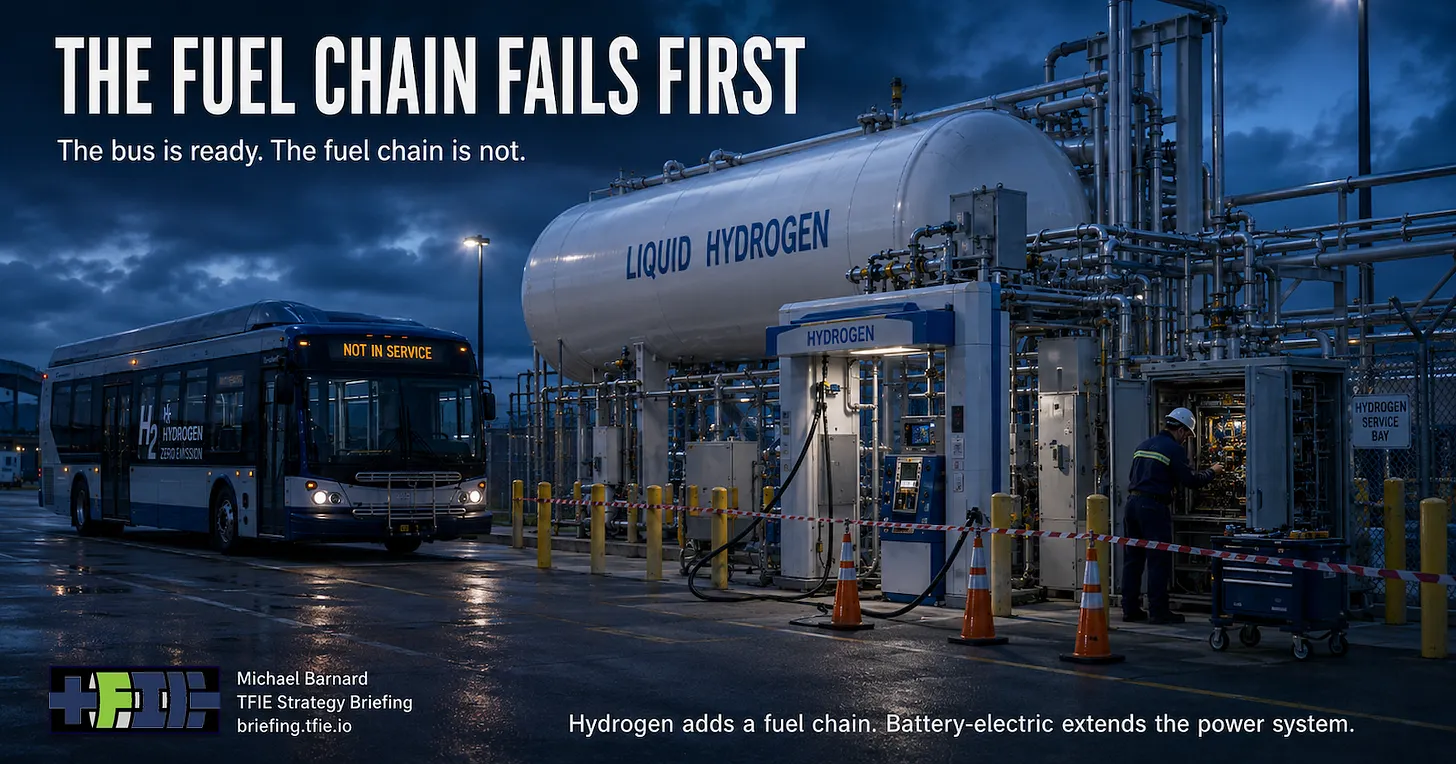
Support CleanTechnica's work througha Substack subscription,on Patreon, oron Stripe. Help us produce all of thehigh-quality, original content we publish week after weekdespite the challenges of content-scraping AI, antisocial media, inflation, and other hurdles.The Orange County Transportation Authority is spending another $27.6 million on hydrogen infrastructure as it expands its fuel-cell bus fleet from 10 buses toward 50. Read the announcement quickly and it sounds like ordinary fleet growth: more buses require more fueling capacity.
OCTA’s history makes the story much less straightforward. The agency already opened a substantial hydrogen station at its Santa Ana base in 2020, sized for roughly 40 to 50 buses a day. That station became unusable after OCTA and Air Products failed to reach a new commercial agreement covering leased liquid-hydrogen equipment. Air Products removed its tank and vaporizers in January 2026, leaving OCTA with buses that still had years of service life but no functioning depot fuel system.
The operational impact was severe. OCTA’s ten fuel-cell buses traveled 270,462 miles in 2024 and only 14,232 miles in 2025, a drop of almost 95%, as fueling problems pushed the agency toward an off-site commercial station and temporary mobile fueling while it worked on restoring depot capability.
OCTA also runs battery-electric buses, which gives the agency its own comparison instead of forcing us into a model-versus-model debate. OCTA nevertheless reported no lost bus deployments because charging infrastructure was unavailable. The battery-bus charging infrastructure cost about $6 million, while hydrogen depends on a much more specialized chain of storage, supply, contracting and dispensing.
A fuel-cell bus can be perfectly serviceable while the fuel pathway behind it is not. Transit agencies need hydrogen that arrives every day, meets purity requirements, is affordable at the nozzle and is genuinely low-carbon across production and delivery. The station is only the last visible part of a system that also includes production, compression or liquefaction, transport, storage and specialized maintenance.
The Garden Grove award also illustrates how much of the “station” is actually fuel-system support. The $27.6 million contract bundles design and construction with facility modifications, hydrogen supply, operations, maintenance and training for the opening period. Those services are necessary because the agency is not merely installing a dispenser; it is securing a working fuel pathway around the buses. The total expenditure for refueling has risen to over $100 million.
The new Garden Grove station provides more capacity and redundancy, which could be a rational response once an agency has committed to a larger hydrogen fleet. Committing to the larger fleet when the refueling system failed and required massive new investment was the strategic failure, especially when they had more reliable and cheaper electric buses operating already. From a procurement perspective, it also shows how quickly a supposedly simple fast-refueling advantage turns into a requirement for duplicated specialized infrastructure and durable fuel-supply relationships.
Battery-electric transit has infrastructure headaches of its own, especially depot power upgrades. But bus charging extends an electricity system that already serves buildings, industry and vehicles throughout the region. Hydrogen asks a transit agency to establish and sustain a second energy-delivery system for a comparatively small fleet.
The rational decision for OCTA would have been to write off its existing 10 hydrogen buses as Aberdeen did in a similar situation, cancel the order for 40 more and lean into battery electric, which was proving in their own system to be more reliable and much cheaper. But OCTA is one of a handful of California transit agencies which still has hydrogen fever, so rational thinking and competence with spreadsheets are in short supply.
For procurement, the bus itself is only part of the propulsion system. An agency considering hydrogen needs a credible answer for how affordable, genuinely low-carbon fuel will reach the depot for the full 12- to 15-year service life of the buses. OCTA’s experience is valuable because the buses, the failed fuel arrangement and a battery-electric comparison all sit inside the same agency. The deeper Briefing analysis follows OCTA’s total infrastructure spending, what happened at other long-running hydrogen bus programs, and how subsidy-supported fleets can create pressure for still more investment after the original purchase.
Read the full analysis in TFIE Strategy Briefing:https://briefing.tfie.io/p/octas-hydrogen-bus-expansion-is-really Sign up for
CleanTechnica's Weekly Substack for Zach and Scott's in-depth analyses and high level summaries, sign up forour daily newsletter, andfollow us on Google News!Have a tip for CleanTechnica? Want to advertise? Want to suggest a guest for our CleanTech Talk podcast?
Contact us here.Sign up for our daily newsletter for 15 new cleantech stories a day. Or sign up forour weekly one on top stories of the weekif daily is too frequent.
CleanTechnica uses affiliate links. See our policy
here.CleanTechnica's Comment Policy