TL;DR — Key Takeaways
Nvidia is reportedly paying $6 billion for a non-exclusive license to Poolside’s Model Factory, while offering jobs to 109 employees and investing another $1 billion in the remaining company.** The structure fits a broader Nvidia pattern:**license strategic technology, recruit the people who built it and leave the original company legally independent, as seen with Enfabrica and Groq.The bigger strategy is control across more of the AI stack. Networking, scheduling, inference and now model development complement Nvidia’s GPUs and software, while regulators are increasingly scrutinizing acquihire-style transactions.
There is a new kind of takeover emerging in the AI industry. The buyer does not actually buy the company. It licenses the technology, hires the people who created it and leaves the corporate entity behind to insist that nothing was acquired.
Nvidia appears to be getting very good at it.
The latest example is Poolside, the AI startup best known for developing coding models and the internal system it calls Model Factory. According to an investor letter obtained by Newcomer, Nvidia has agreed to pay $6 billion for a non-exclusive license to Model Factory. Nvidia will also make employment offers to 109 Poolside employees involved in developing its Laguna models and invest another $1 billion in Poolside at a $12 billion pre-money valuation.
Poolside’s founders will reportedly remain, as will the company itself. The investor letter goes out of its way to say the transaction is not an acquisition or an acquihire.
Technically, that may be true. Practically, it depends on what you believe makes a company a company.
If Nvidia licenses the model-development factory and hires much of the team that built and operated it, what remains of Poolside’s model-development business? There may be a perfectly good answer, but neither Nvidia nor Poolside has provided it publicly. In fact, neither company has formally announced the transaction as of this writing. The terms continue to come primarily from the Poolside investor letter reported by Newcomer. What Nvidia is reportedly licensing is considerably more important than one coding model.
Poolside describes Model Factory as an integrated platform for turning model development into an industrial process. It handles data mixing, synthetic-data generation, architecture experiments, pretraining, reinforcement learning from code execution, post-training and automated evaluation. Poolside says experiments that once took weeks to schedule can now be launched in under an hour.
That kind of system could be extremely valuable to Nvidia as it moves beyond providing the hardware used to train AI models and deeper into the business of building the models themselves.
Poolside’s Laguna S 2.1 demonstrates what the factory can produce. It is an 118-billion-parameter mixture-of-experts model that activates approximately eight billion parameters per token. Poolside says it was trained on 30 trillion tokens, with pretraining beginning on 4,096 Nvidia H200 GPUs. It went from the beginning of training to release in less than nine weeks, and an NVFP4 version is small enough to run on a single Nvidia DGX Spark. Poolside released three Laguna models in three months.
This is not just another code-generation model Nvidia can add to a catalog. It is a system, a collection of training recipes and a group of people that have shown they can build and release sophisticated models quickly.
Still, the word “non-exclusive” matters. It means Poolside apparently retains ownership of the underlying technology. Depending on the provisions in an agreement that we have not seen, Poolside may be able to license Model Factory again, sell the intellectual property or sell the company that continues to own it.
We have seen this movie before.
Is Poolside the Next Windsurf?
In July 2025, OpenAI’s proposed acquisition of AI coding company Windsurf fell apart. Google quickly stepped in with a different kind of transaction.
Google paid a reported $2.4 billion for a non-exclusive license to portions of Windsurf’s technology. Windsurf CEO Varun Mohan, co-founder Douglas Chen and members of its research and development team joined Google DeepMind. Google did not acquire Windsurf, take an equity stake or assume control of the company. Windsurf was free to continue operating and license its technology to others. Reuters confirmed the structure.
Three days later, Cognition acquired what remained of Windsurf.
That second transaction included the Windsurf IDE, intellectual property, product, trademark, brand, business, customers and remaining employees. Cognition said Windsurf had $82 million in annual recurring revenue, more than 350 enterprise customers and hundreds of thousands of daily users. Cognition announced the transaction without disclosing what it paid.
Google kept its licensed rights. Cognition acquired the underlying company and IP.
One startup had effectively supported two transactions. Google obtained the leaders, researchers and a license to the technology it wanted. Cognition acquired the operating business, remaining organization and ownership of the assets.
Poolside could follow a similar path.
Nvidia would have access to Model Factory and the opportunity to recruit the people most familiar with it. Another company could potentially acquire Poolside, its ownership of the technology, its Laguna models and whatever products, people and commercial relationships remain. That buyer would take those assets subject to Nvidia’s existing rights and whatever restrictions are contained in the licensing agreement.
There are plenty of possible suitors. Another chipmaker might want a model factory it could optimize for its accelerators. A hyperscaler could use it to strengthen its proprietary model-development capabilities. An AI coding company could combine Poolside’s models with an existing developer product. A sovereign-AI investor could see value in owning a Western open-weight model platform.
None of that means Poolside is currently negotiating another sale. Nor does “non-exclusive” necessarily mean Poolside can license the identical technology to an Nvidia competitor tomorrow.
Nvidia may have negotiated rights to future improvements, restrictions involving direct competitors, change-of-control protections, source-code access, modification rights or a first look at any proposed sale. Its $1 billion investment could also come with board, information or consent rights that give Nvidia influence over Poolside’s next move.
We do not know because the agreement is not public. But Windsurf established the precedent: A non-exclusive license-and-hiring transaction does not have to be the final transaction involving the company or its IP.
Nvidia Has Done This Before
Poolside is not an isolated case. It fits an emerging Nvidia pattern.
In September 2025, Nvidia reportedly spent more than $900 million in cash and stock to license technology from AI networking startup Enfabrica and hire CEO Rochan Sankar and other employees. Enfabrica had developed technology for connecting enormous numbers of AI accelerators into a system that could operate more like a single computer. Nvidia did not buy the entire company. Reuters reported the arrangement.
Then came Groq.
In December, Nvidia entered into a non-exclusive agreement to license Groq’s inference technology. Groq founder Jonathan Ross, president Sunny Madra and other members of the company joined Nvidia to advance the licensed technology. Groq continued operating independently under a new CEO, and GroqCloud remained in business. Groq confirmed the structure but not the price, which was reported elsewhere as reaching as high as $20 billion. Groq’s announcement sounds remarkably similar to the reported Poolside arrangement.
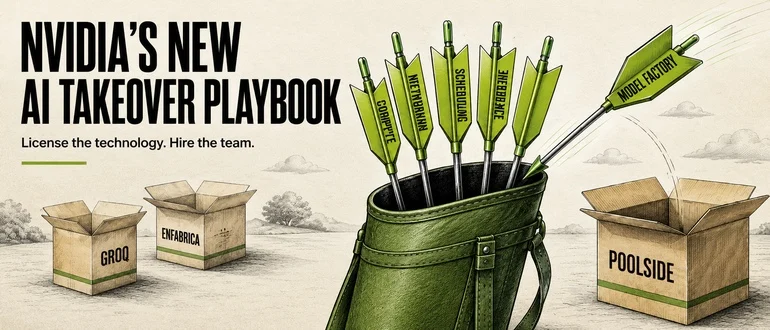
License the technology. Hire the people who understand it. Leave the remaining company legally independent.
Nvidia is not philosophically opposed to regular acquisitions. It acquired SchedMD, the company behind the open source Slurm workload-management system, in December. Slurm handles scheduling and resource allocation across high-performance computing and AI clusters. Nvidia promised to continue distributing it as open source and vendor neutral. Nvidia announced that acquisition directly.
The difference suggests Nvidia is selecting the transaction structure that best fits each target. It can purchase an entire company when that is efficient. When it wants a specific technology and technical team without the rest of the operation—or without the scrutiny accompanying a formal acquisition—it has another arrow in its quiver.
The capabilities Nvidia is collecting are not random. Enfabrica contributes networking technology for enormous AI clusters. SchedMD adds workload scheduling and orchestration. Groq brings specialized inference architecture and expertise. Poolside would add model training, experimentation, post-training and evaluation.
Put those together with Nvidia’s GPUs, NVLink, Spectrum-X, CUDA, NeMo, NIM and enterprise software, and the outline becomes clearer. Nvidia is assembling more of the complete AI production system around its processors.
Nvidia is also developing increasingly ambitious open and open-weight models. It is working on Nemotron 4, with the largest planned version reportedly containing at least one trillion parameters. Nvidia confirmed that Nemotron 4 is under development but did not confirm the size or release timing reported by The Information. Reuters reported that Nvidia views accessible frontier models as strategically important for companies and countries.
Model Factory could give that effort an experienced team and an industrialized development platform rather than forcing Nvidia to create everything internally.
Nvidia does not have to become another OpenAI or Anthropic to benefit. Open and open-weight models create demand for training, customization, fine-tuning, deployment and inference. When those models are developed and optimized around Nvidia systems, they help pull even more activity toward Nvidia hardware, networking and software.
Nvidia can compete at the model layer without depending on model subscriptions for its return. It makes money when the models create more demand for compute.
The Regulators Are Watching
The structure may also attract less automatic merger scrutiny because the startup is not formally acquired. But regulators are beginning to question whether the label accurately reflects the economic substance.
In March, the head of the Justice Department’s antitrust division described these acquihire-style arrangements as a “red flag.” The official specifically cited Nvidia’s Groq transaction as an example of a company licensing technology and hiring its CEO without acquiring the startup. Reuters reported the warning.
That does not make the Poolside transaction illegal, nor does it establish that Nvidia designed it to evade regulatory review. It does raise a legitimate question: If a dominant company obtains the critical technology and hires most of the people capable of advancing it, how much competition has been preserved by leaving the startup’s corporate registration intact?
Poolside may retain ownership of Model Factory, but software does not improve itself. The people, training practices, failures, corrections and institutional knowledge surrounding the software can be as important as the code. Nvidia is not paying $6 billion merely for permission to download a repository.
The economic structure is equally unusual. Poolside’s existing investors will reportedly receive the proceeds of the $6 billion licensing payment, while Nvidia puts another $1 billion into the company that remains. That begins to look like Poolside being divided into two economic pieces: The model-development capability and much of its team move toward Nvidia, while a separately financed company remains with ownership rights and whatever other operations fall outside the transaction.
Poolside had already separated its model-building operation from Poolside Infrastructure Company after its original agreement with CoreWeave for the massive Horizon data-center project in West Texas fell apart. The Financial Times reported that the failed CoreWeave arrangement disrupted an earlier $2 billion fundraising effort that Nvidia had been expected to anchor. Poolside reportedly concluded that competing at the frontier would require access to more Nvidia hardware than it could secure.
There is an Indispensability Trap in there.
Poolside built its models on Nvidia hardware. It required additional Nvidia compute to keep competing. Nvidia was already an investor. Now Nvidia is reportedly licensing Poolside’s most important development platform and offering jobs to the employees who built it.
The supplier, investor and gatekeeper to scarce compute became the party best positioned to capture the customer’s most strategically valuable capability.
Poolside may become the next Windsurf. Another buyer could acquire the remaining company and its IP. Poolside might instead reinvent itself around infrastructure, applications or enterprise deployment. It could rebuild the model team or continue with employees who decline Nvidia’s offers.
Nvidia does not have to wait to find out.
It gets access to Model Factory, the opportunity to recruit the team and the ability to integrate both into a platform that already stretches across nearly every layer of AI infrastructure. Its investment also gives it an economic interest in whatever Poolside becomes next.
Nvidia does not need to own every AI company. It only needs to own, license or exert sufficient influence over the technologies that make the rest of the AI market increasingly difficult to operate without it.
That may not be an acquisition in the traditional sense. It may be something even more effective.