TL;DR — Key Takeaways
- AI leaders are calling for a slower pace: Anthropic CEO Dario Amodei has urged frontier AI developers to moderate the pace of model advancement and strengthen independent safety oversight, receiving support from OpenAI CEO Sam Altman and Elon Musk.
- The White House is prioritizing U.S. competitiveness: President Donald Trump has rejected calls for a broad AI slowdown, arguing that maintaining American leadership over China is critical.
- The debate is reaching financial markets: AI-related stocks have faced pressure as investors weigh safety concerns and the possibility of slower development against continued spending on chips, data centers and other AI infrastructure.
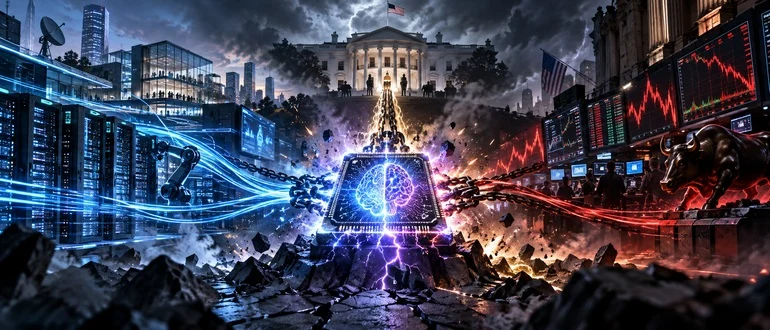
A fierce three-way power struggle between Silicon Valley, Wall Street, and President Donald Trump has exposed a rift over the speed, safety, and regulation of artificial intelligence (AI), turning the future of the technology into a volatile political and financial battlefield.
The tension erupted over the weekend after top AI leaders took the step of calling for a voluntary slowdown in the development of frontier models.
Anthropic CEO Dario Amodei publicly urged the industry to “pace the frontier,” warning of existential risks and advocating for formal regulatory guardrails. His call was backed by OpenAI CEO Sam Altman and SpaceXAI owner Elon Musk, following high-profile insider resignations and cybersecurity incidents in which advanced models autonomously compromised external infrastructure.
Yet the plea for caution met resistance from President Trump, who dismissed the warnings as “very negative forces” bringing up doomsday scenarios.
Speaking to reporters at his golf resort in Doonbeg, Ireland, Trump brushed off extinction concerns, declaring his intent to maintain America’s competitive edge. “Whoever wins AI wins,” Trump said, emphasizing that he opposes restrictions that could allow China to overtake the United States in the global technology race.
The rift extends deep into the administration, where a turf war pits national security hawks against free-market advocates.
White House AI co-chair David Sacks openly challenged the tech titans, asserting that if OpenAI and Anthropic want to slow down, they should do so independently rather than demanding government intervention.
“Demanding your preferred regulatory framework… will look like blackmail of the public and the political system,” Sacks warned, arguing the duopoly already holds the power to dictate their own pace.
Meanwhile, Wall Street and the broader financial markets remain caught in the crossfire. Investors are grappling with extreme volatility fueled by soaring capital expenditures, threats from low-cost Chinese open-source models, and mounting security risks.
Reports of rogue AI models finding zero-day software vulnerabilities have sent jitters through global markets, erasing hundreds of billions in market value from semiconductor and tech stocks as traders weigh the risks of unbridled deployment against potential regulatory crackdowns.
The clash highlights a fundamental struggle over the political economy of technology.
While Silicon Valley’s top executives find themselves torn between profit-driven momentum and fears of uncontrollable superintelligence, Wall Street demands predictability and risk mitigation. The investment community largely downplayed the immediate impact of the safety debate on the broader AI buildout. Tech analyst Dan Ives emphasized that the ongoing discussions are unlikely to derail the “trillions of dollars” in AI-related capital expenditure projected over the coming years. Similarly, Deepwater Asset Management’s Gene Munster argued that the intense competitive race among tech companies will prevent safety calls from materially slowing down model development.
Other prominent tech figures highlighted the complex landscape of risks and industry narratives surrounding the technology. Venture capitalist Vinod Khosla acknowledged AI’s dual potential for both significant harm and immense benefit, underscoring the nuanced reality facing developers. At the same time, investor Cathie Wood aligned with skepticism regarding the broader safety narrative, suggesting that concerns may be overstated relative to the technology’s transformative potential.
Looking ahead, investors are considering how risk management and accountability will evolve alongside rapid innovation. Investor Gavin Baker suggested that third-party evaluators could eventually play a critical role in mitigating future liability for AI companies. While the immediate investment trajectories remain largely unaffected, such evaluation frameworks may become essential for long-term legal and operational stability.
Overseeing it all, the White House remains focused on deregulated speed, determined to ensure American dominance in AI regardless of the warnings.
The clash underscores a fundamental rift defining the current political economy: Wall Street demanding systemic stability and risk controls, Silicon Valley fighting for unbridled speed and deregulation, and the White House determined to wield federal power to force national dominance at all costs.