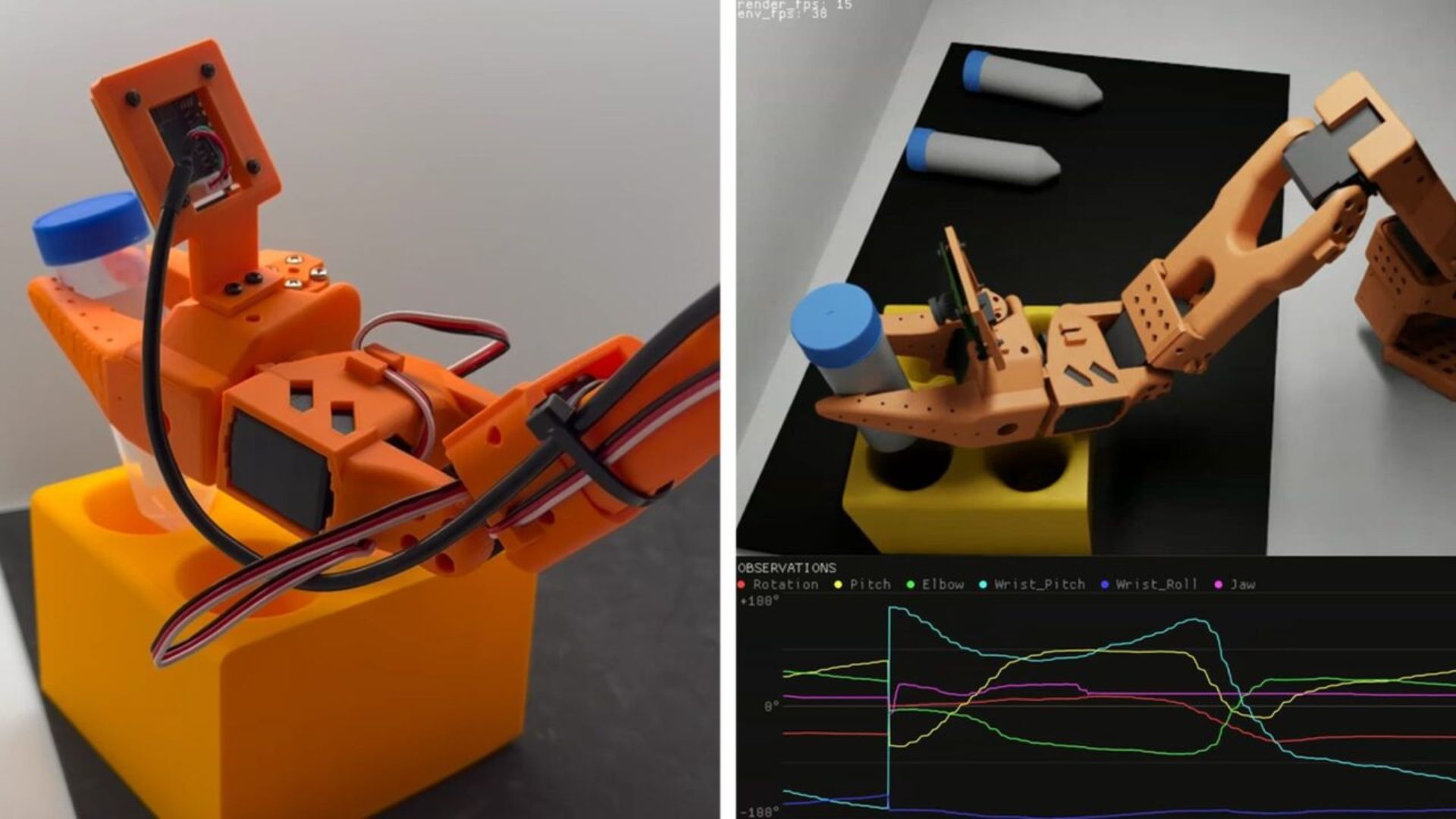
For robotics engineers and ML practitioners, combining open foundation models, teleoperation tooling and simulation in one library lowers integration overhead and shortens the sim-to-real loop. Per NVIDIA's developer blog and company posts, LeRobot now includes Isaac GR00T 1.7 and Isaac Teleop integrations, enabling vision-language-action workflows and standardized human-demonstration data collection (developer.nvidia.com; blogs.nvidia.com). Multiple outlets report that support for NVIDIA Cosmos 3 is planned for a future release (Interesting Engineering; IT Brief Asia). NVIDIA's blog also cites community reach figures of 3 million robotics developers and Hugging Face's 16 million AI builders, which the companies present as rationale for broader access to physical-AI tooling.
What happened
Per NVIDIA's blog and developer posts, Hugging Face's open-source robotics library LeRobot now includes Isaac GR00T 1.7 and the Isaac Teleop framework for end-to-end robot model development (blogs.nvidia.com; developer.nvidia.com). LeRobot already provides simulation and dataset workflows; the new additions stitch NVIDIA's humanoid VLA model and a standardized teleoperation data-collection pipeline into that environment (Interesting Engineering; IT Brief Asia).
Technical details
Per NVIDIA's developer post, Isaac GR00T 1.7 is a vision-language-action model pretrained on roughly 32,000 hours of real human demonstrations and 8,000 hours of simulation, and it uses a Cosmos-Reason2-2B / Qwen3-VL backbone with ONNX/TensorRT export support (developer.nvidia.com). Reporting across sources lists complementary software in the stack: Isaac Teleop for collecting human demonstrations in standardized formats, Isaac Sim and Isaac Lab for simulation and environment benchmarking, and deployment pathways targeting Jetson-class hardware (Interesting Engineering; Electronics For You).
Reported data and roadmap
Electronics For You and other outlets report a physical-AI dataset cited in the partnership containing more than 350,000 real and simulated robot trajectories and 57 million grasp samples; sources indicate Cosmos 3-a world-model style physical-AI foundation model-is planned for future integration into LeRobot to augment synthetic-data and scenario generation (Electronics For You; IT Brief Asia).
Context and significance
Editorial analysis: For practitioners, the integration matters because it pairs a pretrained humanoid VLA (Isaac GR00T) with standardized teleop capture and established sim tools inside a single open library, which lowers the engineering cost of building training datasets, running post-training adaptation, and deploying policies to varied robot embodiments. Industry-pattern observations: Open-source ecosystems that combine models, data and tooling (model zoo + sim + data collection) accelerate reproducibility and benchmarking, and they reduce wasted effort on format conversions and bespoke pipelines.
What to watch
Observers and developers should track (a) availability of Cosmos 3 within LeRobot and the extent of its synthetic-data capabilities; (b) example repositories or benchmarks showing GR00T fine-tuning and cross-embodiment transfer; and (c) community uptake metrics such as contributed datasets or shared policies, where progress will indicate whether the integrated stack meaningfully reduces sim-to-real gaps. Thomas Wolf's direct quote in NVIDIA's coverage-"Open source is how a field turns advanced research into something people can study, adapt and build on"-appears in NVIDIA's announcement as the stated community rationale (blogs.nvidia.com).
Editorial analysis
Robotics teams historically face high friction when combining large models, simulators and teleoperation pipelines; centralized open integrations reduce that friction and make iterative experimentation with robot foundation models more practical for smaller labs and startups.
This integration does not remove core robotics challenges - physics mismatch, safety validation and real-world data scarcity remain - but it makes experimentation and shared benchmarking easier across teams that already use open-source model and simulation stacks. For practitioners, the immediate practical gain is lower integration cost when experimenting with VLA-style policies and faster iteration between teleop-collected demonstrations, sim validation and post-training deployment.
Key Points #
- 1Open integration of foundation models, simulators and teleoperation tooling reduces engineering friction and accelerates iteration for robotics teams.
- 2Standardized teleop capture plus a pretrained VLA (Isaac GR00T 1.7) enables faster dataset creation and imitation-learning experiments across embodiments.
- 3Planned Cosmos 3 support could expand synthetic-data generation, which matters when physical data collection is costly or dangerous.
Scoring Rationale #
This is a notable tooling integration that lowers integration overhead for robotics practitioners but stops short of a paradigm-shifting model release. It meaningfully improves accessibility for developers experimenting with humanoid VLA policies and sim-to-real workflows.
Sources #
Public references used for this report.

[01blogs.nvidia.comNVIDIA and Hugging Face Bring New Models and Frameworks to ...](https://blogs.nvidia.com/blog/hugging-face-lerobot-models-frameworks-open-robotics/)

[02developer.nvidia.comDevelop Humanoid Robot Policies End-to-End with NVIDIA Isaac ...](https://developer.nvidia.com/blog/develop-humanoid-robot-policies-end-to-end-with-nvidia-isaac-gr00t/)

[03electronicsforu.comRobot AI Models Goes Open Source - Electronics For You](https://www.electronicsforu.com/news/robot-ai-models-goes-open-source)
View 6 more sources #
04NVIDIA & Hugging Face add robotics tools to LeRobot - IT Brief Asiaitbrief.asia05NVIDIA Brings Robot Foundation Models to Hugging Face LeRobothyper.ai06Nvidia and Hugging Face Bring New Models and Frameworks to ...theaiinsider.tech07NVIDIA Isaac GR00T N1.7 - A Foundation Model for ... - GitHubgithub.com08Seeed reBot Arm Successfully Integrates with LeRobot V0.6.0 ...seeedstudio.com09LeRobot gets NVIDIA AI tools to help developers build smarter robotsinterestingengineering.com
Practice interview problems based on real data
1,625 SQL & Python problems across 15 industry datasets — the exact type of data you work with.