cd /news/large-language-models/mimo-v2-6-pro-architecture-and-train… · home topics large-language-models article
[ARTICLE · art-137114] src=sebastianraschka.com ↗ pub= topic=large-language-models verified=true sentiment=↑ positive

MiMo-V2.6 Pro Architecture and Training Notes

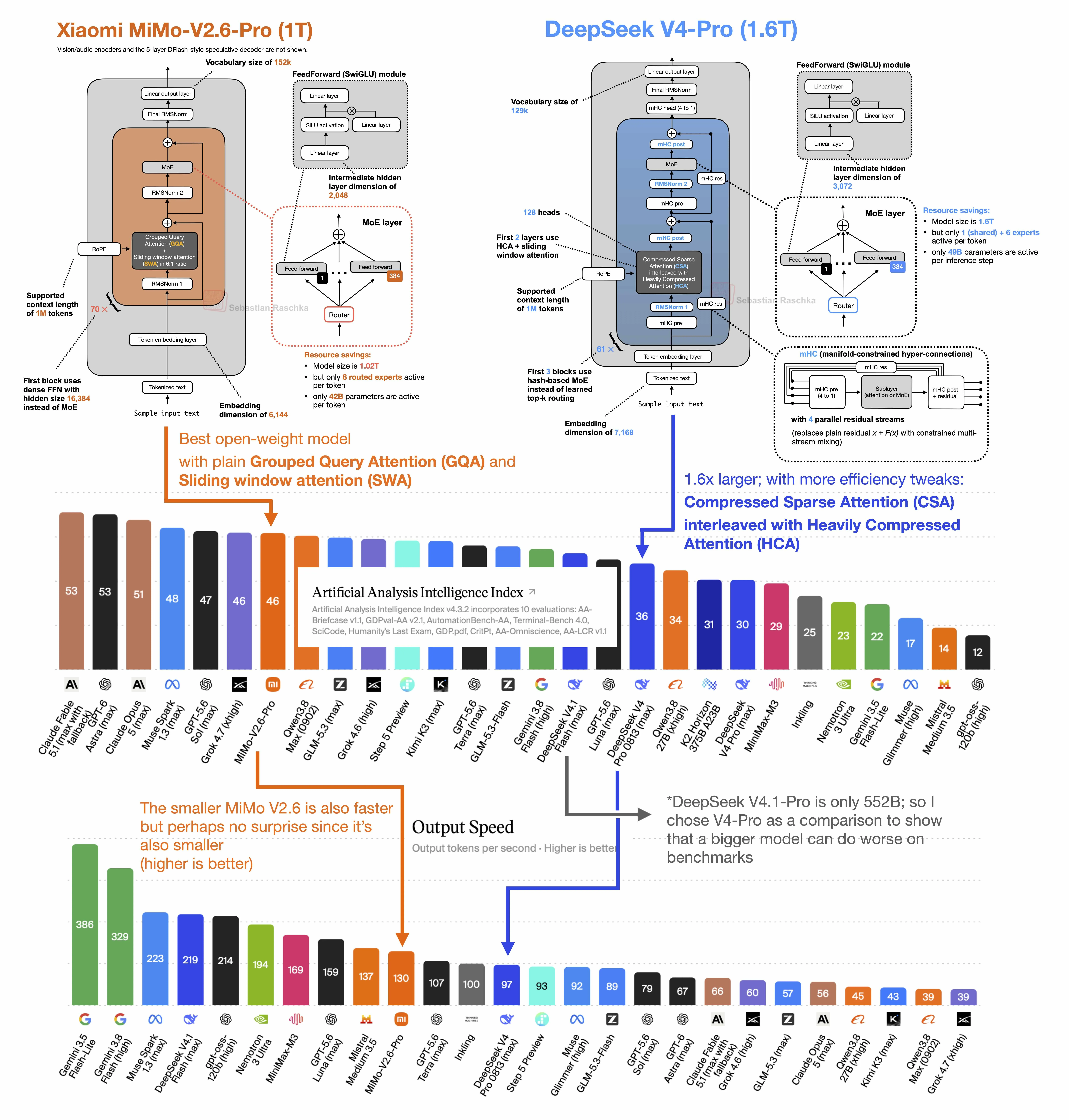
Xiaomi's MiMo-V2.6 Pro ranks No. 1 on open-weight benchmarks by weighted average despite using a classic Grouped Query Attention architecture with Sliding Window Attention at a 128-token window, according to training notes published by Sebastian Raschka. Xiaomi's MiMo team reported in its technical report that DeepSWE pass@1 accuracy on held-out harnesses improved from approximately 50% to 66%, with training using 1,568 prompts × 16 rollouts = 25,088 trajectories and 2.7–3.7 billion training tokens per update. The team also replaced a simple correctness verifier with an agentic grader that examines execution traces, which Raschka cites as evidence that data and post-training recipe improvements, not attention variants, drive most progress.

read1 min views2 publishedSep 22, 2026
MiMo-V2.6 Pro Architecture and Training Notes
Image: Sebastianraschka (auto-discovered)

Xiaomi’s new MiMo-V2.6 Pro is “simply” the best (for now). Despite its simple architecture design it’s currently No.1 in the open-weight benchmarks (weighted average).

With “simple,” I mean a classic Grouped Query Attention (GQA) with Sliding Window Attention (SWA) at a tiny 128-token window size.

So, that underlines one of the points I’ve been trying to make in recent months: most of the progress still comes from the data and post-training recipe improvements. Fancy attention variants are just mostly efficiency tweaks.

What are some of the training data improvements and recipe improvements? The MiMo team shared a pretty detailed technical report. Lots to carefully digest there, but in short, there are a few things that stood out:

An increase in agent tasks; also training across different harnesses (the average DeepSWE pass@1 accuracy on held-out harnesses improved from approximately 50% -> 66%). 2. Better reward signals: they replaced a simple correctness verifier with an agentic grader that looks at the execution traces as well. 3. Large RL batches (1,568 prompts × 16 rollouts = 25,088 trajectories) and 2.7–3.7 billion training tokens per update (unclear, though, what the predecessor used).

Source: website version of my Substack note.

It's Easy to Dismiss Jev as Just a Classifier A short note on Jev's generalization, possible encoder-style architecture and training, and Choice and Noul API examples.

Pacing != Pacing Development My take on AI model pacing as a framework for release checks and the competitive pressure around model releases.

AI Reasoning Models Course on LinkedIn Learning A 90-minute LinkedIn Learning course on how reasoning models relate to conventional LLMs and how they are developed.

── more in #large-language-models 4 stories · sorted by recency
── more on @xiaomi 3 stories trending now
sponsored brought to you by zahid.host 4,200+ EU-deployed projects
reading about agents? ship yours in a single git push.

Run your AI side-project on zahid.host

EU-based hosting, git-push deploys, automatic HTTPS, no cold starts. Free tier with a custom domain — perfect for shipping the agent you just read about.

$git push zahid main
Live at https://your-agent.zahid.host
Get free account → Pricing
from €0/mo · no card required
LIVE [news/mimo-v2-6-pro-archit…] indexed:0 read:1min 2026-09-22 ·