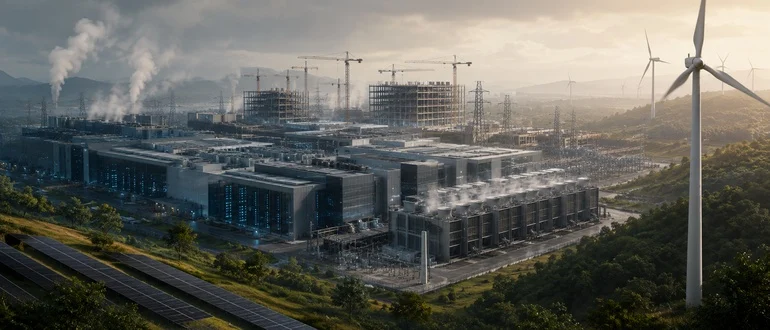
Microsoft’s investment in AI has significantly increased its environmental footprint, with the company reporting a 25% year-over-year rise in greenhouse gas emissions as rapid expansion of AI data centers outweighed gains from sustainability initiatives.
The figures, published in Microsoft’s 2026 Environmental Sustainability Report, highlight the mounting tension confronting hyperscalers. As demand for AI computing accelerates, companies are building vast new data center capacity while attempting to meet ambitious climate commitments.
Microsoft is not alone in reporting higher emissions tied to AI expansion. Amazon reported a 16% increase in greenhouse gas emissions in its latest sustainability report, while Google’s emissions rose 18% as both companies continued expanding AI infrastructure.
Microsoft’s total greenhouse gas emissions reached approximately 20 million metric tons of carbon dioxide equivalent during fiscal 2025. The company attributed most of the increase to construction of AI infrastructure, which requires vast quantities of concrete, steel, chip components and electrical gear, along with the enormous levels of electricity needed to run cloud facilities.
The increase comes despite Microsoft’s continued commitment to become carbon negative by 2030. Chief Sustainability Officer Melanie Nakagawa said the company remains focused on that target, while acknowledging that the rapid buildout of AI infrastructure has complicated the path toward achieving it.
Initiatives That Limited Emissions
Microsoft said sustainability initiatives helped limit what would have been an even larger increase in emissions. The company estimates that without measures including carbon-free electricity procurement, sustainable fuels, Xbox hardware efficiency improvements and lower-carbon Surface devices, emissions would have reached roughly 34 million metric tons.
The company also reported that it matched 100% of its annual global electricity consumption with renewable energy during fiscal 2025. It has shifted away from purchasing short-term renewable energy certificates that do not directly add new clean power generation.
Instead, Microsoft said it is prioritizing investments that expand carbon-free electricity production, even though the accounting change raises reported emissions in the near term.
The report shows how the composition of Microsoft’s emissions is changing as AI infrastructure grows. Scope 2 emissions, generated from purchased electricity, represented 13% of the company’s total carbon footprint, compared with roughly 2% a year earlier. Scope 3 emissions, mainly associated with suppliers and construction, remain the company’s largest source of greenhouse gases.
Microsoft said it replenished more than 14 million cubic meters of water during fiscal 2025, exceeding the amount it withdrew for the first time. The company added it will now place greater emphasis on restoring water in the local watersheds where it operates, shifting its focus beyond achieving a positive global water balance.
Furthermore, Microsoft said it has eliminated all but 0.07% of single-use plastics from primary product packaging, reused or recycled 92% of decommissioned cloud servers and components for a second consecutive year, and diverted more than 90% of construction and demolition waste from landfills. It has also expanded its Circular Centers program to seven facilities worldwide.