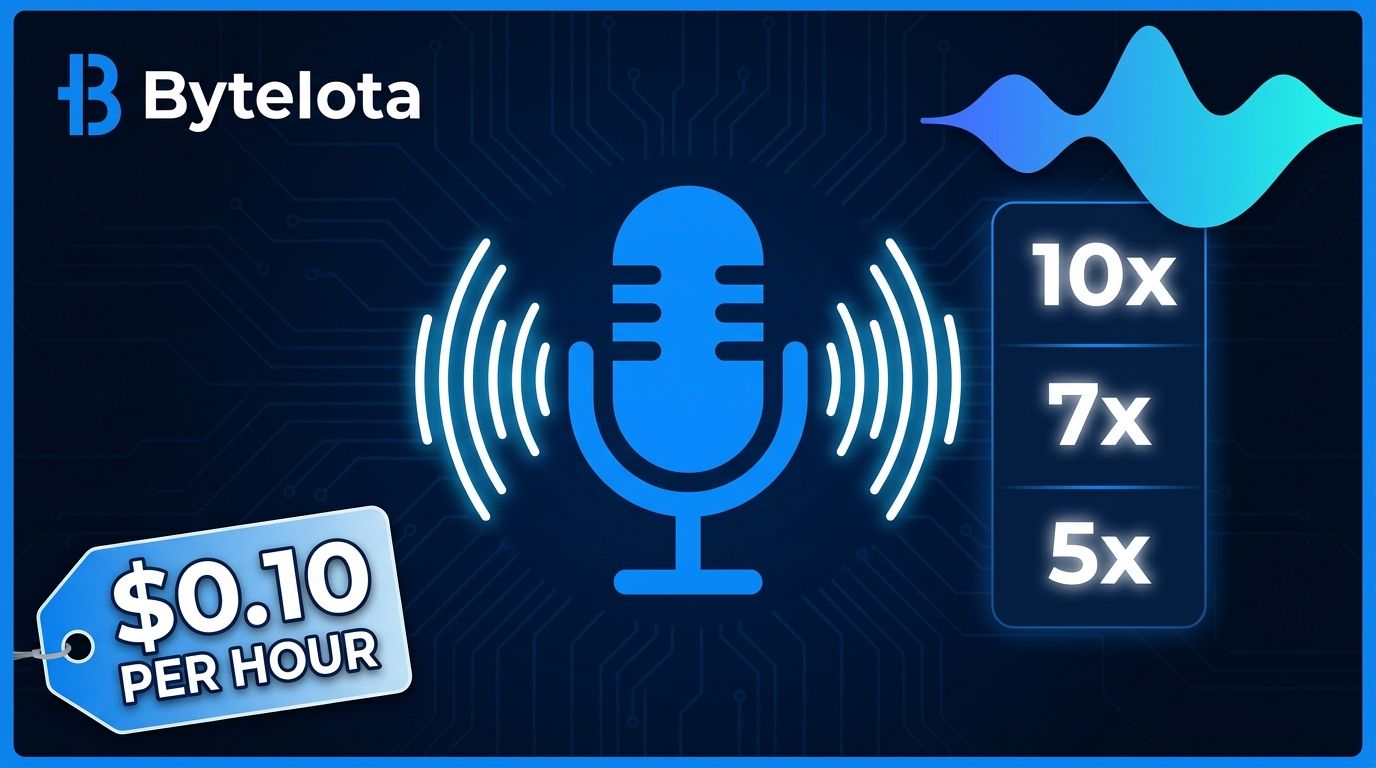
Microsoft just beat OpenAI, Google, and ElevenLabs on speech-to-text simultaneously — on price, speed, and accuracy. MAI-Transcribe-2, which dropped September 3rd, is priced at $0.10 per audio hour. That’s 72% cheaper than the API rate Microsoft charged for its own previous model, and less than a third of what OpenAI’s hosted Whisper costs. If you’re routing production transcription through any of the major providers right now, this is worth a look before your next billing cycle.
The Numbers That Matter #
MAI-Transcribe-2 claims first place on the FLEURS benchmark across 60 languages with a 5.2% average word error rate. On speed, Microsoft says the model processes at roughly 410x real-time — one hour of audio in about 10 seconds. That’s 10x faster than GPT-Transcribe, 7x faster than ElevenLabs ScribeV2, and 5x faster than Gemini 3.5 Transcribe.
The pricing comparison is where things get stark:
| Provider | Price/hr | Speed vs MAI-T2 |
|---|---|---|
| MAI-Transcribe-2 | $0.10 | — |
| OpenAI GPT-Transcribe | $0.36 | 10x slower |
| ElevenLabs ScribeV2 | ~$3.67* | 7x slower |
| Gemini 3.5 Transcribe | N/A public | 5x slower |
| Groq Whisper v3 Turbo | $0.04 | Faster, no diarization |
For teams running call center workloads, the math is blunt: 100,000 hours annually drops from $36,000 to $10,000.
The Developer Feature Set #
Raw price and benchmark numbers are only half the story. MAI-Transcribe-2 ships with four features that cover the most common production transcription needs.
Speaker diarization segments a recording by speaker and returns labeled segments with timing metadata. Enable it with diarization.enabled: true. Word-level timestamps give you offset and duration for every word — useful for video editors, search indexing, and transcript navigation. Keyword biasing via phraseList.phrases boosts recognition accuracy for domain-specific terms, product names, and abbreviations that trip up generic models. And the transcription style toggle — "clean" vs "verbatim" — handles whether you want readable output (fillers removed) or a full compliance record (every “um” and false start preserved).
Code-switching between Hinglish, Spanglish, and other common blended pairs is handled automatically with no extra configuration.
Quick Integration #
You need an Azure subscription and a Microsoft Foundry resource for Speech. Once that’s in place, you’re one API call away:
curl --location 'https://YourResourceName.cognitiveservices.azure.com/speechtotext/transcriptions:transcribe?api-version=2025-10-15' --header 'Content-Type: multipart/form-data' --header 'Ocp-Apim-Subscription-Key: <YourSpeechResourceKey>' --form 'audio=@"YourAudioFile.wav"' --form 'definition={
  "enhancedMode": {
    "enabled": true,
    "model": "MAI-Transcribe-2"
  }
}'
Accepted formats: WAV, MP3, FLAC. File size cap: 300 MB. Also available through the MAI Playground for no-code testing, and via OpenRouter if you’re already routing model calls through there.
Read the Fine Print #
Here’s what Microsoft’s own documentation says: MAI-Transcribe-2 is in public preview, “without a service-level agreement and not recommended for production workloads.” That’s a meaningful caveat. If you’re building anything customer-facing that can’t tolerate occasional downtime or behavior changes, you’re taking on risk right now.
The $0.10 rate is explicitly a promotional price through end of 2026. Microsoft hasn’t published what permanent pricing looks like. Building a 2027 business case around the launch price is a gamble. The rapid deprecation cycle adds to that risk: MAI-Transcribe-1 launched in April and was already deprecated by August — five months. Plan your migration windows accordingly.
One more thing: this is Azure-only infrastructure. Unlike Deepgram or AssemblyAI, which run cloud-agnostic, you’re committing to an Azure subscription and a Foundry resource. If you’re already in Azure, there’s no added friction. If you’re not, that’s the real cost to evaluate — not the $0.10 rate.
The Bigger Picture #
MAI-Transcribe-2 isn’t an isolated product launch. It’s part of Microsoft’s push to build its own AI models — speech, image, voice — instead of reselling OpenAI capabilities. The VentureBeat coverage frames this as Microsoft pursuing “AI self-sufficiency.” The pacing is aggressive and intentional.
For the speech API market, this is the second major price cut in six months from a Tier-1 vendor. If the promotional rate sticks or becomes the new normal, it forces Deepgram, AssemblyAI, and ElevenLabs to respond. That’s good for developers regardless of which provider you end up with.
Bottom Line #
If you’re using a hosted transcription API for call center, clinical, or media workloads — or paying OpenAI’s $0.36/hr Whisper rate — MAI-Transcribe-2 is worth piloting. Test on your own audio before committing; FLEURS and real-world accents don’t always agree. Watch the fine print on promotional pricing before locking in a cost model. And keep an eye on the deprecation timeline. Full details in the official documentation.