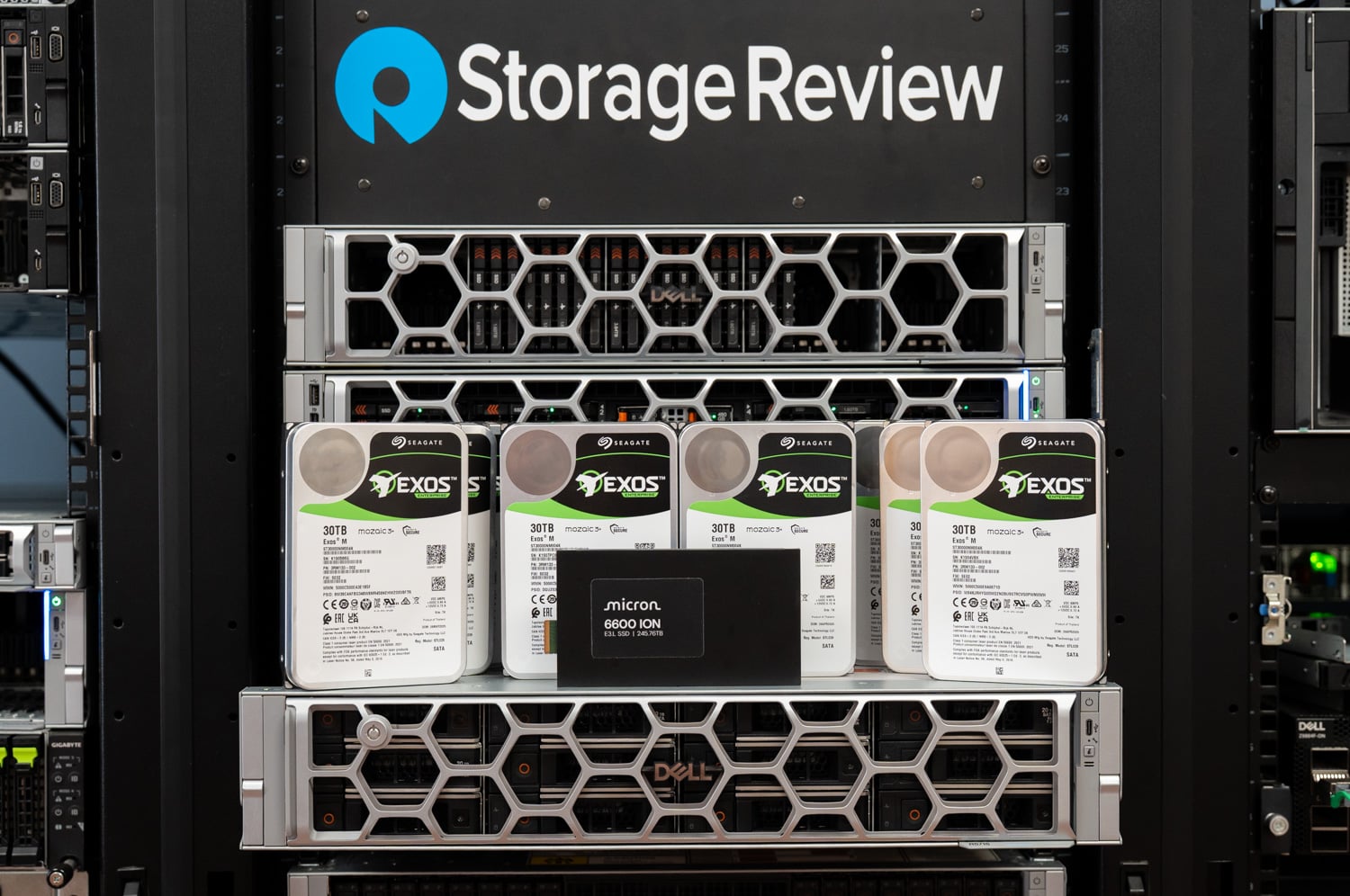
For two decades, the SSD-versus-HDD conversation ended the same way: flash wins on performance, disk wins on price per terabyte, and the size of that price gap settled the argument in favor of bulk storage. As storage technology has matured and AI has taken over, that framing is clearly out of date. The largest data center operators are no longer capacity-constrained by what they can afford to buy; they are constrained by what they can power, cool, and physically fit. When we reviewed the 245TB capacity Micron 6600 ION SSD earlier this year, the drive’s benchmark results told one story, but the more consequential one was the math around watts and rack units. In our measurements, a single Micron 6600 ION SSD did the work of eight nearline hard drives, and the flash configuration writing at full tilt drew less power than the HDD configuration at rest. Extend that swap across an exabyte, and the footprint collapses from 22 racks of best-case HDD density to 6 racks of flash, handing 16 rack positions back to the compute plan. A drive that puts nearly a quarter petabyte into a single slot changes how exabytes are planned, and in today’s facilities, both the watts and the racks are spoken for years in advance. Micron has promoted the 245TB capacity 6600 ION aggressively since it began shipping in May, and we have the test data to check the claims. The FIO and power work here, alongside the GPU Direct Storage and DLIO checkpointing results in our full review of the drive, supports a specific version of the pitch: for read-heavy bulk storage at scale, the drive delivers density and efficiency that nearline HDDs cannot approach, with trade-offs that are predictable when the workload matches the design.
Key Takeaways #
One drive replaced eight:A single 245TB Micron 6600 ION stood in for eight Seagate Exos M 30TB drives in RAID5 in the same Dell R5715, with the HDD backplane and RAID controller pulled from the chassis.Flash writing draws less than disk idling:170.2W under sequential writes against 173.5W for the HDD configuration at rest. Every measured state freed between 49.7W and 63.8W, blending to 55W per unit.Watts convert directly to compute:44.0kW freed per rack of flash servers. At 2,182 drives, less than three racks, the swap frees the 120kW that operates a complete GB200 NVL72.Efficiency, not just draw:72.7 MB/s per watt against 10.4 for the HDD array, or 3.8 watt-hours to read a terabyte against 26.7, roughly 7x on sequential reads.An exabyte in 6 racks instead of 22:4.2 times the capacity per rack with both sides at best-case density, returning 16 rack positions and roughly 320 square feet of white space per exabyte.
Data Center Economics Are Being Rewritten #
The International Energy Agency projects data center electricity consumption will more than double to roughly 945 TWh by 2030, with AI the largest driver, and in the facilities absorbing that growth, power, space, and cooling have replaced budget as the binding constraints. In a power-capped building, every watt and every rack position allocated to storage is capacity that cannot be used for revenue-generating GPUs.
The 245TB capacity Micron 6600 ION SSD was built for that arithmetic. Nearline HDDs still win on acquisition cost per terabyte, and for cold archives and rarely accessed data, that advantage remains decisive. But operators planning at exabyte scale are pricing something different: the cost to own and operate that capacity over its service life within a fixed power and space envelope. Measured that way, the drive’s density converts directly into recovered watts, rack positions, and cooling headroom, which is to say, into the compute the facility can now hold. Travis Vigil, Dell Technologies’ senior vice president of ISG product management, made the vendor version of the TCO case at launch, calling the 6600 ION “a meaningful reduction in total cost of ownership for customers building out AI and large-scale data center environments.” IDC’s Jeff Janukowicz, research vice president for solid state drives and enabling technologies, described the same shift at launch: “Rapid AI dataset growth is shifting storage economics from individual drives to rack-level efficiency. Operators need more usable capacity per rack while staying within strict power and cooling constraints.” The following sections provide our own measurements to support that argument.
Micron 6600 ION 245TB Overview #
The 6600 ION 245TB is currently the highest-capacity commercially available SSD, shipping since May 5, 2026, in E3.L 9.5mm and U.2 15mm form factors. It is built on Micron’s ninth-generation G9 QLC NAND with a six-plane architecture that pushes NAND I/O to 3.6 GB/s, the fastest QLC currently shipping in a data center SSD. The controller rides a PCIe Gen5 x4 interface, and the drive carries the compliance list a procurement team expects: OCP 2.6, NVMe 2.0d, TAA eligibility, and FIPS 140-3 Level 2 certifiability with CNSA 2.0 and SPDM 1.2 support.
The spec sheet makes the design intent straightforward. Sequential reads are rated at 13,700 MB/s against 3,000 MB/s writes, and random reads at 1.78 million IOPS against 42,000 random write IOPS. The top-capacity model uses a 16K indirection unit rather than 4K, which is why endurance is 1.0 SDWPD for 128KB sequential writes but 0.3 RDWPD for 16K random writes. This is a read-optimized high-capacity SSD.
Specification | Micron 6600 ION 245TB | |---|---| Platform Overview | | Capacity | 245TB | Form Factors |
E3.L (9.5mm) U.2 (15mm) |
Interface |
PCIe Gen5 x4, NVMe 2.0d | NAND | Micron G9 QLC, six-plane, 3.6 GB/s NAND I/O | Performance | | Sequential Read | 13,700 MB/s | Sequential Write | 3,000 MB/s | Random Read | 1,780,000 IOPS | Random Write (4K/16K) | 42,000 IOPS | Latency (QD1, Read/Write) | 100µs / 20µs | Power and Endurance | | Max Power | ≤30W | Idle Power | ≤5W | Endurance | 1.0 SDWPD (128KB sequential) 0.3 RDWPD (16K random) | MTTF / UBER | 2.5 million hours @ 50°C <1 sector per 10 17 bits read | Features | | Compliance | OCP 2.6 NVMe 2.0d NVMe-MI 1.2d TAA | Security | FIPS 140-3 L2 certifiable CNSA 2.0 SPDM 1.2 Micron SEE, SED options |
What Our Testing Showed #
We tested the performance and power of the Micron 6600 ION 245TB in a Dell R5715, alongside a configuration of eight 30TB HDDs in RAID5. The platform was specifically chosen as it included 3.5″ HDD support, as well as a PERC13 RAID to put the drives on their best foot forward in terms of performance.
Because the R5715’s platform overhead is the same in both configurations, the per-workload delta between the Micron 6600 ION and eight HDDs in RAID5 represents the storage-attributable power difference. We used our Quarch Mains Power Analysis Module to measure the server’s power draw. Idle power measurements include all server components at rest; the gap reflects the difference in drive power, standby electronics, and fan response between the two configurations. Active workload deltas follow the same logic: the server’s non-storage draw changes only marginally between workloads, so the active savings is the storage subsystem, as well as some CPU uplift in areas where the SSD is driving higher I/O through the system.
Configurations Tested
- HDD RAID5: Eight Seagate Exos M 30TB drives installed via the R5715’s standard HDD backplane, connected to the onboard RAID controller and configured as a RAID5 group presenting 210TB of usable capacity. The backplane, controller, and all eight drives were fully populated and operational during measurement.
- NVMe SSD: The HDD backplane was removed from the chassis entirely. A dedicated E3.L riser was installed in its place, and the Micron 6600 ION 245TB was seated into that riser and connected via PCIe Gen5 x4 NVMe, presenting the full 245TB as a single namespace. No spinning drives, RAID controller activity, or backplane electronics were present during SSD measurement.
On paper, the 245TB capacity Micron 6600 ION SSD is rated at an idle power draw of less than 5W and a maximum power draw of under 30W. The Seagate Exos M 30TB HDDs, by comparison, include an idle power rating of 6.9W and a max operating rating of 9.5W.
FIO workloads
Sequential 128K: Read and write tested independently. We focused on single-threaded sequential transfers for both SSDs and HDDs, reflecting the scan and ingest patterns that dominate high-capacity data lake tiers.
Each workload ran for 3 minutes, with power and performance data averaged over that duration.
Workload Power Consumption Comparison
At rest, the gap is immediate and structural:
Idle draw:115.9W for the 6600 ION configuration against 173.5W for eight Exos M HDDs on their backplane with the RAID controller.The gap:57.6 watts. The HDD configuration draws 50% more power at rest, or, put another way, the flash configuration cuts idle power draw by a third.Normalized to capacity:0.47 W/TB at idle against the HDD array’s 0.72 W/TB on raw capacity parity, a 35% reduction in power per terabyte.
That idle figure matters more than it first appears. Storage isn’t always saturated, particularly in large-scale object storage, archival, and AI data lake environments where data is ingested in bursts and read intermittently.
Under load, the separation holds across both directions of traffic:
Sequential read:175.0W for the 6600 ION configuration against 224.7W for the HDD array.Sequential write:170.2W against 234.0W.No overlap:the flash configuration under its heaviest measured load drew 49.7W less than the HDD array under its lightest.The headline number:sequential write draw of 170.2W sits below the HDD array sitting completely idle at 173.5W.
A quarter petabyte of flash writing at full speed uses less system power than eight idle hard drives.
Power is draw at an instant; energy is draw multiplied by time. That distinction matters here, because the flash configuration does not merely draw less, it finishes sooner. Our review of the 245TB Micron 6600 ION measured 12,729.8 MB/s in 128K sequential reads, while our review of the Seagate Exos M 30TB measured 292MB/s from a single drive. Granting the HDD array perfect linear scaling across all eight spindles, a best case no RAID5 group reaches in practice, the disk side is bounded near 2,336 MB/s. Set those against the power we measured during the sequential read runs and the efficiency gap opens well past the wattage gap:
Throughput per watt:72.7 MB/s per watt for the 6600 ION configuration against 10.4 MB/s per watt for the HDD array.Energy to read one terabyte:roughly 3.8 watt-hours on flash against roughly 26.7 watt-hours on disk.Either way, about 7x,and that is a floor, since it credits the hard drives with scaling they do not deliver.
The throughput figures come from our respective product reviews rather than from the power runs above, so the ratio is derived rather than measured end to end, and it describes sequential reads, the pattern this drive was built for.
Micron reports a much larger advantage from its own testing, citing up to 84x better energy efficiency for AI preprocessing. Micron isolates drive-level power, which strips out the roughly 116W of shared platform draw sitting under both of our configurations, compares against sixteen hard drives rather than eight, and uses AI pipeline access patterns that punish spinning media harder than sequential reads do. Our 7x is the system-level floor; Micron’s ceiling can be much higher depending on the workflow applied.
The Watts-and-Racks Math #
The relevant framing for storage power consumption is not the electricity bill; rather, data center power budgets are finite, grid access is increasingly constrained, and cooling capacity is a hard ceiling on what can be deployed. Every watt a storage system consumes is a watt that cannot go to a GPU. In environments where Blackwell deployments are throttled by available power rather than by procurement limits or software readiness, storage efficiency is a compute-capacity decision.
Our system-level measurements provide the basis. Each comparison unit, one 6600 ION (245TB) replacing eight Seagate Exos M drives in a RAID5 group (210TB usable), shows a measurable power delta across all tested states, ranging from 49.7W (sequential read, 1T) to 63.8W (sequential write, 1T). To get a single representative number, we weighted the three measured states by a duty cycle typical of an AI data lake tier: 40% idle, 45% sequential reads, and 15% sequential writes dominated by ingest and checkpoint traffic, consistent with published characterizations of training-tier storage from Meta and others. That blend lands at 55W freed per unit. The weighting barely matters, which is the point: because every measured state frees roughly 50W to 64W, any realistic mix of idle, read, and write time lands within a few watts of the same answer.
Applying that 55W average to real deployments: a 2U flash storage server holds 40 E3.L drives, and a standard 42U rack holds 20 such servers with 2U left for networking. Mapping the freed power against the current GPU lineup: the H200 SXM carries a 700W TDP, the B200 SXM (Blackwell) 1,000W, the B300 SXM (Blackwell Ultra) 1,400W, and the GB200 NVL72, which packs 72 Blackwell GPUs and 36 Grace CPUs into a single liquid-cooled rack, draws approximately 120kW at full load per NVIDIA’s system documentation.
The threshold tipping point highlights how compelling the power savings can be at scale. Replacing 17,456 spinning drives with 2,182 Micron 6600 ION SSDs, less than three racks of dense flash servers, frees 120kW at the 55W average: enough to operate one complete GB200 NVL72 within the same facility power allocation. That system delivers 1.44 exaFLOPS of FP4 compute across 72 Blackwell GPUs with 13.5TB of unified HBM3e memory. The storage freed that headroom by consuming less power while doing the same job.
The 55W average spans the full range of measured states. In the best case (sequential write 1T, 63.8W), the NVL72 threshold is 1,881 SSDs, about 2.4 racks. In the worst case (sequential read 1T, 49.7W), it rises to 2,414 SSDs, about 3.0 racks. The 55W blend lands the threshold at 2,182 SSDs (2.73 racks), and no realistic workload mix moves it far.
Every figure above is an IT-level delta, which keeps the comparison honest: GPUs have their own cooling overhead, so converting freed watts into GPUs at the IT level is an apples-to-apples comparison. At the facility level, the savings only grow. With a PUE of 1.2 to 1.5, the 44.0kW of IT load removed per rack represents 53 to 66kW of total facility load, since cooling overhead tracks the IT watts it no longer has to reject. The HDD drive counts also use raw capacity parity; serving the same usable capacity through RAID5 would require roughly 17% more hard drives, raising the HDD-side power in every row.
Jeremy Werner, Micron’s senior vice president and general manager for the core data center business unit, framed the trajectory at launch: “AI workloads are driving massive growth in shared data, continuing the shift of data center storage share from HDDs toward SSDs.”
One Exabyte in 6 Racks: The Floorspace Dividend #
Power is only half of the constraint set. The other half is physical: how much capacity fits in a rack, and how many racks an exabyte occupies. The fair way to frame this is best case against best case. For disk, that is Seagate’s Exos 4U106, the densest HDD enclosure shipping, filled with 44TB drives, the largest announced. 10 enclosures fill a 42U rack with 1,060 drives and 46.6PB of raw capacity. For flash, the best case is the E3.L form factor the 6600 ION was built around: 2U servers holding 40 drives each, 20 per rack, 800 drives, and 196.6PB. Rack against rack, each side at its densest, hard drives deliver 46.6PB while the 245TB SSDs deliver 196.6PB, 4.2 times the capacity in the same footprint.
If anything, the comparison is as favorable as possible to disk. A fully loaded 4U106 is a deep, top- enclosure that weighs over 200 pounds populated; many facilities cap HDD racks well below 10 enclosures on floor- grounds alone. We also gave the hard drives a capacity point that is still ramping while the 245TB SSD is shipping today. Stretch the math to a deployed exabyte, and the difference becomes a floor-plan decision. On 44TB disk at best-case density, one exabyte requires roughly 22,730 drives across 22 racks. On 245TB flash, it lands in about 4,070 drives across 6 racks, roughly 73% less floor space. That is 16 rack positions handed back before counting the switching, cabling, and cooling distribution that those racks drag along.
Data center planners typically model net white space at roughly 20 square feet per rack once aisles, power distribution, and cooling clearances are allocated, a planning proxy drawn from the Department of Energy’s best-practices guidance for data center design. By that measure, the 16 rack positions returned per exabyte represent about 320 square feet of white space that never has to be built, leased, or provisioned, and at 10EB the arithmetic clears 3,200 square feet. For facility planners, that is the most valuable kind of capacity: deferral. An expansion that slips a year or is canceled outright returns its budget and its construction timeline to the compute plan.
The savings extend past the concrete. Every rack that is never deployed removes a top-of-rack switch, its power distribution units, and the structured cabling that ties it into the fabric, along with the management overhead it carries for its service life. Network architects see fewer ports to light and fewer devices to patch, operations teams see fewer field units to monitor and replace, and finance sees rack-linked line items, from colocation space to cooling distribution, that simply never appear. Micron’s own space- and power-economics analysis for the 6600 ION reaches the same conclusion from modeled rack math: capacity that grows within existing racks preserves both space and power headroom, while HDD-based growth adds racks, servers, and supporting infrastructure in lockstep.
The reason those 16 racks matter is that rack positions have become the scarcest commodity in the industry. CBRE’s Global Data Center Trends report for 2026 puts Northern Virginia vacancy at 0.3%, Atlanta at 1.0%, and 80% of all capacity under construction in the top four US markets already preleased before it opens. Absorption hit a record 2,236MW globally in the past year, while rents climbed double digits in several major markets. An operator cannot simply buy more floorspace; it doesn’t exist to buy, and new capacity is spoken for years before the concrete is poured. Space recovered within an existing footprint is the only inventory available immediately and at no marginal cost.
Floorspace and power converge on the same conclusion from different directions. A rack that no longer holds nearline disk is not merely emptier; it is available. In a build where every rack position is provisioned for power and cooling before the first server arrives, handing 16 positions back to the compute plan is worth more than the real estate itself. The watts follow the racks, and in current AI facilities, both are spoken for years in advance.
Final Thoughts #
The 245TB Micron 6600 ION is the highest-capacity SSD shipping today, engineered around a single job: put a quarter petabyte in one slot and hold it there at under 30 watts. This is a read-optimized design, so sequential writes cap at 3,000 MB/s and the 16K indirection unit sets random write endurance accordingly. That is a specific lane, something SSDs have gotten better at identifying over the years. When performance is the goal, Micron has a part for that: the Gen6 9650 is rated at 14,000 MB/s sequential writes and up to 900,000 random write IOPS, more than twenty times the ION on random writes. For the read-heavy bulk capacity AI data lakes are built on, that combination changes the arithmetic of the facilities it goes into.
Our measurements bear that out at a scale we did not expect going in. One of these drives displaced eight nearline hard drives in the same server, and the flash configuration writing at full speed drew less system power than the disk configuration sitting idle. Extended across a rack, the swap frees 44.0kW. Extended to 2,182 drives, it frees the 120kW that operates a GB200 NVL72. The floorspace math moves in the exact same way: an exabyte lands in 6 racks instead of 22, returning 16 rack positions and roughly 320 square feet of white space per exabyte to the compute plan.
None of this makes hard drives obsolete. Acquisition cost per terabyte still favors disk, and for cold archives and rarely accessed data, that advantage remains decisive. What has changed is the set of workloads where that comparison is the right one. In a facility where the power budget and the floor plan are both spoken for years in advance, storage stops being a line item measured in dollars per terabyte and becomes infrastructure competing directly with GPUs for the same finite resources. Measured that way, a drive that gives back watts and rack units is not a storage purchase; it is a compute purchase made in the storage tier.
This report is sponsored by Micron. All views and opinions expressed in this report are based on our unbiased view of the product(s) under consideration.