AI is rewriting the private cloud playbook as Dell moves beyond traditional HCI
Private cloud infrastructure is taking on a new role as enterprises rethink where workloads should run and how systems should be built for artificial intelligence. The shift is being driven by several pressures at once. Organizations are looking more closely at public cloud costs, seeking greater control over data and weighing how quickly infrastructure can adapt as AI workloads place new demands on compute, storage and networking. At the same time, changing virtualization strategies are creating pressure for systems that support more than one operating environment.
These trends are reshaping the role of private cloud. Rather than recreating traditional data centers, enterprises are looking for infrastructure that provides cloud-like simplicity while allowing compute and storage to scale independently.
“It’s about economics, it’s about control and it’s about AI sovereignty,” said Dave Vellante, chief analyst at theCUBE Research. “But to make private clouds viable in this AI era, some things have to change. There’s a massive demand for disaggregated architectures and infrastructure, but customers, they don’t want to be integrators all over again.”
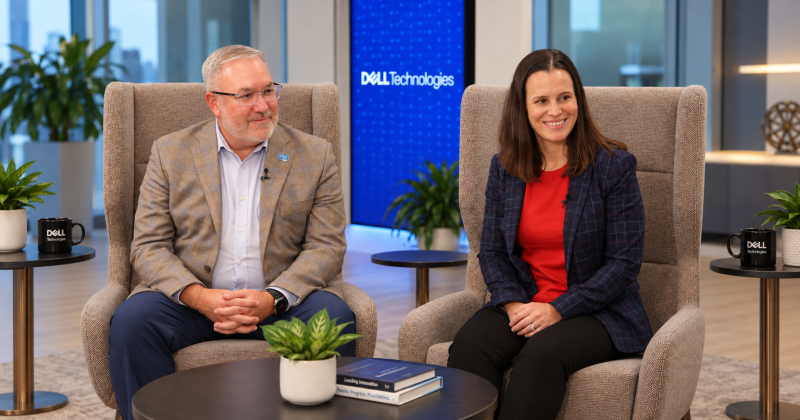
During the “Rethinking Private Cloud for the Age of Intelligence” event — an exclusive broadcast on theCUBE, SiliconANGLE Media’s livestreaming studio — Vellante spoke with Caitlin Gordon (pictured, right), vice president of product at Dell Technologies Inc., and Jodey Hogeland (left), PowerStore global evangelist at Dell about how private cloud architecture is changing as enterprises focus on economics, infrastructure flexibility, automation and AI. During the event, Brian Beeler, editor of StorageReview.com also provided an in-depth look at Dell PowerStore Elite and the automation technologies supporting the platform. ( Disclosure below.)*
Private cloud priorities change
Renewed interest in private cloud reflects a significant change in what enterprises expect from infrastructure. Control remains important, but cost, flexibility and investment protection are moving higher on the priority list.
“In some sense, private clouds are cool again,” Gordon said. “Having control is becoming top of mind for a lot of customers. But the environment has completely changed from what it was just a few years ago or, in some cases, just a few months ago. So, they’re dealing with a lot.”
The challenge is that private cloud requirements have changed alongside the applications running on top of them. Data volumes continue to expand, infrastructure prices are putting pressure on budgets and enterprises want the freedom to change operating environments without replacing the underlying hardware.
“Really, the number one thing that we hear from customers is cost, and then openness, flexibility and then simplicity,” Gordon said. “Bringing all three of those things together is critical for our customers because, ultimately, every dollar that they’re spending on their IT budget is a decision that they’re making and a trade-off that they’re making.”
That is contributing to greater interest in disaggregated architecture. Hyperconverged infrastructure brought simplified deployment and management by tightly integrating compute and storage, but enterprises could also find themselves scaling resources they did not necessarily need.
A disaggregated model allows those components to grow separately while retaining an integrated operational experience.
“If all I need is to dynamically scale the compute infrastructure, I’ve got the freedom, the cost structures and the affordability to do that,” Hogeland said. “If all I need to do is scale the storage infrastructure, I’ve got the freedom, the cost-effective capabilities to be able to do that.”
Dell Private Cloud targets infrastructure flexibility
Dell Private Cloud was designed around this shift toward independent scaling while retaining the simplicity associated with HCI. The platform separates compute and storage while using automation to manage the infrastructure as an integrated system.
The approach also addresses changes underway in virtualization. Enterprises that previously standardized around one hypervisor are increasingly considering multiple environments based on workload requirements.
Dell Private Cloud supports VMware, Red Hat OpenShift, Nutanix and Microsoft Azure Local, allowing organizations to deploy different operating environments on reusable infrastructure, according to Gordon.
“Dell Private Cloud gives you a disaggregated infrastructure, the ability to buy just the infrastructure you need and then scale independently,” she said. “But, importantly, it keeps the simplicity of HCI.”
The ability to change software environments without replacing the underlying infrastructure is emerging as an important consideration for customers. Most current Dell Private Cloud deployments still involve VMware, but many organizations are simultaneously evaluating other options, Gordon added.
“The value prop they’re buying into is the fact that they know they have the escape hatch to where they’re going to go into the future,” she said. “It’s really that optionality that they’re buying into.”
PowerStore Elite focuses on density and efficiency
Storage is another piece of the private cloud architecture being reshaped by AI. Higher-performance workloads require faster access to increasingly large datasets, while data centers face physical constraints involving rack space, power and cooling.
Dell is addressing those requirements with PowerStore Elite, its latest primary storage platform. The system provides up to 6:1 data reduction while increasing performance and density compared with previous generations, according to the company.
“We’re delivering 3x the performance that we were in previous generations,” Hogeland said. “We’re delivering 3x the efficiencies that we were in previous generations. And we’re delivering all of that in a 3-rack unit form factor.”
The density improvements have implications beyond storage itself. Consolidating infrastructure can free rack capacity, electrical connections and cooling resources that enterprises can redirect toward AI servers.
Organizations are increasingly evaluating infrastructure modernization through this broader data-center lens, Hogeland added.
“We have customers … having to accelerate infrastructure purchases to consolidate, to get more efficient,” he said.
Automation changes private cloud operations
Separating compute and storage can provide flexibility, but it also creates the potential for additional management complexity. Dell is seeking to address that problem through the Dell Automation Platform, which applies lifecycle management and infrastructure validation across the private cloud stack. The goal is to carry forward the operational experience of HCI without tying customers to tightly coupled infrastructure.
“Our test shows … up to 66% time savings with the Dell Private Cloud and all the automation software versus managing a 3-tier environment without that automation,” Gordon said.
The architecture can also make infrastructure updates more granular. Instead of applying a large update across an entire integrated stack, administrators can target storage, compute or individual security patches.
“We can enable an update of just the storage or just the compute or a security patch,” Gordon said. “And that allows customers to have the agility that they need today for updates but still have the trust in the validation and the simplicity that they’re used to.”
Storage itself is becoming more automated as well. PowerStore includes Dynamic Node Affinity, which manages where volumes are placed and can adjust backend paths based on performance and workload conditions.
“We’re really having conversations now about autonomous infrastructure,” Hogeland said. “The storage is so intelligent, it’s so smart, that it’s making decisions in and of itself.”
PowerStore moves deeper into the automation stack
Beeler examined PowerStore Elite in the lab, highlighting hardware changes designed to increase density while making the system easier to manage.
The platform includes 40 E3 SSD bays and moves NVRAM and battery backup functionality into the controllers, freeing the front of the system entirely for storage. Dell has also moved to standard OCP network interface cards, providing more flexibility for connectivity. Yet the more significant change is how storage participates in Dell’s broader private cloud automation model, according to Beeler.
Dell Automation Platform Orchestrator can stand up a private cloud using configuration files and deployment blueprints. The workflow incorporates PowerStore hardware validation, compute and networking preparation, hypervisor installation and storage provisioning.
“The array stops being a destination you provision to and becomes a resource the platform composes for you,” Beeler said.
The system is also designed to reduce the level of specialized storage expertise required for ongoing administration.
“This is a very big deal, especially as some of the traditional graybeard storage admins age out,” Beeler said. “These tools make it easier for even an IT generalist or a service provider to help manage your PowerStore estate in a very intuitive way using tools that most of us are very familiar with.”
Rethinking the private cloud trade-off
Private cloud infrastructure has historically required organizations to balance two competing models: tightly integrated systems that simplified operations and disaggregated systems that offered greater flexibility. Dell’s strategy is to remove some of that trade-off by combining independently scalable infrastructure with software-driven management and automation. “They can have the flexibility and the efficiency of a disaggregated infrastructure, and yet they can have the experience … of that simplicity all built into one platform,” Gordon said. “And it doesn’t lock them into any one operating environment.”
That flexibility could become increasingly important as organizations decide where to run AI and how much infrastructure they are willing to commit to any single virtualization or cloud platform.
For Hogeland, the changing role of the infrastructure administrator is another sign of what is ahead. Storage teams are increasingly responsible for broader environments while AI-based systems handle more routine operational work. “A storage admin is no longer just traditionally a storage admin, but they’re becoming managers of AI-based agents that are doing tasks on their behalf,” he said.
Private cloud is therefore becoming less about recreating the data center models of the past and more about building an infrastructure layer capable of changing with workloads. As AI puts greater pressure on data, compute capacity and operating costs, the ability to scale resources independently while automating how those resources are managed could define the next phase of enterprise private cloud. Stay tuned for the complete video interview, part of SiliconANGLE’s and theCUBE’s coverage of Dell’s “Rethinking Private Cloud for the Age of Intelligence” event.
( Disclosure: TheCUBE is a paid media partner for Dell’s “Rethinking Private Cloud for the Age of Intelligence” event. Neither Dell, the sponsor of theCUBE’s event coverage, nor other sponsors have editorial control over content on theCUBE or SiliconANGLE.)*
Photo: SiliconANGLE
Support our mission to keep content open and free by engaging with theCUBE community. Join theCUBE’s Alumni Trust Network, where technology leaders connect, share intelligence and create opportunities.
- 15M+ viewers of theCUBE videos , powering conversations across AI, cloud, cybersecurity and more
- 11.4k+ theCUBE alumni — Connect with more than 11,400 tech and business leaders shaping the future through a unique trusted-based network
Are you an AWS customer? Support SiliconANGLE financially by buying your AWS services from our Marketplace portal page and links: https://siliconangle.com/aws-marketplace/
About SiliconANGLE Media
theCUBE AIand theCUBE SuperStudios — with flagship locations in Silicon Valley and the New York Stock Exchange — SiliconANGLE Media operates at the intersection of media, technology and AI.
Founded by tech visionaries John Furrier and Dave Vellante, SiliconANGLE Media has built a dynamic ecosystem of industry-leading digital media brands that reach 15+ million elite tech professionals. Our new proprietary theCUBE AI Video Cloud is breaking ground in audience interaction, leveraging theCUBEai.com neural network to help technology companies make data-driven decisions and stay at the forefront of industry conversations.